Search - Menendez

Saturday, February 07, 2026 | Daily Newspaper published by GPPC Doha, Qatar.

Search Results for "Menendez" (103 articles)

Gulf Times
International

White House wins enough Senate support for Iran deal

Barack Obama speaks to the media before boarding a boat for a tour of the Kenai Fjords National Park in Seward, Alaska. The presidents has earned sufficient congressional backing to ensure the Iran nuclear deal does not get blocked. AFP/Washington US President Barack Obama on Wednesday earned sufficient congressional backing to ensure the Iran nuclear deal does not get blocked, when a 34th senator announced her support for the accord. Most US lawmakers are opposed to the deal, which would ease punishing economic sanctions on Tehran while preventing it from advancing its nuclear program. Many Republicans warn that the Islamic republic will seek to cheat its way to an atomic bomb. Should Congress pass a resolution that disapproves of the deal, Obama would veto it. Overcoming the veto would require a two-thirds vote in the Senate and House of Representatives. With veteran Senate Democrat Barbara Mikulski announcing her support on Wednesday, the deal now has 34 backers in the Senate - the number needed to uphold Obama's veto. While the deal is not perfect, Mikulski said, "I have concluded that this Joint Comprehensive Plan of Action is the best option available to block Iran from having a nuclear bomb." She added that while she will vote for the deal, "Congress must also reaffirm our commitment to the safety and security of Israel." Republicans are unified in their opposition to the Iran accord, warning that the easing of sanctions will provide Iran with a windfall of up to $150bn, which they say could be funnelled toward terrorist operations or actions against US ally Israel. Democrats "own it," number two Senate Republican John Cornyn posted on Twitter. "Iran deal done. With Mikulski, Obama has all the votes he needs." Kerry makes the case   Secretary of State John Kerry, in Philadelphia to deliver a major speech on the Iran deal, said the Islamic republic will be required to live up to the agreement in full, including taking steps to expand its weapons breakout time, before it starts to benefit from sanctions relief. "Without this agreement, Iran's so-called breakout time was about two months. With this agreement it will increase by a factor of six, to at least a year, and will remain at that level for a decade or more," Kerry said. Two top Democratic senators - Chuck Schumer and Robert Menendez - are opposed to the deal, as are a handful of House Democrats, including Steve Israel, the chamber's highest-ranking Jewish member. Congress is set to vote later this month on the accord, which was reached in July between Tehran and six world powers - Britain, China, France, Germany, Russia and the US. The White House is now eyeing another key threshold in the Senate. Should 41 senators back Obama, they could filibuster, meaning Republicans would not have the 60 votes needed to advance the resolution of disapproval. That would save Obama the embarrassing step of cobbling together a minority coalition for a veto to preserve his landmark agreement, a process that would sow doubts among an already skeptical American public and Washington's international partners, which are keen to see strong US commitment to the accord. Among Democrats in support, many have expressed deep concern about Iran's adherence to the accord, and stressed it is the lesser of several evils.

Gulf Times
International

US will act firmly if Iran reneges on deal: Obama

Obama: All of the options available to the United States – including the military option – will remain available through the life of the deal and beyond.AFP/Reuters/WashingtonThe United States will respond firmly if Iran fails to honour the accord aimed at curbing its nuclear programme, President Barack Obama said yesterday as he works to win over undecided US lawmakers.“We have a wide array of unilateral and multilateral responses that we can employ if Iran fails to meets its commitments,” Obama said in a letter dated August 19 and sent to Jerrold Nadler, a Democrat in the House of Representatives who announced that he will vote to approve the accord.In his letter released by the White House, Obama reiterated his view that the accord reached last month in Vienna is good for the United States, Israel and the Middle East in general.The president also insisted, as he has many times, that all options remain on the table if Iran does not abide by the accord.The agreement lifts economic sanctions against Tehran in exchange for restrictions and other measures designed to prevent it from developing nuclear weapons.“All of the options available to the United States – including the military option – will remain available through the life of the deal and beyond,” Obama said.The letter was released as opponents of the accord wage a fierce campaign against it ahead of a vote in Congress in September.Opponents say the accord goes too easy on Iran, by not allowing spot inspections of nuclear sites or forcing it to halt support of militant groups, for instance.So far only two Democratic senators – Chuck Schumer and Robert Menendez – have come out publicly against the accord.It is unlikely that opponents can muster the two-thirds majority they would to override a certain Obama veto if an initial vote by lawmakers rejects the accord.Nadler said yesterday that he supports it.It is not perfect, but it “gives us the best chance of stopping Iran from developing a nuclear weapon”, he said in a statement.Nadler said that he had reached this conclusion from his perspective as “an American Jew who is both a Democrat and a strong supporter of Israel”.The accord, vehemently opposed by Israeli Prime Minister Benjamin Netanyahu, has sharply divided the US Jewish community.Obama needs to win the backing of one-third of either the House of Representatives or the Senate to prevent Republicans from killing the nuclear deal announced in July.Signed by world powers and Iran, the agreement would require Tehran to abide by new limits on its nuclear programme in return for western governments easing economic sanctions.According to a Reuters tally, Obama is eight votes away from capturing one-third of the Senate, or 34 senators, with about a month remaining to find the additional support he needs.The Bipartisan Policy Centre, which is tracking lawmakers’ positions, said on Thursday that 69 House members now support the Iran deal, with another 140 in the 435-member chamber still undeclared.Obama would need the support of at least 146 House members to safeguard the agreement in that chamber.Even though Congress is on a five-week summer recess and Obama is vacationing in Martha’s Vineyard, the White House has kept up pressure on the president’s fellow Democrats to provide him with enough support when Congress casts votes in September.Senate Majority Leader Mitch McConnell, a Republican, this month told a Kentucky newspaper that the battle in Congress “is stacked in the president’s favour”.In a letter to colleagues yesterday, House Democratic leader Nancy Pelosi said she was confident Democrats would prevent an override of a veto by Obama of a measure to kill the agreement.

Gulf Times
Region

Another top US Democrat opposes Iran nuclear deal

US Senator Robert Menendez gives a speech announcing he will not support the Iran nuclear deal at Seton Hall University yesterday in South Orange, New Jersey.Reuters/South Orange, New JerseySenator Robert Menendez issued a scathing critique of the US-led international nuclear deal with Iran yesterday and became the second senior lawmaker from President Barack Obama’s own party to announce he would vote to kill the pact with Tehran. Defying Obama and many other fellow Democrats, Menendez said in a speech in his home state of New Jersey: “I will vote to disapprove the agreement and, if called upon, would vote to override a veto” by the president. The Senate and House of Representatives have to vote by September 17 on a “resolution of disapproval” being brought by majority Republicans aiming to sink the deal. Obama is trying to gather enough support among Democrats to sustain a veto of the resolution. Under the agreement between six major powers and Iran, new curbs would be imposed on Tehran’s nuclear programme in return for easing sanctions. Iran denies it wants to make a nuclear weapon. Earlier this month, Senator Chuck Schumer of New York, the third-ranking Democrat in the chamber, said he would vote against the deal and would work to convince other senators to do the same, signalling deep divisions within the party. Senator Dick Durbin, the second-ranking Democrat, supports the deal. Democratic Leader Harry Reid will declare his position when the Senate returns from recess September 7, when lobbying and debate in Congress over the deal is expected to intensify. If the agreement were to go into effect, Menendez said, it would hurt national security while abandoning a long-held US policy of preventing nuclear proliferation. Instead, he said, it would establish a policy of “managing” nuclear proliferation. Despite his stance against the Iran deal, it is not clear how much Menendez, a former chairman of the Senate Foreign Relations Committee, would influence other Democrats. A senior Obama administration official said the announcement had been expected and would not alter White House plans. “The strategy is the exact same today as it was yesterday,” said the official, speaking on condition of anonymity. Privately, backers of the deal say while they still hope to have enough votes in the Senate to sustain an Obama veto, they are even more confident of doing so in the House of Representatives. Success in either chamber will ensure the deal survives. Republicans say the deal gives too much ground to Iran and threatens the security of Israel, a major US ally in the Middle East. The speech by Menendez, a strong backer of Israel, at Seton Hall University in South Orange, New Jersey, contained a detailed, technical analysis of the agreement. He pointed out that throughout Obama’s term in office he has mainly backed the Democratic president, voting for Wall Street and healthcare reforms and other major initiatives. Menendez, however, has parted ways with Obama over his opening of diplomatic ties with Cuba and he questioned Obama’s threats to ultimately take military action against Iran if it went ahead with making a nuclear bomb. “We should authorise now the means for Israel to address the Iranian threat on their own in the event that Iran accelerates its programme and to counter Iranian perceptions that our own threat to use force is not credible,” he said. He also criticised Republicans, who he said “reflexively oppose everything the president proposes”. “While I have many specific concerns about this agreement, my overarching concern is that it requires no dismantling of Iran’s nuclear infrastructure and only mothballs that infrastructure for 10 years. Not even one centrifuge will be destroyed under this agreement,” Menendez said. He urged the Obama administration to go back to the negotiating table to rework the main elements, something the Obama administration says would be impossible. Obama gained ground on some other fronts amid an aggressive White House lobbying effort. Democrat Mazie Hirono of Hawaii became the 21st senator, all of them Democrats, to publicly support the agreement. But that is far short of the 34 Democrats Obama will need to sustain his veto and keep the deal alive. The non-partisan Arms Control Association yesterday said 70 nuclear non-proliferation experts issued a statement in support, calling it “a strong, long-term and verifiable agreement that will be a net-plus for international nuclear non-proliferation efforts”. Alan Elsner, a spokesman for the US based Jewish group J Street which supports the deal, said: “We remain confident that the votes will be there ultimately to sustain the president’s veto in both houses” of Congress.

Gulf Times
International

Marines raise US flag at embassy in Cuban capital

Secretary of State John Kerry clapping during the raising of the US flag over the newly-reopened embassy in Havana yesterday.Reuters/HavanaWatched over by US Secretary of State John Kerry, US Marines raised the American flag at the embassy in Cuba for the first time in 54 years yesterday, symbolically ushering in an era of renewed diplomatic relations between the two Cold War-era foes. Three retired Marines who last lowered the flag in 1961 participated in the ceremony, handing a new flag to the Marine Color Guard, which raised it on the grounds outside the embassy building on the Havana seafront. Kerry, the first US secretary of state to visit Cuba in 70 years, told the ceremony it was obvious that “the road of mutual isolation and estrangement that the US and Cuba have been travelling is not the right one and that the time has come for us to move in a more promising direction”. The symbolic event took place eight months after Havana and Washington agreed to restore ties and nearly four weeks after the US and Cuba formally renewed diplomatic relations and upgraded their diplomatic missions to embassies. While the Cubans celebrated with a flag-raising in Washington on July 20, the Americans waited until Kerry could travel to Havana. Kerry made plain in his remarks that despite the historic opening, Washington has not set aside criticism of Communist-run Cuba’s human rights record. “We remain convinced the people of Cuba would be best served by a genuine democracy, where people are free to choose their leaders,” he said. Kerry met Cuban dissidents opposed to the island’s one-party political system at the US embassy residence in Havana later yesterday. But dissidents were not invited to the morning flag-raising in deference to the Cuban government, generating criticism from opponents of US President Barack Obama’s opening to Cuba. Critics of Obama’s move, which seeks to end decades of US isolation and was announced last December in a landmark agreement with Cuban President Raul Castro, complain the Cuban government has made no concessions in exchange for diplomatic ties. “It is shameful that on the grounds of our embassy in Havana, the Cuban regime can dictate to the US government who may or may not attend this ceremony,” Bob Menendez, a Cuban-American senator from New Jersey, said in a statement. Overnight, workers attached a sign reading “Embassy of the US of America” above the entrance of the building, accompanied by a US seal. Three classic American cars like those that still ply the streets of Havana were parked on the street behind the podium where Kerry spoke: a 1955 and a 1957 Chevrolet Bel Air and a 1959 Chevrolet Impala, from the year of the revolution that brought Fidel Castro to power. Fidel Castro handed over power to his brother, Raul Castro, in 2008 because of poor health. Buildings surrounding the embassy were draped with large Cuban flags but the numerous flag poles in front of the embassy were bare but for one Cuban flag. In last December’s agreement, Obama and Raul Castro announced they would restore diplomatic ties, reopen embassies and work to normalize relations. With ties now restored, there are plenty of hurdles along the way to normal relations between the two neighbors. Cuba wants the US to end its economic embargo of the island, return the US naval base at Guantanamo Bay in eastern Cuba and halt radio and television signals beamed into Cuba. The Americans will press Cuba on human rights, the return of fugitives granted asylum and the claims of Americans whose property was nationalised by Fidel Castro’s government. President Dwight Eisenhower severed diplomatic ties with Havana as relations soured soon after the 1959 Cuban Revolution. The seven-story building in Havana and Cuba’s mansion in Washington were closed from 1961 until 1977, when they reopened as interests sections. Obama has defended his move to open up to the Caribbean island saying Washington’s long policy of trying to force change through isolation did not work.

Gulf Times
International

Kerry presides over raising of flag at US embassy in Cuba

John Kerry walks next to the Chief of Mission at the US Embassy in Havana Jeffrey DeLaurentis upon his arrival at Jose Marti international airport in Havana on Friday. Reuters/Havana Watched over by US Secretary of State John Kerry, US Marines raised the American flag at the embassy in Cuba for the first time in 54 years on Friday, symbolically ushering in an era of renewed diplomatic relations between the two Cold War-era foes. Three retired Marines who last lowered the flag in 1961 participated in the ceremony, handing a new flag to the Marine Color Guard, which raised it on the grounds outside the embassy building on the Havana seafront. Kerry, the first US secretary of state to visit Cuba in 70 years, told the ceremony it was obvious that "the road of mutual isolation and estrangement that the US and Cuba have been travelling is not the right one and that the time has come for us to move in a more promising direction." The symbolic event took place eight months after Havana and Washington agreed to restore ties and nearly four weeks after the US and Cuba formally renewed diplomatic relations and upgraded their diplomatic missions to embassies. While the Cubans celebrated with a flag-raising in Washington on July 20, the Americans waited until Kerry could travel to Havana. Historic opening Kerry made plain in his remarks that despite the historic opening, Washington has not set aside criticism of Communist-run Cuba's human rights record. "We remain convinced the people of Cuba would be best served by a genuine democracy, where people are free to choose their leaders," he said. Kerry will meet Cuban dissidents opposed to the island's one-party political system at the US embassy residence in Havana later on Friday. But dissidents were not invited to the morning flag-raising in deference to the Cuban government, generating criticism from opponents of US President Barack Obama's opening to Cuba. Critics of Obama's move, which seeks to end decades of US isolation and was announced last December in a landmark agreement with Cuban President Raul Castro, complain the Cuban government has made no concessions in exchange for diplomatic ties. "It is shameful that on the grounds of our embassy in Havana, the Cuban regime can dictate to the US government who may or may not attend this ceremony," Bob Menendez, a Cuban-American senator from New Jersey, said in a statement. Overnight, workers attached a sign reading "Embassy of the US of America" above the entrance of the building, accompanied by a US seal. Three classic American cars like those that still ply the streets of Havana were parked on the street behind the podium where Kerry spoke: a 1955 and a 1957 Chevrolet Bel Air and a 1959 Chevrolet Impala, from the year of the revolution that brought Fidel Castro to power. Fidel Castro handed over power to his brother, Raul Castro, in 2008 because of poor health. Buildings surrounding the embassy were draped with large Cuban flags but the numerous flag poles in front of the embassy were bare but for one Cuban flag. In last December's agreement, Obama and Raul Castro announced they would restore diplomatic ties, reopen embassies and work to normalise relations. Hurdles to come With ties now restored, there are plenty of hurdles along the way to normal relations between the two neighbors. Cuba wants the US to end its economic embargo of the island, return the US naval base at Guantanamo Bay in eastern Cuba and halt radio and television signals beamed into Cuba. The Americans will press Cuba on human rights, the return of fugitives granted asylum and the claims of Americans whose property was nationalized by Fidel Castro's government. President Dwight Eisenhower severed diplomatic ties with Havana as relations soured soon after the 1959 Cuban Revolution. The seven-storey building in Havana and Cuba's mansion in Washington were closed from 1961 until 1977, when they reopened as interests sections. Obama has defended his move to open up to the Caribbean island saying Washington's long policy of trying to force change through isolation did not work. The Democratic president also has used his executive power to relax some US travel and trade restrictions. But the Republican-controlled Congress has resisted his call to end America's wider economic embargo.

Gulf Times
International

Cecil the lion’s killer finds himself in a legal thicket

Stuffed heads of tigers, leopards and other big cats are seen on the shelves of the US Fish and Wildlife Service (USFWS) National Wildlife Property Repository in Denver, Colorado in a picture provided by the USFWS.   Tribune News Service/WashingtonA 115-year-old US law that’s grown like kudzu now hangs over the head of the Minnesota dentist who shot Cecil the lion.But it’s one of the Supreme Court’s newest decisions that could shape how officials may handle angry members of the public who have raged against the bow-and-arrow wielding dentist, Dr Walter Palmer.Now both hunter and hunted, Palmer has ventured into a legal thicket that’s almost certainly darker than he ever could have imagined. It’s also getting thicker by the day, as lawmakers take aim on their own.“Let’s not be cowardly lions when it comes to trophy killings,” Sen. Bob Menendez said on Friday as he introduced legislation inspired by Cecil’s death.Menendez dubbed his new bill the Conserving Ecosystems by Ceasing the Importation of Large (CECIL) Animal Trophies Act. Menendez, who is facing trial on corruption charges, was the first member of Congress to thrust himself into the Cecil story line.Menendez’s bill, even if it becomes law, won’t directly affect Palmer. Other laws, both foreign and domestic, might.Investigators in both Zimbabwe and the US want to talk to Palmer in connection with the shooting of Cecil in early July. Reportedly, Palmer and his guides lured Cecil from the protected confines of Hwange National Park. First shot by an arrow, Cecil was later tracked, finished off with a rifle and beheaded.US Fish and Wildlife Service officials are taking the lead in the US, guided by a law first passed in 1900 commonly called the Lacey Act. On Friday afternoon, officials revealed via Twitter that they had been “voluntarily” contacted late Thursday “by a rep” of Palmer.“That investigation will take us wherever the facts lead,” Edward Grace, the agency’s deputy chief of law enforcement, said Thursday.Named for an Iowa congressman and staunch conservationist, John F. Lacey, the much-amended law now spans some 11 pages of the US Code and covers much more territory than originally envisioned.Briefly, the Lacey Act makes it “unlawful to import, export, sell, acquire, or purchase” wildlife taken in violation of US, state or foreign laws. A felony conviction can result in a fine of up to $250,000 and a prison sentence of up to five years.“When the Lacey Act was first passed, it was essentially designed to deal with interstate poaching,” Paul Larkin, a senior legal research fellow at the conservative Heritage Foundation, noted in an interview. “It was only over time that Congress began to add in violations of a foreign law.”The prosecutorial emphasis is often on explicitly commercial operations.Palmer said in a statement issued on Tuesday that he relied on professional guides and believed all the necessary permits were in hand.Page Pate, an Atlanta-based defence attorney who has handled Lacey Act cases, noted in an interview on Friday that though the law is pinned to importation or trafficking, prosecutors could conceivably argue that it also covers “conduct that you think is going to happen,” such as conceiving a plan to ship an animal trophy.“It would not be an easy case to make,” Pate said.A different legal question arises from the furious reactions to Palmer’s killing of Cecil. Online postings collected by the BuzzFeed news site included a number that sounded like threats.One man, for instance, declared that “I’d put a cross bow bolt through Walter Palmer then track him from 40 hrs, shoot him, behead him, skin him and sleep peacefully.”It sounds horrific. But under a Supreme Court decision issued last June, in a case arising out of graphic Facebook postings, conviction on a charge of making a threatening communication requires that the defendant actively intends a threat or knows his or her words will be seen as threatening.

The Cuban flag flutters at the Cuban Embassy in Washington. Reuters
International

Cuban flag raised over Washington embassy as ties restored

Reuters/WashingtonThe Cuban flag was raised over Havana's embassy in Washington on Monday for the first time in 54 years as the United States and Cuba formally restored relations, opening a new chapter of engagement between the former Cold War foes. Cuban Foreign Minister Bruno Rodriguez presided over the reinauguration of the embassy, a milestone in the  diplomatic thaw that began with a breakthrough announcement by US President Barack Obama and Cuban President Raul Castro on Dec. 17. The US Embassy in Havana was also officially reopened for business. But the Stars and Stripes will not be hoisted there until a visit by U.S. Secretary of State John Kerry expected next month. Without fanfare in the pre-dawn hours, maintenance workers also hung the Cuban flag in the lobby of the US State Department, where it joined the banners of other countries with which the United States has diplomatic relations. Serious differences remain between the United States and Communist-ruled Cuba, and efforts toward full normalization of ties are expected to proceed slowly for now. But the steps that officially took effect on Monday carried enormous symbolism after more than two years of initially secret negotiations between governments that had long shunned each other. More than 500 people, including Obama administration officials, US lawmakers and a large visiting Cuban delegation, attended the ceremony at the nearly century-old mansion that was being converted back into the Cuban Embassy. The US delegation was headed by Assistant Secretary of State Roberta Jacobson. A three-man honor guard marched onto the front lawn where the Cuban flag was mounted on a newly installed pole while a band played the Cuban national anthem. As the flag was slowly raised, there were competing chants from the crowd outside the gates. "Cuba si, embargo no!" Shouted one group. "Cuba si, Fidel no," yelled a much smaller group. In a further sign of a desire to move past decades of enmity, Kerry and Rodriguez, the first Cuban foreign minister on an official visit to Washington since the Cuban Revolution, were due to meet at the State Department and then hold a news conference later on Monday.  No invitations to anti-Castro lawmakers The crowd at the embassy reopening included members of Congress who have supported rapprochement. But no invitations went to hard-line anti-Castro lawmakers, such as Senators Marco Rubio and Bob Menendez, who have opposed Obama's outreach and modest easing of restrictions on business and travel. "You don't invite into your home those who want to do you harm," Gustavo Machin, deputy director for US affairs in the Cuban Foreign Ministry, said in Havana last week. The meeting between Kerry and Rodriguez will be their first since April during the Summit of the Americas in Panama, where Obama and Castro also held talks. The opening to Cuba marks not only a legacy achievement for Obama but also a major application of his presidential doctrine of negotiating with enemies, a concept that now faces an even tougher test with a nuclear deal reached with Iran last week. The re-establishment of embassies could usher in a new era of engagement between the United States and Cuba by easing government contacts heavily constrained since the United States broke off diplomatic relations in 1961. A full-service US mission in Havana could offer some reassurance to companies interested in investing in Cuba and also help seed the way for more - although still heavily restricted - travel to the island by American citizens. But both countries have made clear that restoration of ties, agreed on July 1, will be just a step in a long normalization process that is only inching along because of lingering disputes as well as Havana's desire to keep a tight rein on Cuba's society and its state-run economy. Differences include the US economic embargo, Cuba's human rights record, outstanding legal claims against each country, American fugitives still sheltered in Cuba and Washington's retention of its naval base at Guantanamo Bay. The embargo will remain in place, and only Congress can lift it, something that majority Republicans are unlikely to do anytime soon. Neither side has named an ambassador. The Obama administration has made clear it is in no rush, mindful that  Republicans have vowed to block any nominee. 

Gulf Times
Sport

Tomic’s family mulls legal action over ‘Hall of Shame’

By Mike Hytner in Sydney/theguardian.comThe father of Australian tennis star Bernard Tomic has said his family is considering taking legal action against Tennis Australia following an e-mail sent on Monday that stated the country’s top-ranked men’s player was to feature in the “Hall of Shame Tennis Championships”.John Tomic issued a statement through Fairfax Media which made clear his frustration at the latest instalment of the very public disintegration of the Tomic family’s relationship with the governing body.“The Tomic family is very disappointed by TA’s continual shaming and misrepresentation of Bernard,” John Tomic’s statement read. “Bernard has already been punished by his non-selection for the upcoming Davis Cup tie.“Bernard accepted his sanction in a professional manner and was willing to move on ... how typically childish and arrogant of TA to permit publication of such material and then expect to get away with it. We have no alternative but to refer the matter to our legal people for advice.”Tennis Australia was on Monday forced into issuing an apology for the typo in the email which should have said Tomic would be playing in the Hall of Fame Tennis Championships, taking place this week in the US city of Newport. A TA statement blamed the faux pas on a “simple clerical error”.Tomic is only playing at the tournament in Rhode Island after being dumped from the Australian Davis Cup team for his 10-minute tirade against TA officials following his exit from Wimbledon a week and a-half ago. He lost his first round encounter against fellow Australian John-Patrick Smith in straight sets 6-3, 7-5.Australia’s Davis Cup team is playing Kazakhstan in a World Group quarter-final this weekend.Smith sends tomic crashing AFP/NewportAustralian John-Patrick Smith won his first ATP main draw victory on Monday, upsetting third-seeded countryman Bernard Tomic 6-3, 7-5 in the first round of the Hall of Fame Championships. Smith, ranked 156th, needed only 70 minutes to dispatch Tomic, taking 15 of 23 points off Tomic’s second serve and surrendering only one service break to the world number 25. Smith had been 0-5 in ATP matches after first-round losses this year to South African Kevin Anderson at Delray Beach and Frenchman Kenny De Schepper in five sets at Wimbledon. Next up for Smith will be 166th-ranked American Jared Donaldson, who beat 125-rated compatriot Austin Krajicek 6-7 (5/7), 6-3, 6-2 in another opener on the grass courts outside the tennis legends honour hall where induction ceremonies will be staged on Saturday. Croatian second seed Ivo Karlovic blasted 11 aces and never faced a break point in battling past Ukraine’s Illya Marchenko 7-6 (7/4), 6-7 (6/8), 6-4. Karlovic took the only break of the match to advance after two hours and 23 minutes. Japan’s Tatsuma Ito outlasted US wildcard Noah Rubin 6-3, 6-7 (7/9), 6-4 to book  a second-round date with US seventh seed Steve Johnson, who downed Germany’s Michael Berrer 6-7 (6/8), 6-1, 6-2. Also moving on was Colombia’s Alejandro Falla, who ousted Spain’s Adrian Menendez-Maceiras 6-1, 7-5.

Gulf Times
Qatar

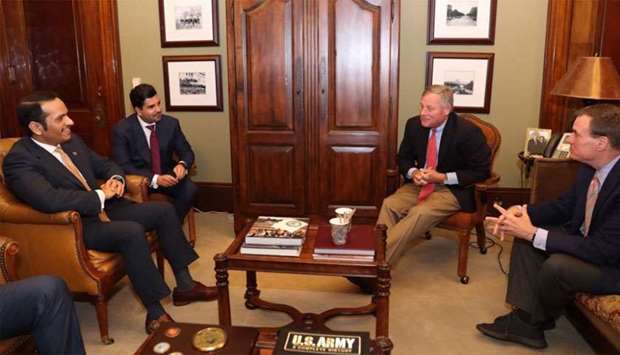
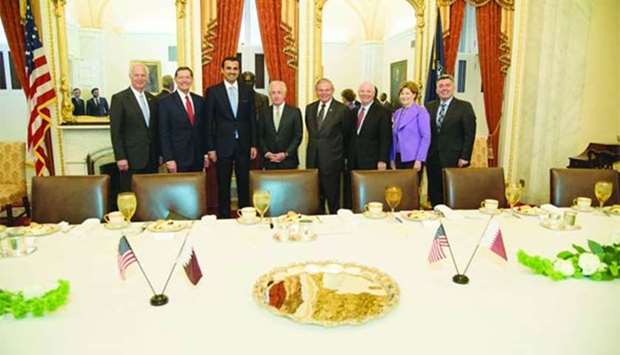
Emir meets US Congressmen, senior officials

HH the Emir Sheikh Tamim bin Hamad al-Thani with the Leader of Minority in the House of Representatives Nancy Pelosi and other senior officials in Washington yesterday.   QNA /WashingtonHH the Emir Sheikh Tamim bin Hamad al-Thani met number of members of the US Senate at the Congress here yesterday. The Emir held the first meeting with Chairman of the Armed Services Committee Senator John McCain, Intelligence Committee Chairman Council Senator Richard Barr, Deputy Chairman of the Armed Services Committee Senator Jack Reed, and Vice-Chairman of the Intelligence Committee Senator Dianne Feinstein. The meeting reviewed bilateral relations between Qatar and the US and the prospects for developing co-operation between the two countries. In the second meeting, HH the Emir met the Senate Foreign Relations Committee Chairman Robert Menendez, and several members of the Committee. Discussions during the meeting dealt with bilateral ties and areas of co-operation and ways to promote them in order to serve the common interests, as well as exchange of views on the latest developments in the Middle East. The meeting was attended by the members of the official delegation accompanying the Emir. The Emir also met at the US Congress with the Democratic House Minority Leader, Nancy Pelosi. Discussions during the meeting dealt with topics of mutual interest. The meeting was attended by the members of the official delegation accompanying the Emir.

Netanyahu: his address to Congress would make him just the second foreign leader to do so three times. Right: Boehner: The Congress can make this deci
International

Boehner ‘pokes’ Obama with Netanyahu invite

Reuters/WashingtonUS House of Representatives Speaker John Boehner has invited Israeli Prime Minister Benjamin Netanyahu to address Congress on Iran without consulting President Barack Obama, and the White House questioned whether protocol had been violated.Setting up a diplomatic showdown on an issue that has sharply divided Obama and congressional Republicans, Boehner announced the invitation the day after Obama pledged in his State of the Union address to veto Iran sanctions legislation being developed in Congress.An Israeli official said that Netanyahu, whose relationship with Obama has often been tense, was looking into the possibility of meeting with Obama when he comes to Washington to address a joint meeting of Congress – both the Senate and House – on February 11.White House spokesman Josh Earnest said: “The protocol would suggest that the leader of one country would contact the leader of another country when he’s travelling there. This particular event seems to be a departure from that protocol.”Asked by a reporter if inviting Netanyahu without speaking to the White House was a “poke in the eye” to Obama, Boehner, a Republican, said: “The Congress can make this decision on its own. I don’t believe I’m poking anyone in the eye.”A Republican aide later said that Netanyahu will travel to Washington in March to address Congress so he can make one trip instead of two in the run-up to the March 17 Israeli election.“The Israelis initially agreed to a date in February, but decided they only wanted the prime minister to make one trip to the US before the election, so they asked to change to the first week in March,” the aide said yesterday.Lawmakers trying to amass enough support to override any veto by Obama are developing several pieces of Iran-related legislation, including a bill to tighten sanctions if a final nuclear agreement is not reached before the end of June.On Wednesday, the Senate Foreign Relations Committee held a contentious hearing on Iran with administration officials.The Senate Banking Committee is due to vote on the sanctions bill next week.Speaking to reporters travelling with Obama aboard Air Force One, Earnest said that the White House was reserving judgment until there was a chance to discuss Netanyahu’s trip with Israeli officials.“We’ll need to hear from them about what their plans are and what he plans to say in his remarks to Congress before we have a decision to make about any meeting,” Earnest said.A Republican aide said Boehner’s office and Senate Republican Leader Mitch McConnell’s office began discussing an invitation to Netanyahu at the staff level last year.The aide said Boehner called Israeli Ambassador Ron Dermer on January 8 to gauge Netanyahu’s interest, just after he was re-elected Speaker.Dermer responded with “a quick affirmative response” and Boehner’s office offered a series of potential dates, the Republican aide said.An Israeli embassy spokesman declined comment.Netanyahu’s planned address to Congress would make him only the second foreign leader to address a joint meeting of Congress three times. The other was Britain’s war-time prime minister, Winston Churchill.In a statement announcing the invitation to Netanyahu, Boehner said: “In this time of challenge, I am asking the prime minister to address Congress on the grave threats radical Islam and Iran pose to our security and way of life.”Iran’s nuclear programme has been one of the more contentious issues in the Netanyahu-Obama relationship.Netanyahu has been a vocal critic of Obama’s Iran diplomacy, saying that the administration is making too many concessions to Iran for too little in return.Congressional Republicans, who overwhelmingly back stronger sanctions legislation, and some Democrats have accused the president of making too many concessions to Tehran and therefore not being sufficiently supportive of Israel.US Deputy Secretary of State Antony Blinken testified in the US Senate on Wednesday that there was still a “credible chance” for international negotiators to reach an agreement on Iran’s nuclear programme.He said negotiators were aiming to conclude major elements of an agreement by the end of March and complete technical details by the end of June.Separately, the US State Department said US and Iranian negotiators would hold talks in Switzerland today and tomorrow about Iran’s nuclear programme.Lawmakers at Wednesday’s hearing insisted that Congress should be allowed to vote on any final nuclear agreement.Some disagreed with the administration’s strategy, including allowing Iran to continue low-level uranium enrichment in any final pact.“The more I hear from the administration ... the more it sounds like talking points that come straight out of Tehran,” said Senator Robert Menendez, the leading Democrat on the Foreign Relations panel.Boehner said the House would also likely at some point hold hearings on more sanctions against Iran.

Gulf Times
International

Obama faces tough task to lift Cuba embargo

Cuban President Raul Castro (third right) receives released Cuban prisoners Ramon Labanino (second left), Gerardo Hernandez (third left), and Antonio Guerrero (second right), who were greeted also by Fernando Gonzalez (left) and Rene Gonzalez (right) upon their return from the US.  Labanino, Hernandez and Antonio Guerrero, released after more than 15 years behind bars in the US, arrived on Cuban soil following a prisoner exchange that paved the way for a historic breakthrough the Cold War standoff with the US. AFP Washington US President Barack Obama’s historic decision to renew ties with Cuba was a diplomatic triumph but he faces a tough battle with Congress over lifting the embargo at the heart of the dispute. As world leaders welcomed the groundbreaking announcement, the harsh reality remained that the embargo, a cornerstone of US policy, is here to stay, at least for the near future. “This Congress is not going to lift the embargo,” Republican senator Marco Rubio, a Cuban-American seen as a possible presidential candidate in 2016, told reporters. He blasted Obama’s moves as “a victory for oppression” and said he would “use every tool at our disposal in the majority to unravel as many of these changes as possible.” Experts agree that, in addition to government agencies signing off on rolling back the embargo, congressional legislation would be needed to repeal laws like the Helms-Burton Act of 1996, which tightened prohibitions on US trade with Cuba. Obama said he would urge Congress to lift the embargo imposed in 1960, while using his presidential authority to advance diplomatic and travel links and ease restrictions on finance. “We are all Americans,” Obama declared, breaking into Spanish. But the Republicans will take full control of Congress in January and, with anger still pulsing over Obama’s unilateral immigration action last month, a swift repeal of the embargo is unlikely. While some backed Obama’s move, key Democrats, including senator Robert Menendez and congressman Eliot Engel, expressed opposition. “I believe that Congress must see a greater political opening in Cuba before lifting the embargo,” said Engel, the top Democrat on the House Foreign Affairs Committee. Funding to re-open the US mission in Havana would require congressional appropriation, and lawmakers like senator Lindsey Graham say they would seek to block it. Meanwhile Zoe Valdes, one of the best-known Cuban authors, yesterday said the historic rapprochement was not likely to improve the lives of people in the communist-run island. “It’s very important progress, but for the Castro leaders, not for the people,” Valdes, who has lived in exile in France for close to two decades, said adding she was “very sceptical and pessimistic.” “I don’t think this will improve the lot of the Cubans. We will have to wait for the death of both Castros, or even more, for things to change.” Raul Castro, 83, took over from his ailing older brother Fidel in 2008 and set about toning down the government’s anti-American rhetoric and taking baby steps toward economic reform, helping to pave the way for the rapprochement. Castro and US President Barack Obama made simultaneous speeches Wednesday in Havana and Washington to make an announcement that took the world by surprise. “There is already a bad sign: Obama’s speech was not broadcast in Cuba,” said Valdes, who was born in Cuba in 1959. “In his, Raul Castro said: ‘we must begin to behave in a civilised manner’. Is he going to apply that inside the country? I don’t think so. And we don’t know the content of discussions between the two countries.”      

A destroyed car is seen through a shrapnel hole in Donetsk yesterday.
International

Donetsk sees heaviest shelling since October

Reuters/DonetskEast Ukraine’s rebel stronghold Donetsk was pummelled yesterday by the heaviest shelling in a month, and the OSCE said it spotted an armoured column of troops without insignia in rebel territory that Kiev said proved Moscow had sent reinforcements.A two-month-old ceasefire to end a war that has killed 4,000 people has appeared shakier than ever in the past few days, with both sides accusing the other of having violated the terms of the peace plan.Reuters journalists inside Donetsk, who have been there throughout the fighting, said that the shelling sounded more intense than at any time since early October, a period when a playground was struck killing at least 10 people.Yesterday’s strikes appeared to come from territory held by both government and rebel forces.Ukraine’s military said its stand-off with the Russian-backed separatists in the east had intensified in the past week, which saw the rebels swear in new leaders after elections the government says violated the terms of the truce pact.Ukraine has accused Russia of sending a column of 32 tanks and truckloads of troops into the country’s east to support the pro-Russian rebels in recent days.Moscow has long denied its troops operate in east Ukraine, although many have died there.The Organisation for Security and Co-operation in Europe (OSCE), which includes Russia and Ukraine as well as the United States and Nato countries, operates in east Ukraine with the blessing of all sides and is widely seen as neutral.Its statement that it spotted an unidentified armoured column in rebel territory helps support Kiev’s position that Moscow has been sending in reinforcements to protect separatist enclaves the Kremlin now refers to as “New Russia”.In one 40-vehicle convoy, “19 were large trucks – Kamaz type, covered, and without markings or number plates – each towing a 122mm howitzer and containing personnel in dark green uniforms without insignia”, the watchdog said in statement.Ukraine said it had no doubt the new troops were Russians.“Although the OSCE did not specify to whom the equipment and soldiers belonged, the Ukrainian military has no doubt of their identity,” said military spokesman Andriy Lysenko. “The past week was characterised by an increase in the intensity of shelling and the transfer of additional force: ammunition, equipment and personnel, to terrorist groups.”Reuters reporters in rebel-held Donetsk said intense shelling by heavy artillery continued throughout the night and into the early hours, and then picked up again later yesterday morning.The shelling could be heard in the centre of the city, which had a pre-conflict population of more than 1mn.“There have been rumours for a while that one of the sides is getting ready to break the ceasefire and go on the offensive,” local businessman Enrique Menendez said, describing Saturday’s shelling as a “night of wrath”.Large clouds of black smoke could be seen over the ruins of the airport, which is still under government control but which the separatists are seeking to seize.Lysenko said three Ukrainian soldiers had been killed in the past 24 hours and a further 13 injured. The media service for the military operation said two police officers and one civilian had died in shelling yesterday.OSCE chairman Didier Burkhalter said on Saturday that he was “very concerned about a resurgence of violence in the eastern regions of Ukraine and about activities leading to more fragility instead of further stabilisation of the situation”.He urged both sides to stick to the agreements reached in a 12-point ceasefire deal on September 5.Lysenko said Ukraine’s military believes Russia could stir up tension to provide grounds to “send in so-called Russian peace-keeping units”.The United States and European Union have imposed economic sanctions on Moscow over Ukraine since March, when Russia seized Ukraine’s Crimea peninsula.Moscow has since backed separatists who rose up in east Ukraine, while denying the presence of its own troops.The sanctions have hurt Russia’s economy, already facing a fall in the price for its oil exports, and have helped drive a crash in the value of the Russian rouble.US Secretary of State John Kerry said on Saturday that the United States and Russia had agreed to exchange information about the situation on the Russia-Ukraine border due to some “some disagreements about some of the facts on the ground”.Although Russia blames the crisis on Kiev and the West, Nato has said it has overwhelming evidence that Russia has aided the rebels militarily in the conflict.On Saturday, investigative journalists published a report on the downing of a Malaysian airplane over rebel territory in July in which 298 people died.The Bellingcat report said there was “strong evidence indicating that the Russian military provided separatists in eastern Ukraine with the Buk missile” believed to have shot down the plane.