Search - covid 19

Wednesday, December 24, 2025 | Daily Newspaper published by GPPC Doha, Qatar.
Search Results for "covid 19" (360 articles)

Indian ambassador Vipul
Opinion

Amir’s visit to India will be a landmark for bilateral ties

India will have the honour to receive His Highness the Amir of Qatar Sheikh Tamim bin Hamad al-Thani on Feb 17-18, 2025 on a state visit. This will be the second state visit of His Highness to India, the first being in 2015. Since the first visit of His Highness a lot has changed in the region and the world. Today, the world stands at the cusp of a huge technological revolution being brought by Artificial Intelligence and other technologies with transformative potential for humankind. Yet at the same time the regional conflicts have intensified.In all this, India and Qatar have been resilient in their economic growths and in deepening their historic and multifaceted ties. The trade and investment relations between the two countries have been robust and long-term energy partnership renewed for several more years. Qatar has emerged as a significant diplomatic voice for resolving various conflicts and humanitarian situations. Its successful hosting of FIFA 2022 and other international sporting events has also brought joy to the Indian community. Both countries also supported each other during the tough times of Covid-19.It is now time for both countries to build on their friendly ties and take them to another level. The visit of His Highness the Amir to India will prove to be a landmark in this regard.Over the last decade, under the inspiring leadership of His Highness Sheikh Tamim bin Hamad al-Thani and Prime Minister Modi, the political relations between both countries have remained strong. PM Modi paid visits to Qatar in 2016 and 2024. Both leaders also met on the sidelines of international meetings and kept in touch on phone especially during the Covid pandemic. The last year has seen intense ministerial contacts, especially between Qatar’s Prime Minister and Minister of Foreign Affairs HE Sheikh Mohammed bin Abdulrahman bin Jassim al-Thani and India’s External Affairs Minister Dr S Jaishankar. These meetings have enabled both sides to exchange views on taking forward the bilateral relationship and discuss important regional and international issues.Trade has always been a strong pillar of relations between India and Qatar. In ancient times trade was dominated by spices and pearls while in modern times many new items have been added to the list, especially energy exports from Qatar to India. Our bilateral trade today stands at about $14-15bn annually. The Indian exports include a variety of goods, including foodstuffs like rice, spices, tea and meat as well as engineering products and electronic items. We believe that there is significant potential for enhancing trade between the two countries. Initiatives such as the recently held inaugural meeting of Joint Business Council should help by bringing together businessmen and ideas of both countries on one platform. Services is also an important facet of bilateral trade which should continue to grow.Government of India has given a lot of attention to Ease of Doing Business by opening almost all sectors for foreign investments and simplifying laws. This has enabled greater FDI into India, reaching the level of $1tn. Qatari FDI in India has also grown and reached at least $1.5bn covering sectors such as retail, power, education, IT, health and affordable housing. There are a huge number of opportunities for profitable investments in India as the country continues to grow at 6-7%. This could include sectors such as infrastructure, gas infrastructure, logistics, renewable energy, EVs, semiconductors and pharmaceuticals. Indians have also made substantial investments in Qatar’s economy, with over 20,000 SMEs registered in their names.With both Indian and Qatari economies expected to register good growth in coming years there is scope for further enhancing our economic partnership. The focus on technology, innovation and sustainability in the policies of both countries also provides exciting potential. India has one of the largest ecosystems of start-ups in the world utilising technology like AI in diverse fields like health, bio-sciences, finance, space, agriculture, logistics, transport, entertainment and education. Some of the Indian start-ups are part of Web Summits in Qatar and opportunities provided by them can be leveraged. The conversations during the upcoming visit will provide further guidance for cementing co-operation in these areas.Energy partnership between India and Qatar was renewed in February 2024 when both countries signed a contract for continuing supply of 7.5mn tonnes of LNG from Qatar to India for 20 years from 2028 when the current deal ends. The contract is estimated worth $78bn. There have also been other deals for LNG and naphtha supplies this year. Both countries have significant synergy for enhanced energy co-operation as India is targeting 15% share of gas in its energy mix and Qatar raising its LNG production to 142mn tonnes. The energy ministers of both countries met at India Energy Week earlier this month continuing the important dialogue on energy issues.The people-to-people and cultural ties provide the foundational connect between India and Qatar. One manifestation of this is the presence of a large Indian community in Qatar whose contribution is well appreciated by the Qatari leadership and society. The Indian leadership has always expressed gratitude to Qatar for the support it provides to the Indian community. Qatar itself has become a hub of culture, education, research and sports. The co-operation between both countries in these areas should strengthen especially with focus on our youth. With good connectivity, travel and tourism between India and Qatar is already strong but could be further developed.The visit of His Highness the Amir will also provide a valuable occasion to both sides to discuss regional and global issues of mutual interest. Qatar has played an important diplomatic role in various conflicts and its efforts in bringing about a deal for Gaza ceasefire and release of hostages is well appreciated. India has always advocated dialogue and diplomacy for resolving issues. Both countries also work together in various international forums.As we eagerly look forward to the visit of His Highness the Amir to India, it is certain that our relationship is set to soar to newer heights in the years to come. Qatar will be one of the foremost partners for India in its quest for development and becoming ‘Viksit Bharat’ or developed India by 2047.

Novak Djokovic of Serbia (second left), Carlos Alcaraz of Spain (second right), Stefano Tsitsipas of Greece (right) and Gregory Dimitrov of Bulgaria yesterday are seen with the Qatar ExxonMobil Open trophy during a promotional event ahead of the Feb 17-22 tournament in Doha. Some of the biggest names in tennis are in Doha to compete for the trophy and get a share of the prize money. Confirmed tournament participants besides Djokovic, Alcaraz, Tsitsipas and Dimitrov include Daniil Medvedev, Andrey Rublev and Karen Khachanov.
Sport

Alcaraz set to take on Cilic on the opening day of Qatar ExxonMobil Open

DOHA: Top seed Carlos Alcaraz will make his Qatar ExxonMobil Open debut today when he takes on Marin Cilic of Croatia.Winner of four Grand Slams, Alcaraz is seeded ahead of Grand Slam king Novak Djokovic of Serbia at the Feb 17-22 tournament to be played at Khalifa International Tennis Stadium.Alcaraz may be preparing for his maiden appearance at the Qatar ExxonMobil Open, but it will not be the first time the Spaniard sets out to prove himself on the courts of Khalifa International Tennis Complex. Four years ago, Doha hosted the qualifying rounds for the 2021 Australian Open, a move made for logistical reasons in the midst of the Covid-19 pandemic. Then competing as a 17-year-old No 141 in the PIF ATP Rankings, Alcaraz booked his spot in the main draw of a Grand Slam tournament for the first time by winning his three qualifying matches for the loss of just one set. This week, the Spaniard returns to Doha as the World No. 3 and top seed for the 2025 Qatar ExxonMobil Open, which will this year be held as an ATP 500 for the first time. As he prepares to take on Cilic in his opening match, Alcaraz reflected on how contrasting his latest Doha experience is likely to be.“I played the qualies of Australian Open in 2021 because of the pandemic,” Alcaraz told ATP Media. “For me it’s totally different. I couldn’t go out from the hotel in that moment. There was no crowd, no people here, so it’s totally different. But four years on, I think I’m coming here feeling different, obviously, but I have great memories from here, from this last time.“I think Doha has had always really good tennis players at this tournament,” said the 17-time tour-level champion. “Great names, so I’m excited about playing my first time here in Doha, and let’s see. I’m still focusing on the things that I have to improve, just focus on myself, and hopefully show some great tennis here.”Cilic told ATPTour.com following the Doha draw: “An interesting setup, how the pieces fall into their spaces. What a way to start the year for me. The first match of the year to play Carlos. What a way to set the tone for the year. Hopefully I can play many more against the top guys on the Tour. It’s always great fun, a great challenge.”


Defaced election campaign posters featuring a portrait of Germany’s far-right Alternative for Germany (AfD) party co-leader and main candidate Alice Weidel (top) and of German Chancellor Olaf Scholz (bottom), candidate for chancellor of the Social Democratic Party (SPD), near the Opera building in Frankfurt am Main, western Germany yesterday, ahead of parliamentary elections due to take place on February 23, 2025. (AFP)
Opinion

Germany needs an economy that works for young people

On February 23, German voters will elect a new federal parliament, and many expect the country’s established political parties to lose ground. In recent elections – for the European Parliament in June and in the East German Länder (federal states) of Saxony, Thuringia, and Brandenburg in September – young voters flocked to the far-right Alternative für Deutschland. In the three eastern states, for example, 31-38% of voters under the age of 25 voted for the AfD.It was a shocking shift: in the 2021 federal election, young Germans largely supported the Greens and the liberal Free Democrats (FDP), which won, respectively, 23% and 21% of the vote among 18- to 24-year-olds and 21% and 15% among 25- to 34-year-olds. Building on this success, the Greens and the FDP formed a new government with the Social Democrats. Hopes were high that the Ampelkoalition, or traffic-light coalition, for the three parties’ colours, would address the economic concerns of the young voters who helped bring it to power.That did not happen, and young Germans – like their counterparts across the democratic West – have swung to the right, into the arms of the populist AfD. A 2023 study suggests that the growing appeal of such parties can be explained by zero-sum thinking. The belief that groups gain only if other groups lose is deeply embedded in populism, which sets itself against global elites, the deep state, or foreigners whose success is believed to come at the expense of locals.The study’s authors found that zero-sum thinking tends to prevail when resources are scarce. That is certainly the case in Germany, where the economy has stagnated since the Covid-19 pandemic, leaving young people with limited job prospects and little chance of moving up the income scale. Even if the German economy were growing robustly, young people would still be facing one of the lowest rates of social mobility among OECD countries.Improving young people’s economic prospects and increasing social mobility should be a high priority for the next German government. The Harvard economist Raj Chetty has some suggestions for how to go about it.To promote equality of opportunity, which is easier to agree on than redistributing income, Chetty recommends focusing on communities, rather than the individual, as the unit of change. Specifically, he suggests targeting areas where opportunity is lacking. Such an approach accounts for the fact that the chances of a child escaping poverty vary dramatically across places, but also within cities. For example, Chetty’s research has shown that moving to a better neighbourhood can improve children’s prospects significantly, even when families’ financial status remains unchanged.Increasing social mobility, according to Chetty, also requires building social capital through a system of “connected capitalism,” in which financial incentives link people who have opportunities with those who lack them. In communities where the rich and poor interact more, people born into poverty are more likely to receive guidance from their wealthier connections on navigating complex decisions, such as where to go to university, and to be inspired to follow similar career paths. One way to reduce class segregation is by providing low-income families with housing vouchers to move to opportunity-rich neighbourhoods.Implementing these ideas and others espoused by Chetty requires a wholesale reorganisation of social assistance. In Germany, the different government agencies responsible for affordable housing, employment, and state benefits would need to unite around the common cause of creating opportunity and to devise policy to achieve that goal.A quarter-century ago, the Harvard political scientist Robert D. Putnam published Bowling Alone, which showed how the US, once a country of joiners, was turning into a country of loners. Americans were not attending church or marrying as often as they had been, and Putnam warned of social isolation’s corrosive effect on democracy.The same trend can be seen in Germany, where feelings of loneliness have increased over the past five years, especially among people under the age of 30. This has surely contributed to the widening political divide between the country’s young men, who have grown increasingly conservative, and its young women, who have adopted far more liberal views. Compounding young people’s plight is the fact that almost one in five Germans between the ages of 20 and 34 have no vocational qualification, which often results in below-average earnings.Like Chetty, Putnam underscored the importance of building “bridging social capital” – the ties that link people across generations, genders, and incomes. The next German government must focus on improving such ties, which includes promoting community well-being and economic prosperity, to give young people hope for the future and stop their drift toward far-right populism. – Project SyndicateDalia Marin, Professor of International Economics at the School of Management of the Technical University of Munich, is a research fellow at the Centre for Economic Policy Research and a non-resident fellow at Bruegel.

Gulf Times
Opinion

Britain’s low-income shoppers challenge growth agenda

Deb Taylor emerged empty-handed from her branch of budget fashion retailer Primark in Southampton, southern England, complaining that “even the cheap stuff’s not cheap anymore”.The 63-year-old cleaner was echoed by Antonia Alden, a stay-at-home mum of three who was on a rare shopping trip looking for a birthday present. “Other than that, I don’t even bother going to the shops,” the 30-year-old said.Both women are struggling to make ends meet after months of high inflation and soaring energy bills, and epitomise the drop in confidence and spending among lower-income shoppers shown in a succession of British surveys.While the bottom fifth of households by income account for just a tenth of UK consumer spending, their reluctance or inability to open their wallets is a headwind for a government that has made growth its top priority, and a political risk too.The Labour Party, elected last July, is already under pressure from Nigel Farage’s right-wing Reform party which is having success in targeting those Britons who feel left behind.The financial stress is also bad news for retailers reliant on less affluent shoppers, with the likes of Primark, discounters Poundland and B&M, baker Greggs and sportswear group JD Sports all struggling in the key Christmas quarter.In contrast, mid-market retailers such as Marks & Spencer and Next performed well.“Clearly there is a huge disparity between the haves and have nots, and this appears to be getting worse not better at the start of 2025,” said Neil Bellamy, consumer insights director at market research firm GfK. Many business executives had hoped that Labour’s landslide election victory would bring some stability to Britain following 14-years of often chaotic Conservative rule dominated by the departure from the European Union.But its first budget announcement in October, with a £25bn ($31bn) tax raid on companies to fund investment and public services, has left them reeling.While interest rates are slowly coming down and earnings adjusted for inflation are rising at the fastest pace for more than 20 years, the jobs market has weakened and the economy has flatlined. Retailers warn of price hikes due to higher costs, the Bank of England sees overall inflation rising back to 3.7% this year, and employers have said they expect to rein in pay awards.Britain has long used its minimum wage to support the lowest paid and it has risen almost 50% since before the Covid pandemic - but even with that, large increases in the cost of energy and food have hit the lowest paid disproportionately hard.Eoin Tonge, finance director of Primark parent Associated British Foods, told Reuters the budget had not helped: “If anything uncertainties remain for elements of society, with unemployment and also part-time work being challenging.”The pressures can be seen in a monthly Income Tracker from supermarket group Asda and the Centre for Economics and Business Research, which calculates how much UK households have left to spend after paying taxes and bills. Top and middle income households saw their weekly disposable income grow in December, up 9.9% year-on-year to £894 ($1,111) for the most wealthy, and 18.6% for those in the middle. But for the UK’s lowest-earning 20% of households, it fell by 0.3%, leaving a shortfall of £70 per week.GfK said confidence levels in households with incomes under £14,500 a year fell 11 points in its January survey to minus 46. In contrast, households with incomes over £50,000 saw a drop of just 4 points to minus 1.Similarly, the Institute of Grocery Distribution said its most recent survey found 41% of shoppers who earn below 21,000 pounds plan to cut grocery spend in the next few months, and more than half plan to eat out less.On top of money worries, concerns around job security have risen. Supermarket groups Tesco, Sainsbury’s and Morrisons have announced 3,600 job cuts in recent weeks. John Jones, who runs shop and online store Philip Morris and Sons in Hereford, western England, may cut two of his 22 staff as he faces a £100,000 jump in his annual costs from April due to policy changes in the budget.“When you’ve already got no growth, and probably no prospect of growth because the consumers aren’t feeling very confident, that’s a lot of money to be finding,” he said.Outside Primark, Alden is bracing for a tough year: “I don’t see it getting any better.” - Reuters

Gulf Times
Opinion

Covid-19 linked to accelerated heart disease risk

A new study, which has found that Covid-19, caused by the Sars-CoV-2 virus is linked to accelerated plaque buildup in the coronary arteries, increasing the risk of heart-related complications, has brought back grim memories of the pandemic. The findings were published last week in Radiology, the journal of the Radiological Society of North America. “Covid-19, caused by Sars-CoV-2, is initially characterised by acute lung injury and respiratory failure,” explained the study’s senior author, Junbo Ge, MD, professor and director of the Cardiology Department at Zhongshan Hospital, Fudan University in Shanghai, China. “However, emerging evidence indicates Covid-19 also involves an extreme inflammatory response that can affect the cardiovascular system.”Dr Ge noted that this inflammation continues beyond the first month of infection, raising the risk of severe cardiovascular issues and even death. To understand this impact, researchers used coronary CT angiography (CCTA) to examine changes in the tissue surrounding the coronary arteries. They analysed signs of inflammation, plaque buildup, and the presence of high-risk arterial blockages. The retrospective study included patients who underwent CCTA between September 2018 and October 2023. The final study group of 803 patients (mean age, 63.9 years, 543 men) included 329 patients (41%) imaged before the Covid-19 pandemic and 474 patients imaged during the pandemic. Of those, 25 patients were infected with Sars-CoV-2 before imaging.The research team analysed a total of 2,588 coronary artery lesions, including 2,108 lesions among Sars-CoV-2 patients and 480 lesions among uninfected patients. For all patients, researchers compared baseline and follow-up measurements of plaque volume changes, the presence of high-risk plaque, and inflammation. They also analysed the relationship between Sars-CoV-2 and cardiovascular events, such as a heart attack or revascularisation procedure. At baseline, the mean stenosis, or narrowing of the artery, per lesion was 31.3%. Only 8.1% of lesions had diameter stenosis of 50% or more. Compared to the uninfected patients, the plaque volumes grew faster in Sars-CoV-2 patients. Lesions in patients with Sars-CoV-2 infection had a higher incidence of developing into high-risk plaques (20.1% versus 15.8%) and coronary inflammation (27% versus 19.9%). Patients with Covid-19 also had a higher risk of target lesion failure (10.4% versus 3.1%), an indicator of increased heart attack or stroke risk.“Inflammation following Covid-19 can lead to ongoing plaque growth, particularly in high-risk, noncalcified plaques.” Dr Ge said. “Patients with Sars-CoV-2 infection are at increased risk for myocardial infarction, acute coronary syndrome, and stroke for up to a year.” He added that these effects persist during the aftermath of Covid-19, regardless of comorbidities such as age, hypertension, and diabetes. “Effective management strategies for these patients are imperative,” Dr Ge said.The findings suggest that Sars-CoV-2 infection may exacerbate cardiovascular risk by accelerating the progression of susceptible plaques and coronary inflammation. However, a more comprehensive understanding of the biological mechanisms is required to formulate preventative and therapeutic approaches. “It’s crucial to anticipate a heavier cardiovascular patient burden in the future as most infected individuals recover from acute Sars-CoV-2 infection,” Dr Ge added.Incidentally, a US National Institutes of Health-funded study, which focused on the original Sars-CoV-2 strain and featuring unvaccinated participants during the pandemic, and published in October 2024, had revealed that the first wave of Covid-19 increased risk of heart attack, stroke up to three years later. The findings, among people with or without heart disease, had confirmed previous research showing an associated higher risk of cardiovascular events after a Covid-19 infection but were the first to suggest the heightened risk might last up to three years following initial infection, at least among people infected in the first wave of the pandemic. Compared to people with no Covid-19 history, the study found those who developed Covid-19 early in the pandemic had double the risk for cardiovascular events, while those with severe cases had nearly four times the risk. The findings were published in the journal *Arteriosclerosis, Thrombosis, and Vascular Biology.

Fahad Badar
Business

US dominates but risks lie in wait

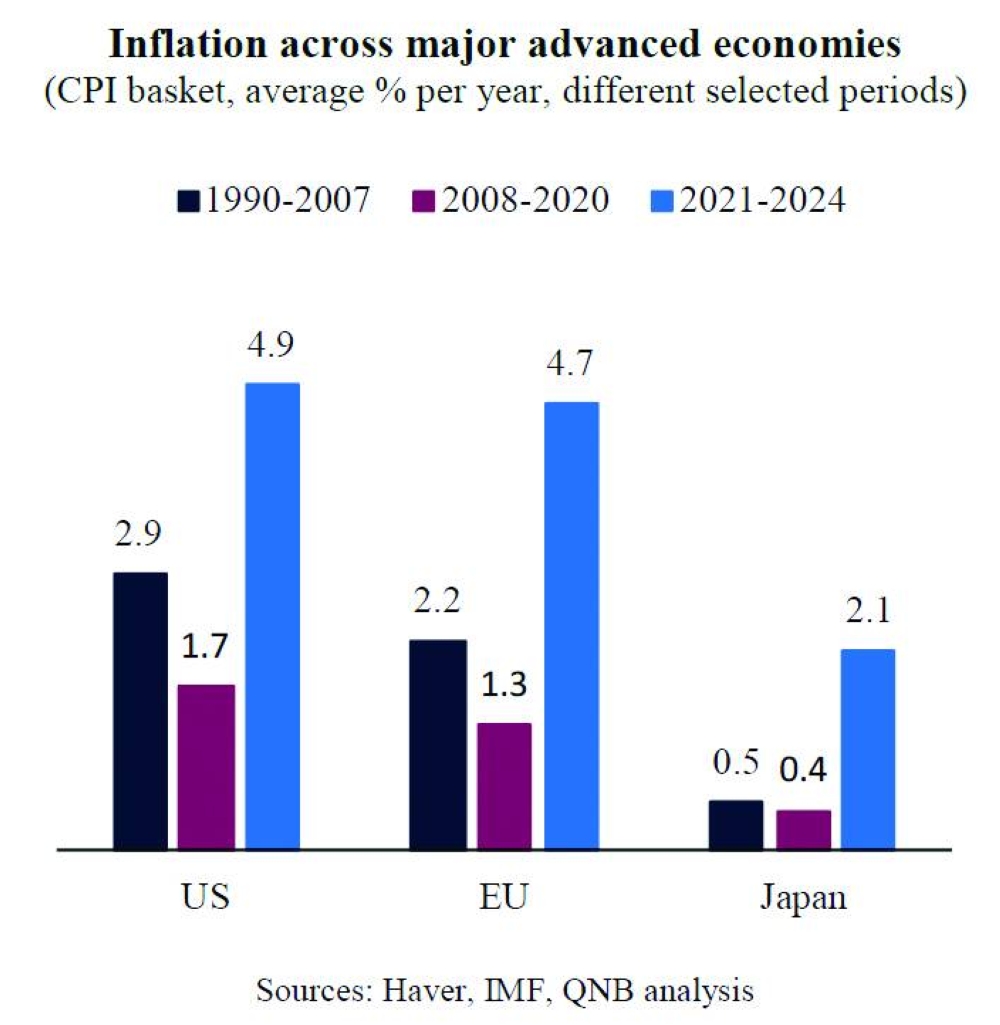
The US economic juggernaut continues with the bullish policies of the new president. But are there significant risks both for the US and the world? In sober language, the latest IMF Outlook report suggests that there areGiven the radical agenda of the US President Donald Trump, a remarkable feature of the latest quarterly IMF Outlook for the world economy is how much continuity there is in global economic trends, carrying from those of 2023 and 2024. The report opens by stating that ‘the global economy is holding steady’.One cause is that many investors and economists correctly anticipated Trump’s victory in the November election, so some of the changes are already priced in.There is a consensus that US growth will continue to be greater than that of other western economies, and that the US will not have its economic or geopolitical hegemony significantly threatened.The IMF notes that, globally, growth is slowing, although slightly, with GDP growth for the final quarter of 2024 just 0.1% below the projection. The Fund anticipates global growth of 3.3% for 2025, compared with an average of 3.7% for the period 2000-2019. An upward revision in the US offsets downward revisions in other major economies. Global headline inflation, meanwhile, is expected to fall to 4.2% this year, and to 3.5% in 2026, but the report notes unquantifiable inflationary risks emerging.Across the globe there is some divergence, notably on inflation and monetary policy. There are inflationary pressures in the US and some other western economies, while low inflation is expected to persist in China and some other economies.The very high public debt, and deficit, of the US, is set to continue, and potentially increase. The dollar is the world’s reserve currency, giving the US more ability to borrow than other economies, but running a high deficit over a prolonged period comes with risks. High US borrowing could increase demand for capital globally, leading to an increase in interest rates and possibly depressing economic activity elsewhere, the IMF notes.There is, perhaps, a certain western bias among some economists in describing US growth of just under 3% as strong, and Chinese growth of 4.7% as weak. The reality is, however, that China does need a higher level of GDP growth to generate equivalent improvements in living standards. More of its economy is export-focused, and there is a smaller internal market compared with the US.The forecast of 2.7% US growth in 2025 is 0.5% higher than the projection made in October – but the strong growth prospects for the US economy are tilted towards the short term, the IMF observes. A loose fiscal policy, deregulation of business and financial markets, and the unpredictability of tariffs all incur medium- and long-term risks. In the case of deregulation, the report states that an excessive encouragement of risk-taking and debt accumulation ‘may generate boom-bust dynamics for the United States in the longer term, with repercussions for the rest of the world’.The effect of tariffs on inflation is difficult to anticipate. Policy responses from affected countries are not known, and resulting dynamics can be complicated. The IMF warns that the cyclical positions of many major economies are more prone to inflation than in 2016, when Trump was first elected with a protectionist policy agenda. There could be retaliation against the US on materials that are difficult to substitute.The US continues to dominate the world economy in part because of significant challenges facing other large economies. Geopolitically, China is the only power with the potential to rival the US. Europe has continued to experience sluggish growth, and is in need of restructure if this is to change. The other emerging economies denoted by the Brics acronym in addition to China – Brazil, Russia, India and South Africa – have had varying fortunes, most negatively Russia, severely impaired by the human and economic cost of its invasion of Ukraine.China has made major strategic decisions for political reasons, that have hampered economic growth. It continued with strict Covid-19 pandemic lockdown measures longer than other nations, and the state has exerted greater control over businesses. Now there is a US Presidency determined to curb imports from China. For several reasons, the world’s second largest economy has become a less attractive destination for foreign direct investment. A belligerent and confrontational US President, who sees China as the great rival, requires adroit policy responses from Beijing.Overall, as 2025 begins with the global economy appearing to be ‘steady’, this may not last.The author is a Qatari banker, with many years of experience in the banking sector in senior positions.


This handout photo from the Royal Thai Government taken and released yesterday shows Prime Minister Paetongtarn Shinawatra with President Xi Jinping during an official visit at the Great Hall of the People in Beijing. – AFP
International

Call for China, Thailand to beef up ties to fight global uncertainties

China and Thailand should deepen trust in each other and expand co-operation to counter growing global uncertainties, President Xi Jinping said yesterday during a meeting in Beijing with Thai Prime Minister Paetongtarn Shinawatra.The Thai leader’s official visit to China from February 5-8 is her first since taking office in August, marking the 50th anniversary of diplomatic ties between the two countries.Xi cited projects such as a high-speed railway set to link Bangkok with southwestern China’s Kunming, adding that digital economy and electric vehicles were additional areas for greater co-operation.“In the face of unprecedented changes not seen for a 100 years, China and Thailand should deepen mutual trust over strategic interests and firmly support each other,” state broadcaster China Central Television (CCTV) quoted Xi as saying.His remarks follow US President Donald Trump’s decision to impose fresh tariffs of 10% on imports from China.Online fraud and safety concerns have topped the issues between the two, particularly after Chinese actor Wang Xing was rescued from a scam centre in Myanmar following his abduction in Thailand, to which he was lured on the pretext of an acting job.After his high-profile alleged kidnapping, the number of Chinese tourists visiting Thailand during the Lunar New Year holiday sharply declined in comparison to previous years.Thailand has sought to allay safety concerns among the Chinese, who contribute the largest group of visitors to the Southeast Asian nation.“The safety of people and tourists visiting Thailand is the government’s highest priority,” Paetongtarn said, adding that both nations would co-operate on a warning system to fight crime. “Thailand is ready to work with China to suppress criminal activity that passes through Thailand.”On Tuesday, the Thai government said it would cut electricity to some areas bordering Myanmar in a bid to rein in the activities of scam centres.Xi said China appreciated the Thai measures to combat online gambling and telecom fraud, calling for both to strengthen law enforcement as well as security and judicial co-operation to safeguard people’s lives and property.China is a hugely important market for Thailand as it seeks to rebuild its tourism sector in the wake of the coronavirus (Covid-19) pandemic.

Nasser Saleh al-Attiyah’s car undergoes final preparations on Tuesday at the Lusail International Circuit, ahead of Qatar International Rally.
Sport

QMMF plans 50th anniversary celebrations of Qatar Rally

This weekend’s Qatar International Rally is the second round of the FIA Middle East Rally Championship (MERC) but it is also the 50th anniversary of the first ever event to be held in 1975.From that small acorn, the joint third oldest rally in the Middle East – the Rally of Lebanon and Cyprus ran for the first time in 1968 and 1970 and Kuwait also hosted a rally in 1975 – has become one of the most popular events in the whole of Asia. Nasser Saleh al-Attiyah will be trying to break his own record of 17 victories on his home rally this weekend. The list of previous winners is an impressive one: current FIA President Mohammed Ben Sulayem won on nine occasions, local legend Saeed al-Hajri claimed six wins and the defending MERC champion, Abdulaziz al-Kuwari, prevailed back in 2012.As far as co-drivers are concerned, Irishman Ronan Morgan holds the record with eight wins, Mathieu Baumel and Chris Patterson partnered al-Attiyah to six and five successes apiece and Giovanni Bernacchini claimed four victories with the Qatari between 2010 and 2014.Two of the most surprising wins came with victories for Group N/MERC 2 cars. Oman’s Nizar al-Shanfari teamed up with the late Tom Steele to stun his rivals with victory in a Mitsubishi Lancer Evolution V in 1999 and Rashid al-Naimi and Hugo Magalhaes secured a shock win in 2017 with a Subaru Impreza WRX STi.The Qatar Motor and Motorcycle Federation (QMMF) will be celebrating 50 years this weekend, as 29 teams and competitors from 19 countries make their final preparations for the weekend’s action at the service park within the Lusail International Circuit.Twenty-one of those teams are now registered for 2025 MERC points.Al-Attiyah began competing in off-road events from 1989 and 1990 and then returned to the sport with a vengeance in 2003. He won his first Qatar International Rally that year with British co-driver Steve Lancaster in a Subaru Impreza WRC and has since celebrated victory in Qatar with four additional car manufacturers and as many new co-drivers.Speaking at Lusail on Tuesday, al-Attiyah said: “I remember when Saeed (al-Hajri) and Mohammed (Ben Sulayem), Jaber al-Marri, Mamdouh (Khayat) and many others were competing. We were watching. Then, in 1990, I did the first Qatar International with a Toyota Celica from Mohammed. I was leading all the way until we broke the rear diff. People started to say that this was the new Saeed coming. It was nice memories. “I stopped for 10 years and came back to win for the first time in 2003. I raced the full championship with a WRC Prodrive Subaru and we won the championship for the first time. Then, we started to make our own history. So many changes over the years, from the cars to safety. Now, when you see the old cars compared to the new ones, you don’t want to jump in the older ones. We are happy with the safety of the new cars. We talk about the Rally 2 car. That is faster than even the WRC car from 2015 and 2016.”Bernacchini is working as team co-ordinator for the 1993 event winner Nasser Khalifa al-Atya this weekend. The Italian said: “This rally is one of the best in the Middle East with typical desert conditions. I won here four times. That was good memories but I didn’t just make this rally with Nasser Saleh. I made it with Nasser Khalifa. My first rally here was actually in 2009 with Faisal al-Attiyah, so almost with all the family I made this rally.“There has been a big improvement. It is very difficult to see the way on desert roads. But the QMMF now marks the stages properly with flags and fences. When I first started it was very difficult with just corners to manage the co-driving. Now, even though it is a desert rally, you can see the roads from afar. The fact we also have Lusail and the QMMF HQ and the super special stage all very close is now very good.”Nasser bin Talibe al-Marri has been following the Qatar International Rally since he was a young boy and has a regular blog on social media portraying archive of the MERC. Speaking at Lusail, the Qatari said: “I remember my first event was in 1976. The start was at the Khalifa Stadium. I was around six-years-old and I came with my brother. Then I came again in ’78 and then in 1983.“I spectated on all those rallies. Then I was with my brother from 1995 and with the federation (QMMF) in 2004 and 2005 until 2010. The Middle East is not like before but everything has improved. Before, for many years, everything to do with the rally was at the Ramada in Doha and now we have the circuit and the modern facilities and that has changed everything.”The 50th anniversary rally is being held under the chairmanship of QMMF President Abdulrahman al-Mannai, senior committee member Abdulrazaq al-Kuwari and the QMMF’s Executive Director Amro al-Hamad.Today, competitors will carry out a full reconnaissance of the six different gravel special stages in the northern desert. Vehicles will also pass technical scrutineering checks at the Lusail International Circuit.Qatar International Rally – previous winners+1975 Peter Austin (GBR)/Hameed Abdel Rahman (QAT) Mazda 929 Coupe1976 no rally+1977 John Blackwell (GBR)/John Rollings (GBR) Mazda 808+1978 Harry Kallstrom (SWE)/Claes Billstam (SWE) Datsun 160JSSS1979 to 1982 no rally+1983 Saeed al-Hajri (QAT)/John Spiller (GBR) Opel Ascona 4001984 Saeed al-Hajri (QAT)/John Spiller (GBR) Porsche 911 SC RS1985 Saeed al-Hajri (QAT)/John Spiller (GBR) Porsche 911 SC RS1986 Bjorn Waldegard (SWE)/Fred Gallagher (GBR) Toyota Celica Twin Turbo1987 Saeed al-Hajri (QAT)/Ronan Morgan (IRL) Porsche 911 SC RS1988 Mohammed Ben Sulayem (UAE)/Ronan Morgan (IRL) Toyota Celica Twin Cam Turbo1989 Saeed al-Hajri (QAT)/Steve Bond (GBR) Ford Sierra RS Cosworth1990 Mohammed Ben Sulayem (UAE)/Ronan Morgan (IRL) Toyota Celica GT41991 Mohammed Ben Sulayem (UAE)//Ronan Morgan (IRL) Toyota Celica GT41992 Saeed al-Hajri (QAT)/Mike Corner (GBR) Toyota Celica GT41993 Nasser Khalifa al-Attiyah (QAT)/Mubarak al-Hajri (QAT) Toyota Celica GT41994 Suhail Bin Khalifa Al-Maktoum (UAE)/Khaled Malik (UAE) Toyota Celica Turbo1995 Khalifa al-Mutawei (UAE)/Mubarak al-Hajri (QAT) Toyota Celica Turbo 4WD1996 Mohammed Ben Sulayem (UAE)/Ronan Morgan (IRL) Ford Escort RS Cosworth1997 Mohammed Ben Sulayem (UAE)/Ronan Morgan (IRL) Ford Escort RS Cosworth1998 Mohammed Ben Sulayem (UAE)/Ronan Morgan (IRL) Ford Escort WRC1999 Nizar al-Shanfari (OMN)/Tom Steele (GBR) Mitsubishi Lancer Evolution V2000 Mohammed Ben Sulayem (UAE)/Ronan Morgan (IRL) Ford Focus WRC2001 Mohammed Ben Sulayem (UAE)/Khaled Zakaria (JOR) Ford Focus WRC2002 Mohammed Ben Sulayem (UAE)/John Spiller (GBR) Ford Focus WRC2003 Nasser Saleh al-Attiyah (QAT)/Steve Lancaster (GBR) Subaru Impreza WRC*2004 Nasser Saleh al-Attiyah (QAT)/Chris Patterson (GBR) Subaru Impreza WRX STi2005 Nasser Saleh al-Attiyah (QAT)/Chris Patterson (GBR) Subaru Impreza WRX2006 Nasser Saleh al-Attiyah (QAT)/Chris Patterson (GBR) Subaru Impreza WRX STi2007 Nasser Saleh al-Attiyah (QAT)/Chris Patterson (GBR) Subaru Impreza WRX2008 Nasser Saleh al-Attiyah (QAT)/Chris Patterson (GBR) Subaru Impreza N142009 Nasser Saleh al-Attiyah (QAT)/Tina Thörner (SWE) Mitsubishi Lancer Evolution2010 Nasser Saleh al-Attiyah (QAT)/Giovanni Bernacchini (ITA) Ford Fiesta S20002011 Nasser Saleh al-Attiyah (QAT)/Giovanni Bernacchini (ITA) Ford Fiesta S20002012 Abdulaziz al-Kuwari (QAT)/Nasser al-Kuwari (QAT) Mini S20002013 Nasser Saleh al-Attiyah (QAT/Giovanni Bernacchini (ITA) Ford Fiesta RRC2014 Nasser Saleh al-Attiyah (QAT)/Giovanni Bernacchini (ITA) Ford Fiesta RRC2015 Nasser Saleh al-Attiyah (QAT)/Mathieu Baumel (FRA) Ford Fiesta2016 Nasser Saleh al-Attiyah (QAT)/Mathieu Baumel (FRA) Skoda Fabia R5 RRC2017 Rashed al-Naimi (QAT)/Hugo Magalhaes (PRT) Subaru Impreza WRX STi (MERC 2)2018 Vojtech Stajf (CZE)/Veronika Havelkova (CZE) Skoda Fabia R52019 Nasser Saleh al-Attiyah (QAT)/Mathieu Baumel (FRA) Volkswagen Polo GTI R52020 Cancelled – Covid-192021 Nasser Saleh al-Attiyah (QAT)/Mathieu Baumel (FRA) Volkswagen Polo GTI R52022 Nasser Saleh al-Attiyah (QAT)/Mathieu Baumel (FRA) Volkswagen Polo GTI2023 Nasser Saleh al-Attiyah (QAT)/Mathieu Baumel (FRA) Volkswagen Polo GTI2024 Pierre-Louis Loubet (FRA)/Loris Pascaud (FRA) Skoda Fabia RS Rally2*denotes MERC candidate event+not a round of MERC

Gulf Times
Opinion

Making sense of Germany’s under-performing economy

Germany’s economy is slowing more sharply than in the rest of Europe, and may well be in recession. Can it recover anytime soon?The factors behind Germany’s under-performance are not difficult to discern. As in much of the developed world, productivity growth has been sluggish for some time. Moreover, since the Covid-19 pandemic, inflation – including a rise in energy prices – has taken a toll on growth. The Ukraine war compounded these headwinds, not least by forcing Europe to replace Russian fossil fuels with more expensive substitutes. Higher energy prices hit Germany’s heavily industrial economy particularly hard.Germany is also facing declining demand for its exports, owing to sluggish global growth, weakness in key markets (especially China), and rising foreign competition in autos and advanced industrial machinery. But exports are vital to Germany’s economic model: the country has long run trade (and current account) surpluses, in order to offset insufficient domestic aggregate demand.Then there are the economy’s labour shortages. As is true of most developed countries, as well as China, Germany’s population is ageing. At 1.35 births per woman, fertility is well below the replacement rate of 2.1. Add to that increasing longevity, and Germany’s dependency ratio – the proportion of dependents (old and young) to the working-age population – is on the rise, straining social security and healthcare systems. Already, the labour force has levelled off at around 44mn, and unless something substantial changes – say, workforce participation or net migration increases significantly – it will begin to shrink within the coming decade.The last time Germany faced such serious economic challenges, in the late 1990s, the government, in collaboration with industry and labour, carried out far-reaching reforms. This effort included a crucial structural shift: German industrial sectors moved to occupy the high-valued-added segments of supply chains, with other segments moving to lower-cost countries, including the emerging post-communist economies in Central and Eastern Europe. By 2006, Germany was outperforming other large European economies, and it continued to do so until 2017.Replicating this success today would require Germany to move to the forefront of the digital transformation. Fortunately, Germany does not lack talent, entrepreneurial activity, or innovative capacity. BioNTech, headquartered in Mainz, is a leading developer of vaccines and cancer treatments, with a growing global footprint. Berlin, Munich, and Hamburg boast entrepreneurial ecosystems and innovation hubs. Forty-six unicorns in Germany – mostly operating in digital-technology-enabled sectors – have received funding from domestic and international venture-capital and private-equity firms.But technological advances happen faster in very large, integrated markets, because the returns on costly upfront investments in innovation are higher when the total addressable market is bigger. This means that progress in Germany will depend significantly on European policy.Some might argue that the main problem here is that the world economy is becoming more fragmented, more complicated, and less open – perhaps permanently. And this does create serious challenges, especially for an export-oriented industrial economy like Germany.But an even bigger obstacle to digitally driven structural change in the economy, especially in Germany, is the growing digital-technology gap between the European Union and the other two global economic powerhouses, the United States and China. It might be tempting to downplay the importance of this gap, because divergences can appear in any sector over time and across countries. But digital technologies do not form just one sector; they are essential to the technological and structural transformation of every economic sector, including industrial manufacturing.In his September 2024 report on European competitiveness, Mario Draghi, a former head of the European Central Bank and prime minister of Italy, examined the main causes of the EU’s tech deficit. Perhaps inconveniently for Germany, some of them – for example, a dearth of basic research in science and technology – can be addressed only at the EU level, as they require centralised funding and administration. Similarly, services-sector and capital-market integration – vital to enable Europe’s innovators to reap the full benefits of its large economy – will require coordinated action across countries.EU-level regulatory approaches might also need to be reconsidered. As it stands, the mega-platforms that support the largest cloud-computing systems – which generate spin-offs, fund basic research (especially in quantum computing, artificial intelligence, and AI applications in science), and support AI development – are located mostly in the US and China.To be sure, major players – Microsoft Azure, Amazon Web Services, and Google – have established large data centres in Europe, including Germany, to serve local markets, leverage Europe’s deep pools of scientific talent, and comply with EU data-protection rules and AI regulations. But there are no comparable home-grown entities. This has contributed to a regulatory and policy bias toward risk mitigation and data security, with less attention being paid to leveraging tech’s upside potential and creating an enabling environment for digital structural transformation.A final imperative for Europe – and particularly for Germany – is progress on the digital transformation of industrial sectors, including automobiles, where China’s advances in electric-vehicle batteries and solar energy represent a huge competitive threat. This will require incumbent firms to overcome organisational inertia and let go of old mindsets and models. More important, it will require software engineering on a massive scale. But Europe does not currently have enough qualified people for these jobs. While an AI-fuelled surge in software-engineering productivity might help to ease this bottleneck, large amounts of engineering talent will still be essential. Changes to immigration policy can help here.But there is cause for cautious optimism. The Chinese startup DeepSeek has just stunned the AI world by demonstrating that a cutting-edge large language model can be trained more cheaply, and with less computing power, than previously thought. This discovery potentially reduces the EU’s deficit in the computing infrastructure required to support advanced AI development, thus creating an opportunity for Germany, and Europe more broadly, to close the gap with the world’s current tech leaders. But success will be possible only if EU leaders, national governments, and industry work together to mobilise the required human capital and deliver the necessary investment, not least in digital infrastructure. — Project Syndicate Michael Spence, a Nobel laureate in economics, is Emeritus Professor of Economics and a former dean of the Graduate School of Business at Stanford University and a co-author (with Mohamed A El-Erian, Gordon Brown, and Reid Lidow) of Permacrisis: A Plan to Fix a Fractured World.

Gulf Times
Opinion

India budget opts for economic sugar rush over reform

India’s annual budget announcement was a bigger deal than usual this year: As the first full budget of Prime Minister Narendra Modi’s third term, it will set the tone for how the world’s fifth-largest economy confronts slowing growth and sagging markets.But the year’s top economic policy event opted mainly for short-term economic relief through middle-class tax cuts, while passing up a chance to go big on reforms needed to reignite rapid growth – once the envy of the world at more than 8%.The budget also scaled back the government’s emphasis on capital spending and infrastructure, another key driver for India’s growth ambitions since the pandemic.Without a strategy to regain high growth rates and assure jobs for India’s young population, the budget disappointed analysts and markets, alarmed in recent months by weak earnings growth and an exodus of foreign investors.“India is aspiring for 8% growth but we don’t have a path to 8% – a growth strategy is not there,” said Madhavi Arora, chief economist at Emkay Global Financial Services.The government has forecast India’s GDP growth will slip to a four-year low of 6.4% in the current financial year to March 31 and stay close to that level next year as well, compared with 8.2% in 2023-24.While the latest tax cuts may help urban consumers, who took some steam out of the economy as weak wage growth and high living costs curtailed their spending habits, economists see deeper problems that need to be addressed.“Eight percent will require far deeper interventions in agricultural markets, human capital and ease of doing business,” said Dhiraj Nim, an economist at ANZ Research.Modi, who returned to power in July of last year with a weaker-than-expected mandate, has turned to appeasing politically important constituencies in the months since the election, analysts said. His party has reversed agricultural trade policies to favour farmers, offered cash handouts to women and, now, cut taxes for the middle class.Analysts noted that this is not the first time, however, that Modi and his Bharatiya Janata Party failed to push economic reforms, which also got brushed aside in his previous two terms when the party had won more decisively and had greater political capital.“In 2019, the BJP got more than 300 seats and had a window (for reforms),” said Amit Ranjan, research fellow at Institute of South Asian Studies (ISAS), National University of Singapore.“But the government gave in to the needs of electoral politics as the government knows reforms do not immediately benefit the large section of voters.”In 2015, Modi let lapse an executive order making it easier for businesses to buy land, after failing to win support from opposition parties in the parliament. And in 2020, both houses of parliament approved new labour codes, but they have yet to be implemented across all states.Plans for large-scale privatisations of state-owned enterprises, aiming to reinvigorate them by reducing government involvement, have also faltered, with the government now opting to put fresh funds into ailing state firms.The case for reforms, however, has not come just from analysts and economists, but from government leaders as well.On Friday, India’s chief economic adviser, V Anantha Nageswaran, made a pitch for rapidly easing rules covering land, labour and factories, among other areas, arguing that government should “get out of the way” as one way to push up growth.“Business as usual carries a high risk of economic growth stagnation, if not economic stagnation,” Nageswaran said in a report presented a day ahead of the budget. The tax cuts’ Rs1tn ($11.56bn) price tag also reduced the government’s leeway to further ramp up spending on infrastructure. The budget includes Rs11.2tn for capital expenditure in 2025-26, close to the level of spending planned for the current year, although actual outlays fell short of that due to delays linked to national and state elections.“We think that capital expenditure and infrastructure development will provide a longer-term, longer-lasting boost to growth than things like tax measures,” said Christian de Guzman, senior vice-president and lead sovereign analyst for India at Moody’s Ratings.Since the Covid-19 pandemic, the government has raised capital expenditure sharply in the hope of fashioning an investment-led recovery but the strategy is yet to pay off, with job creation and wage growth remaining weak.

no image
Opinion

Global food and nutrition security in alarming state

Food and nutrition insecurity remain pressing global challenges. Despite progress in some areas, millions of people around the world still struggle to access sufficient, safe, and nutritious food.Many countries continue to grapple with recurring crises fuelled by climate change, high food prices, and conflict, all of which undermine access to the healthy, nutritious food that people need to thrive.It is five years since the onset of the Covid-19 pandemic and five years away from the 2030 deadline for the UN’s Sustainable Development Goals (SDGs).The 2030 Agenda for Sustainable Development, adopted by all United Nations Member States in 2015, provides a shared blueprint for peace and prosperity for people and the planet, now and into the future.At its heart are the 17 Sustainable Development Goals (SDGs), which are an urgent call for action by all countries - developed and developing - in a global partnership.They recognise that ending poverty and other deprivations must go hand-in-hand with strategies that improve health and education, reduce inequality, and spur economic growth – all while tackling climate change and working to preserve our oceans and forestsMonitoring food and nutrition security is a notoriously challenging task and one that often suffers from major data gaps, according to some experts at the World Bank who recently highlighted five alarming statistics that underscore the urgency of the global food and nutrition security situation and discuss how data innovations are pivotal in combating global hunger.Last year’s ‘State of Food Security and Nutrition in the World’ report found that up to 733mn people globally suffered from malnutrition in 2023, an increase of 152mn since 2019.This sharp rise underscores the escalating crisis of hunger and food insecurity worldwide.The same report concluded that rising food prices and income inequality have led to 2.8bn people being unable to afford a healthy diet in 2022, contributing to what is termed as “hidden hunger.” Rising food prices disproportionately affect poorer households which spend a greater proportion of their incomes on food.World food prices have declined from their 2022 peaks, but price dynamics will remain a key determinant of food security in 2025. During the sharp price rises in 2022, World Bank estimations found that a mere 1% rise in global food prices pushes an additional 10 million people into extreme poverty.This underscores the vulnerability of low-income populations to even seemingly minor market fluctuations.Last year, researchers at the University of Oxford and London School of Economics concluded that market failures and inefficiencies contribute to $10tn in hidden costs each year within the global food system.These losses highlight the need for systemic changes to transform our food systems to be more efficient, equitable, and less wasteful so that we can sustainably feed people with nutritious food on a liveable planet.According to the UN’s State of Food Security and Nutrition in the World 2023, over 735mn people face hunger globally.Urgent action, therefore, is needed to strengthen food systems, support sustainable agriculture, and ensure equitable food distribution.

A fan of Brazilian side Santos holds a flag with pictures of Brazilian football star Neymar near the Urbano Caldeira stadium in Santos, Brazil, on Friday. Neymar announced his return to Brazilian side Santos, the club that trained him, three days after ending his disappointing adventure in Arab football. (AFP)
Sport

Neymar to play for Santos, eyes 2026 FIFA World Cup

Neymar announced on Friday he was returning to Brazilian club Santos, where he started his career, after ending his injury-plagued spell with Saudi Arabia’s Al Hilal.“I will sign a contract with Santos Futebol Clube,” Neymar wrote on social media in a post accompanied by images of his past with the Sao Paulo-based team, where football icon Pele spent most of his career.“My feelings for the club and fans have never changed.”Santos’ X account replied to Neymar’s post, saying: “Your home awaits you. Your people await you.”Neymar will be presented to fans in a ceremony at the club’s Estadio Urbano Caldeira, featuring concerts by several local music stars, today.The 32-year-old former Barcelona and Paris Saint-Germain forward played just seven times for Al Hilal despite a reported salary of around $104mn a year.Neymar, Brazil’s all-time top scorer, joined Al Hilal in August 2023, following fellow superstars Cristiano Ronaldo and Karim Benzema to the Gulf.But two months after his arrival in Riyadh, he ruptured a cruciate ligament in his left knee while playing for Brazil in a 2026 World Cup qualifier, which kept him on the sidelines for a year.He then suffered a series of hamstring and knee injuries as he tried to return to action.The club’s coach Jorge Jesus said recently: “He can no longer play at the level we are used to. Things have become difficult for him, unfortunately.”Neymar’s return to Brazil is likely the last chance of his faltering career.Neymar has scored 79 goals in 128 matches for his country.Neymar had been courted by MLS teams in the United States but has chosen to return home with the goal of earning selection for the Brazil squad for the 2026 World Cup in Mexico, the United States and Canada.“Now I need to play again,” said Neymar. “And only a club like Santos can provide the love I need to prepare for the coming challenges of the next years.”He faces a huge challenge at Santos, who only returned to the elite division in 2024 after a year in the second tier.Neymar will face a busy schedule punctuated by long flights across Brazil, with the Sao Paulo State tournament, the Brazilian Cup and the national championship which begins at the end of March on the program. The presence of such a big name will attract huge interest from Santos fans, but Neymar’s best days are almost certainly behind him.At the start of his career he was cast as the heir to Pele. After scoring 136 goals in 225 appearances for Santos, he joined Barcelona in 2013, becoming the young star of a team that also featured Lionel Messi and Luis Suarez, which swept to the Champions League title in 2015 by beating Juventus 3-1 in the final in Berlin.In 2014 his participation in the World Cup in Brazil was cut short by injury in the quarter-finals and Brazil crashed out after a humiliating 7-1 defeat by Germany in the semi-finals. Neymar gained some redemption in 2016 when he scored the winning penalty in a shootout as Brazil won the men’s football gold medal at the Rio Olympics.In 2017, Qatar-owned Paris Saint-Germain prised him away from Barcelona with what is still a world-record transfer fee of €220mn ($230mn).He won five Ligue 1 titles and he and prolific French forward Kylian Mbappe led PSG to the final of the Champions League in the Covid-blighted 2019-2020 season, but they lost to Bayern Munich.PSG reunited Neymar with Messi in the French capital, but the trio with Mbappe failed to gel as personal rivalries got in the way and he was pushed to the exit, and to Saudi Arabia, by the Parisian management in 2023.