Search - World Summit for Social Development

Friday, October 16, 2026 | Daily Newspaper published by GPPC Doha, Qatar.

Search Results for "World Summit for Social Development" (360 articles)

All words
Gulf Times
Region

Spokesperson for UN Secretary-General: Qatar is a very important component of international cooperation for the UN

The Spokesperson for the UN Secretary-General Stephane Dujarric affirmed that the State of Qatar is a very important component of international cooperation for the United Nations, both in terms of diplomacy in its mediation efforts and in terms of humanitarian work. In an exclusive interview with Qatar News Agency (QNA), Dujarric stated that Qatar is one of the largest supporters of the UN agencies working in the humanitarian and relief field, stressing that "Qatar should be an example to other member states at a time when humanitarian donations have gone down. He noted that Qatar's signing of a multi-year funding mechanism with the United Nations is much appreciated, given the growing global humanitarian needs. He added that Qatar has played an extremely important role in facilitating the delivery of humanitarian aid, not only through funding but also by ensuring that assistance reaches those in need. "In that sense, Qatar has been very useful," he said. In this context, the UN spokesperson also said that they look forward to the State of Qatar hosting the World Summit for Social Development later in November, adding that the UN Secretary-General António Guterres will participate in the summit. Regarding the recent Israeli attack targeting the State of Qatar, Stephane Dujarric said, "it is obvious to all the esteem in which Qatar's role as a mediator is held because there was uniformity in condemnation, uniformity in expressing solidarity with Qatar," recalling that the UN Secretary-General was quick to condemn this violation of Qatar's territorial integrity and national sovereignty, and that the Security Council also held a meeting and unanimously approved a press statement condemning the attack and expressing solidarity with Qatar, noting that this a rare occurrence in this era. On the main issues to be discussed at the 80th session of the United Nations General Assembly, the spokesperson explained that this year is particularly significant as it coincides with the 80th anniversary of the organization's establishment following World War II. He pointed out that the Secretary-General has put forward a reform agenda aimed at making the UN more effective, flexible, and responsive to the needs of peoples. He added that the Secretary-General's speech to the General Assembly will emphasize that this is a time for choice, and that member states must choose diplomacy, human rights, and climate justice, and choose for humanity to control technology rather than technology controlling humanity. He emphasized the need to reform the organization to empower member states to effectively pursue these priorities, anticipating that hundreds of bilateral meetings will take place between various delegations during the United Nations General Assembly sessions, representing a valuable opportunity for peace and advancing development goals. Regarding the New York Declaration, which was adopted with a majority of 120 votes in favor of establishing a Palestinian state, the Spokesperson for the UN Secretary-General affirmed that the declaration shows that the world has not lost hope in the two-state solution, noting that the alternative to this solution is unsustainable and involves violations of international law. The Spokesperson for the UN Secretary-General Stephane Dujarric concluded his interview with QNA by saying, "We were pleased to see this recommitment by a vast majority of member states. The Secretary-General will continue to work towards doing whatever he can to find a two-state solution."

Gulf Times
Qatar

Qatar continues being effective partner for Landlocked Developing Countries

The State of Qatar affirmed that it will continue to play its role as an effective strategic partner in confronting challenges and responding to global needs.Qatar has spared no effort in supporting the aspirations of landlocked developing countries and assisting them in their journey toward achieving sustainable development, under the wise directives of His Highness the Amir Sheikh Tamim bin Hamad Al-Thani, which embody a solid approach to strengthening cooperation and partnership with the international community.This came in the State of Qatar's statement, delivered by His Excellency Minister of State for International Cooperation Dr. Maryam bint Ali bin Nasser Al Misnad, at the Third United Nations Conference on Landlocked Developing Countries (LLDCs), held in Awaza, Turkmenistan, under the theme "Driving Progress through Partnerships."Her Excellency expressed the State of Qatar's welcome to the adoption of the Awaza Program of Action (APoA) 2024-2034, recognizing the structural challenges facing landlocked developing countries, particularly those related to transportation, transit, and logistics, which limit their ability to achieve regional integration and integrate into the global economy.She added that, in affirmation of its concern for the situation of the least developed countries (LDCs), including the LLDCs, the State of Qatar is proud of hosting the Fifth UN Conference on the Least Developed Countries in March 2023, and to continue its pioneering role in implementing the Doha Program of Action (DPoA) 2022-2031. She indicated that in this context, the Qatar Fund for Development (QFFD), in cooperation with the Office of the United Nations High Representative for the Least Developed Countries, Landlocked Developing Countries and Small Island Developing States (UN-OHRLLS), is working to finance two projects within the program's outputs, which are concerned with enhancing food security and supporting countries' resilience and crisis-response capabilities. The State of Qatar is also preparing to host the high-level meeting for the mid-term review of the Doha Program of Action in 2027, to follow up on progress and enhance the implementation of commitments until 2031.Her Excellency highlighted that the State of Qatar is a major investor in the United Nations Development Program Accelerator Labs Network project. She added that last year, it also launched its initiative to swap debt for investment in education, in partnership with the World Bank, based on its belief that education is a fundamental pillar of renaissance and progress.Her Excellency the Minister of State for International Cooperation also noted the State of Qatar's readiness to host the Second World Summit for Social Development, affirming its unwavering commitment to social development issues and in line with its vision of placing people at the center of development and strengthening international partnerships toward building more just, prosperous, and sustainable societies. In this context, she said that the international community affirmed, through the outcome document of the Fourth International Conference on Financing for Development, known as the Sevilla Commitment, its commitment to continuing to implement the Doha Program of Action for the Least Developed Countries and the Program of Action for Landlocked Developing Countries (2024-2034).Her Excellency Dr. Maryam bint Ali bin Nasser Al Misnad pointed out that the document called for strengthening efforts to achieve sustainable development and accelerating the integration of landlocked developing countries, least developed countries, and small island developing states into the international trading system by improving infrastructure, especially digital infrastructure, developing statistical systems, removing trade barriers, expanding partnerships, and facilitating access to concessional financing. She reiterated the State of Qatar's full commitment to working with all partners at various levels to implement the Awaza Program of Action and to continue its support for landlocked developing countries in their quest to achieve sustainable development and prosperity for their people.

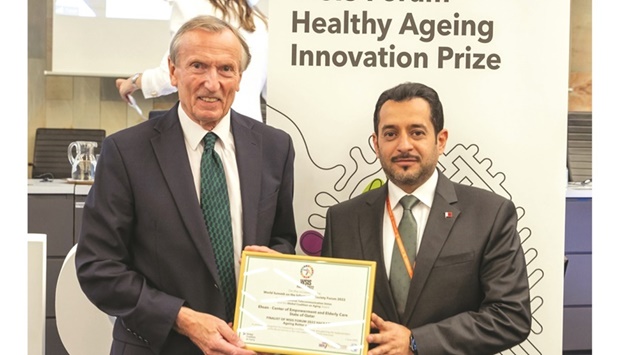
Ehsan Center was honoured with the award of the International Telecommunication Union and the Global Alliance on Aging, which is one of the highest international awards.
Qatar

Ehsan qualifies for final stage in WSIS Forum contest in Geneva

Ehsan Center, one of the centers under the umbrella of the Qatar Foundation for Social Work, was qualified for the final stage in the Innovation Aging Competition at the World Summit on the Information Society (WSIS) 2022 Forum in Geneva. The center participating in the official delegation of the State of Qatar qualified for the e-learning project for the elderly among 115 projects worldwide, and was honoured with the award of the International Telecommunication Union and the Global Alliance on Aging, which is one of the highest international awards. The center participated in the Innovation Award for Aging in the special track on information and communication technology and the elderly, which focuses on information and communication technology that fulfills the needs of people over age 60 to maintain an active life. Ehsan Center seeks to achieve the Qatar National Vision, the main focus of the center's work, and the driving force of its programs, whether at the national or international level, through its projects, including the "e-learning" project, as a reflection of the center's commitment to the United Nations Agenda for Active Aging. The Ehsan Center e-learning project promotes active aging as a continuous process to develop the functional capabilities of the elderly and achieve their social well-being. The project upholds the rights of the elderly and their right to social integration through a plethora of integrated practical steps. Acting Executive Director of Ehsan Center Khaled Abdullah stressed that the center's participation in this award reflects its endeavour to highlight the digital evolution and maturity in Qatar, including its regional and international leading role, especially with regard to empowering the elderly, in recognition of the importance of the active participation of the elderly and their right to Contribute to the national development process in various fields like other members of society. He added that the electronic learning program offered a significant contribution in bolstering the elderly independence and self-reliance, indicating that e-learning enabled the center to proceed with offering its services during Covid-19 pandemic. The e-learning project started from 2014 until this year and is still active within constant development plans, as per center's plan for the continuous digital training for the elderly, in co-ordination with the relevant authorities to provide training programs devoted to facilitating the elderlys use of technology, including smart devices and enhancing the confidence of the elderly in themselves developing the services provided to them, and strengthening the bonds of communication between generations.    

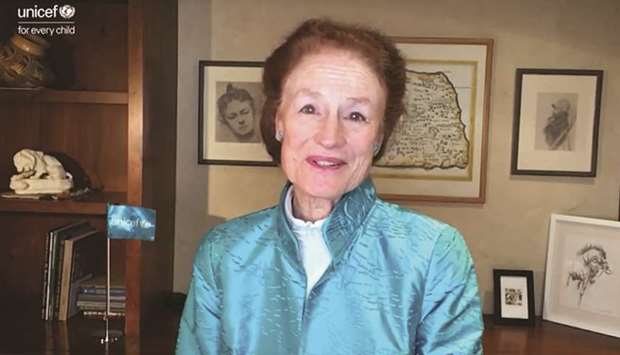
Unicef executive director Henrietta Fore.
Qatar

WISH marks World Children’s Day

United Nations Children’s Fund (Unicef) executive director Henrietta Fore, joined a host of dignitaries at a special symposium jointly organised with Qatar Foundation's World Innovation Summit for Health (WISH) on Friday to celebrate World Children’s Day. Speaking to an online audience, Fore urged governments and organisations around the world to strengthen prevention and response services to help children weather the crisis. “Even before Covid-19, violence against children was far too commonplace. And now, the pandemic is increasing the risk. With school closures, disruption of livelihoods, family confinement, and isolation, children are not only cut off from the social supports that they need at school and in the community, they’re at heightened risk of violence and abuse, as well as child marriage and child labor,” Fore said. These challenges require a multi-layered response that rests on five pillars, Fore added. These include investing in stronger protection and counselling services; strengthening helplines so children can have access to necessary support and counselling; scaling up positive parenting training and resources; making the internet safe for children; and ensuring that students have access to mental health and psychosocial support when schools reopen. Addressing these challenges to safeguard children against abuse topped the agenda of the symposium, which featured three panel discussions titled Protecting Vulnerable Children; Public Health Approach to Addressing Violence Against Children; and Child Development in the Information Age. Dr Jasem al-Mutawa, an educational and social expert and former family court judge in Kuwait, outlined numerous proposals on how governments around the world, in collaboration with various stakeholders, should invest and promote parenting education to fight domestic violence. Domestic violence is only one of many challenges facing children, according to a new report unveiled at the symposium by Inger Ashing, the CEO of international charity Save the Children. Almost one fifth of children worldwide are now living in areas affected by armed conflict, Save The Children’s Stop the War on Children report shows. As a result, more children are facing unimaginable mental and physical trauma, suffering from malnutrition, falling victim to preventable diseases and facing the risk of sexual violence and recruitment by armed groups, Ashing warned. The day concluded with America’s Got Talent winner Kodi Lee performing a number of songs which he dedicated to children around the world, followed by a group of young musicians from Qatar Music Academy playing a medley of songs from Disney’s Aladdin. While the musical performances took place, landmark locations across Doha turned UN blue, including Msheireb Downtown Doha’s Barahat Square, the Museum of Islamic Art, the National Museum of Qatar, and 2015 (QF Headquarters).

WISE
Qatar

WISE holds session at European development forum

The World Innovation Summit for Education (WISE), an initiative of Qatar Foundation (QF), held a session at the recent European Development Days (EDD), Europe’s leading forum on international co-operation and development. EDD is organised annually by the European Commission since 2006, attracting more than 8,000 participants from over 140 countries.  Participants representing 1,200 organisations from the development community share ideas and experiences to inspire new partnerships and innovate solutions to the world’s most pressing challenges. The WISE session, ‘Empowering Women to be Change-Makers,’ highlighted the ripple effect of investing in education for girls and equipping them with the necessary skills to lead and change.  The session was selected from an international call for contributions and marks the second time that WISE has participated in EDD. EDD’s theme this year, “Women and Girls at the Forefront of Sustainable Development: protect, empower, invest,” addressed economic and social rights, physical and psychological integrity, and strengthening girls’ and women’s voice and participation.  This issue is important and urgent, as UNDP statistics show that women perform 66% of the world’s work, yet earn only 10% of the income with an average of only 60–75% of men’s wages. WISE previously hosted notable politicians, including Christos Stylianides, European Commissioner for Humanitarian Aid and Crisis Management; and Andrea Vassiliou, former European Commissioner for Education, Culture, Multilingualism and Youth, in Doha, Qatar.  WISE seeks to continue this ongoing dialogue and collaboration with EU institutions.

Gulf Times
Qatar

Qatar committed to achieve SDGs

 The State of Qatar affirmed its commitment to continuing to work with all countries and partners to achieve the Sustainable Development Goals (SDGs).  This came in a statement delivered by Third Secretary at the Permanent Mission of the State of Qatar to the UN Mohammed Hassan al-Emadi before the Second Committee of the UN General Assembly during its 81st session, under agenda item 17 on sustainable development at UN Headquarters in New York.  Al-Emadi said that Qatar continues to implement its national plan, Qatar National Vision 2030, in pursuit of sustainable and inclusive development. He added that it also works towards a more diversified and sustainable economy and strengthening the role of all sectors by implementing the Third National Development Strategy 2024-2030.  He said that the State of Qatar reaffirms its commitment to enhancing multilateral development cooperation at the international level and is working to translate this commitment into practical steps through the long-term partnerships established by the Qatar Fund for Development with the UN system and international institutions.  He noted that multi-year partnerships with UN agencies reflect the State of Qatar’s commitment to providing more flexible support, thereby advancing sustainable development.  Al-Emadi said that Qatar continues to play its role in hosting international conferences that contribute to advancing the global development agenda, including hosting the Second World Summit for Social Development in Doha in 2025 and preparing to host the High-Level Comprehensive Midterm Review of the Doha Programme of Action for the Least Developed Countries in March 2027.  Regarding the current situation in the region, he noted that Qatar had condemned the attacks carried out by the Islamic Republic of Iran against its sovereignty, territorial integrity and territorial waters, as well as attacks targeting the sovereignty and territorial integrity of brotherly countries.  He described these attacks as a flagrant violation of international law, international humanitarian law and the Charter of the UN, reiterating the need to comply with the provisions of UN Security Council Resolution 2817 (2026), including those relating to rights and freedom of navigation in accordance with international law, particularly through vital maritime routes.  He stressed that the obstruction of navigation poses a direct threat to the security of energy supplies and global food security.  The Third Secretary at Qatar’s Permanent Mission to the UN affirmed that the country’s priority remains containing the escalation and creating space for diplomatic efforts.He noted that Qatar continues to engage with its partners to bring the positions of the parties closer together, establish common ground and reach a peaceful solution that preserves comprehensive and sustainable security, peace and stability in the region.  Al-Emadi also reiterated Qatar’s condemnation in the strongest terms of the Houthi group’s attacks on King Khalid International Airport in Riyadh, in the brotherly Kingdom of Saudi Arabia, which resulted in injuries.  He described the attacks as a serious violation of Saudi Arabia’s sovereignty and a direct threat to regional security, the safety of civilian objects and air navigation, reaffirming the State of Qatar’s full solidarity with the sisterly Kingdom of Saudi Arabia.  

Dr Moez Doraid, UN Women Regional Director for the Arab States.
Qatar

Arab region targets 45,000 new jobs for women by 2026, says UN Women official

At least 45,000 new jobs for women are expected to be created across the Arab region next year, an official of the UN Women announced today during a panel discussion held on the sidelines of the ‘Second World Summit for Social Development’, which will run until November 6 at the Qatar National Convention Centre (QNCC).Speaking at the ‘Solutions Spotlight - Jobs, Skills & Care: Scaling Inclusive Employment for People-Centred Development’, Dr Moez Doraid, UN Women Regional Director for the Arab States, explained that employment generation for women in the Arab region is part of the ‘Surging Women’s Employment Initiative’ (SWEI) led by the UN Women and its partners.He said, “One of UN Women’s top priorities in the Arab region is to solve one of the most persistent problems, both in this region and globally, which is the low levels of women’s labour force participation. It’s a global problem, but in the Arab countries, it takes one of its most extreme manifestations: For the past three decades, women’s labour force participation in the Middle East and North Africa (MENA) has stagnated at around 20%. That is nearly half the global levels.”Doraid pointed out that SWEI also aims to increase women’s labour force participation by “5 percentage points in five years” and also to address and overcome “a persistent paradox” in the MENA region, which is “the contrast between women’s capabilities that have advanced very rapidly primarily through educational attainment and their employment backlog.”Despite significant gains in education—where women now outnumber men in universities and make up 57% of STEM (Science, Technology, Engineering, and Mathematics) graduates—employment figures remain stubbornly low, Doraid lamented.“Women’s capabilities have advanced because women’s illiteracy has been halved in the last two decades. Today, there are more women than men enrolled in universities, and 57% of STEM graduates in the MENA region are women. However, when looking at the workforce, the average labour force participation rate for women across the region is only 20%. There are notable exceptions, such as Qatar, where the participation rate is 63%, nearly three times the regional average,” Doraid further explained.He said, “Women are increasingly represented in STEM education and entrepreneurship. For instance, in the MENA region, the percentage of women tech entrepreneurs surpasses that of Silicon Valley. Additionally, a significant growth area lies in the green economy, which addresses both environmental challenges and enhances women's employment opportunities.“And it covers the entire spectrum of the value chain, empowering women from access to finance to sales, including both in domestic and external markets. The third is the care economy because women constitute the majority of employees in this dimension, as well as care services, such as day care services. And we are doing that by addressing three dimensions of both overcoming obstacles and enabling women.”Doraid noted that SWEI’s approach spans macroeconomic policy, legal reform, and norm-shifting programmes, such as the ‘Dare to Care’ initiative, which encourages men to take on more domestic responsibilities. Currently, women perform “4.7 hours” of unpaid domestic work daily, compared to just “one hour” by men, he also said.He also urged governments and partners to adopt conducive macroeconomic policies, enforce laws, and support cultural shifts that allow women to balance family and career. After the panel discussion, Doraid took to LinkedIn to summarise the points he raised at the Solutions Spotlight event.“Women in the region remain vastly underrepresented in the labour market, despite being among the most educated in the world. SWEI tackles this paradox head-on, working to create 500,000 new jobs within five years and increase women’s employment by 5% by 2030.“The initiative combines evidence-based policy reform, legal change, and social norm transformation - backed by powerful partnerships with Arab governments, the EU, Spain, Germany, and the Islamic Development Bank. It also builds on positive momentum across the region, where 72% of fathers express a desire to spend more time with their children and 86% of policymakers support extended paternity leave - strong indicators of evolving mindsets toward shared care responsibilities,” he stated.Doraid added: “SWEI drives growth where women already lead in the Care, Green, and STEM Economies, and partners with over 700 private sector companies under the Women’s Empowerment Principles (WEPs) to open new pathways for women’s leadership, entrepreneurship, and financial inclusion.”Ends

Gulf Times
Qatar

Qatar's Permanent Representative to UN meets Undersecretary-General for Economic, Social Affairs

HE Permanent Representative of the State of Qatar to the United Nations, Sheikha Alya Ahmed bin Saif Al-Thani met with Under-Secretary-General for Economic and Social Affairs, Li Junhua at Headquarters of the United Nations in New York.During the meeting, they the two sides discussed Qatar-UN cooperation to achieve the Sustainable Development Goals (SDGs) 2030, in addition to the ongoing arrangements for the Second World Summit for Social Development, slated for 2025 in Doha.

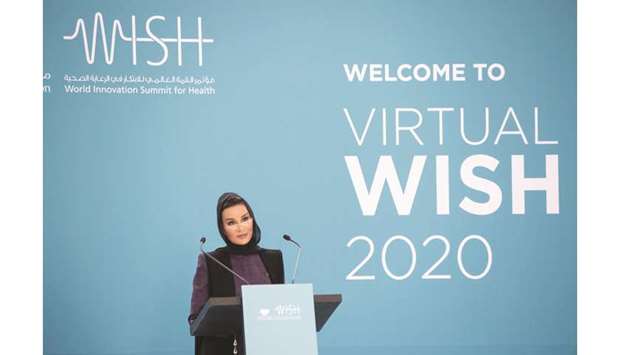
atar Foundation chairperson Her Highness Sheikha Moza addressing the opening session of the World Innovation Summit for Health (WISH) 2020. PICTURE: AR al-Baker.
Qatar

Sheikha Moza opens WISH 2020 summit, salutes health workers

*Participants call for greater international collaboration to combat Covid-19 Saluting healthcare workers in Qatar and all over the world for their outstanding efforts to fight the Covid-19 pandemic, Qatar Foundation (QF) chairperson Her Highness Sheikha Moza bint Nasser, opened on Sunday the World Innovation Summit for Health (WISH) 2020, held under the theme ‘One World, Our Health’. The 2020 summit of QF’s global healthcare initiative got off to a great start with a socially distanced opening ceremony. Along with HH Sheikha Moza, QF vice chairperson and CEO HE Sheikha Hind bint Hamad al-Thani, HE the Minister of Public Health Dr Hanan Mohamed al-Kuwari, WISH executive chair Prof the Lord Darzi of Denham as well as several other dignitaries took part in the event. “In the midst of these trying times brought on by the pandemic, WISH is convening this year to elevate our sense of collective responsibility and unite the world as one – to work together, to share knowledge, to contain this pandemic and to minimise the damage until it is possible for scientists and researchers to restore health security for people everywhere,” said Sheikha Moza in her opening speech. “And so, I salute healthcare workers in Qatar, and globally, for their tremendous efforts in fighting this pandemic, protecting lives, and tirelessly striving to create a better, healthier world,” she added. Highlighting the importance of international healthcare collaboration in the context of Covid-19 Prof the Lord Darzi noted, “The virus has taught us that there can be no security without health security. That’s why I believe it’s time to build a ‘global pathogen shield’ to protect us from novel diseases: a new, global capability to rapidly develop diagnostics, therapies, and vaccines. The only way to do that is through greater international collaboration – which is exactly what WISH is all about. “The virus may have stopped WISH participants from meeting in person in Doha, but it has not stopped WISH. In so many ways, the pandemic has revealed the best of us,” he added. Giving an overview of Qatar’s fight against Covid-19 and highlighting Qatar’s national response to Covid-19, which has seen the pandemic stabilise in the country, Dr al-Kuwari noted, “Every death is a tragedy, but we are thankful that our cases, in global terms, remain low. This stands as testimony to the talent and commitment of our doctors and nurses and the entire healthcare workforce.” “A key factor in our success is our system of universal health coverage. All costs of treatment were covered by the government, irrespective of nationality or social conditions. All patients received the same high standard of care. Our low mortality is attributable to a variety of factors, including the young average age of the population, but particularly to the high quality of medical care, provided equally to everyone. Throughout we strived to keep our healthcare workforce safe and protected and our hospital acquired infections as close to zero as possible,” she explained. Expressing optimism and determination, Dr al-Kuwari said: “We know we will win this battle only if everyone wins it. In solidarity, Qatar has so far helped more than 70 countries and international organisations with equipment and resources. “Covid-19 is not beaten yet. Our strategy remains one of vigilance and focused action tempered by a controlled return to normality, while keeping our people safe. We await, with the rest of the world, the development of a safe, effective vaccine. In the meantime, we must rely on the public health measures with which we are all familiar and the dedication and professionalism of the global health workforce to keep us safe.” The summit attendees also received a special message from Dr Tedros Adhanom Ghebreyesus, director-general of the World Health Organisation (WHO), as he stressed the importance of harnessing the power of innovation in the face of once-in-a-century-crisis that is this pandemic. “Over 200 vaccines are being developed in several countries around the world. Some of them have completed different stages of human trial and waiting for the approvals. This really gives great hope for all,” he highlighted. As part of the WISH 2020 opening ceremony, broadcaster Mishal Husain moderated a high-level panel, The Global Response to Covid-19: What Have We Learned and Where Are We Headed, which heard from international and national leaders including Dr David Nabarro, WHO Special Envoy on Covid-19; Prof Dame Sally Davies, England’s former chief medical officer; and Dr Anders Tegnell, Sweden’s state epidemiologist. WISH 2020 continues until November 19 with the participation of a record number of policymakers, health experts, and frontline healthcare workers.

Sultana Afdhal
Opinion

At WISH, we recognise that nurses are our healthcare heroes

The year 2020 has been named as the Year of the Nurse and the Midwife by the World Health Organisation (WHO). With the world presently engulfed by an unprecedented healthcare challenge, this designation could not be more timely.  Covid-19 has brought into sharp focus the selfless contributions of nurses on the frontline of the global pandemic. They account for almost 60 percent of health professionals worldwide, and are in the highest risk category for contracting the virus. In Italy, healthcare workers make up 9% of all Covid-19 cases, while in Spain this figure is as high as 14%. To date, over 100 National Health Service workers in the UK have died after contracting the coronavirus. Meanwhile, official data from the Centres for Disease Control and Prevention suggests these frontline workers account for 11% of all infections in the United States.  Even as we struggle to comprehend the enormous toll that the virus has taken across all sectors of society, these figures are particularly sobering. The fortitude and selflessness of nurses the world over must be recognised and applauded. There is currently a global shortfall of nurses and midwives, and recent events demonstrate the urgent need to raise their numbers and place them at the heart of resilient healthcare systems all around the world.   My own journey to understanding the critical role that nurses play began with the commissioning of the 2018 WISH report on Nursing and Universal Healthcare Coverage, led by our research group chair, Lord Nigel Crisp, co-chair of Nursing Now, a global initiative launched by the International Council for Nurses and the WHO in 2018.  The report showed strong public backing for nurses to play a greater role in health services, and demonstrated that they are well-positioned to manage the defining health challenges of modern times. Through nursing leadership courses, symposiums, and workshops, we are empowering nurses to expand their horizons in meaningful ways, learn new skills, and make their voices heard in healthcare policymaking. In Qatar, our work is a collaborative effort, supported by the Nursing Now committee which is co-chaired by the Chief Nursing Officer at Hamad Medical Corporation and myself, and brings together senior representatives of WISH, Primary Health Care Corporation, Al-Ahli Hospital, and the University of Calgary in Qatar. We are already witnessing some remarkable changes. Qatar’s nurses are growing in confidence as they realise their true potential and look to become researchers, leaders, and educators. The aim is to inspire more Qataris to take up the profession, build on the skills that nurses of today already possess, leverage technology, and applaud the work they are doing. Recently, I was honoured to be part of the Steering Committee of the State of the World’s Nursing Report 2020, launched by the WHO on April 7. Based on data from 191 countries, the first-of-its-kind report details the latest evidence and policy options for the global nursing workforce. It maps out key recommendations for the nursing sector, to help deliver the 2030 global Sustainable Development Goals and universal healthcare coverage (UHC). These include the need for governments to invest in a massive acceleration of nursing education, the need for six million new nursing jobs to be created by 2030 (primarily in low and middle-income countries), and investments to be made in nurse leadership – new models of care, advanced practice roles, and policy decision-making – to maximise the efficiency and effectiveness of health and social care systems. It is an agenda we must commit to.  At WISH, we recognise that nurses are the backbone of our healthcare systems, yet millions of people are unable to access the crucial primary care services that they provide. For instance, across Africa, there are only 8.7 nurses per 10,000 population, while in the US, 27.9 million people have no health insurance – particularly dire statistics in light of the current situation. To coincide with the Year of the Nurse and the Midwife, WISH is leading the development of special reports, one of which will focus on men in nursing, in partnership with the British Medical Journal. The reports are expected to be published in time for the WISH 2020 summit, set to take place from November 16–18. Additionally, WISH is working on a policy recommendations paper, Nursing and Midwifery Workforce Development, offering a global perspective as well as a specific focus on Qatar. This policy paper will also be ready for WISH 2020, and we look forward to sharing the findings with global healthcare leaders. Alongside our other efforts, WISH has partnered with the Nursing Now campaign to give young nurses a voice at the World Health Assembly meeting in Geneva, an annual gathering of health ministers organised by the WHO. In May last year, nurses from 18 countries participated in five days of meetings, talks, workshops and networking opportunities, offering a chance to positively influence global healthcare policy.  As the world fights the Covid-19 pandemic, it is time to applaud the amazing contributions of our nurses, and that of all healthcare professionals working tirelessly to keep us safe from harm. But applause is not enough – nurses are our healthcare heroes, and investment in nursing represents an investment in our future.

Gulf Times
Qatar

Al Misnad meets Minister of State at Irish Department of Rural and Community Development

HE Minister of State for International Cooperation Maryam bint Ali bin Nasser al-Misnad met today with Minister of State at the Irish Department of Rural and Community Development Jerry Buttimer. Held at the margin of the Second World Summit for Social Developments, the meeting discussed bilateral relations and ways to bolster them in addition to a host of topics of mutual interest.

Gulf Times
Qatar

Qatar's Permanent Representative to UN meets Under-Secretary-General for Economic and Social Affairs

HE Permanent Representative of the State of Qatar to the United Nations, Sheikha Alya Ahmed bin Saif Al-Thani, met with Under-Secretary-General for Economic and Social Affairs Li Junhua at the United Nations Headquarters in New York.The meeting reviewed the State of Qatar's ongoing preparations to host the Second World Summit for Social Development, scheduled to be held from November 4-6.