


Material recycling and recovery sector is set to be a promising field of investment for various local industries and small and medium-size enterprises (SMEs) over the coming years in Qatar as the country has continued to achieve positive results in this area.
According to a recent report by Qatar Development Bank (QDB) on Qatar Recycling Sector 2024–2025, the efforts in this sector were coordinated under a multi-stakeholder governance model involving: the Ministry of Municipality, the Ministry of Environment and Climate Change (MECC), the Ministry of Economy and Commerce and the Public Works Authority (Ashghal) and a number of private recycling operators.
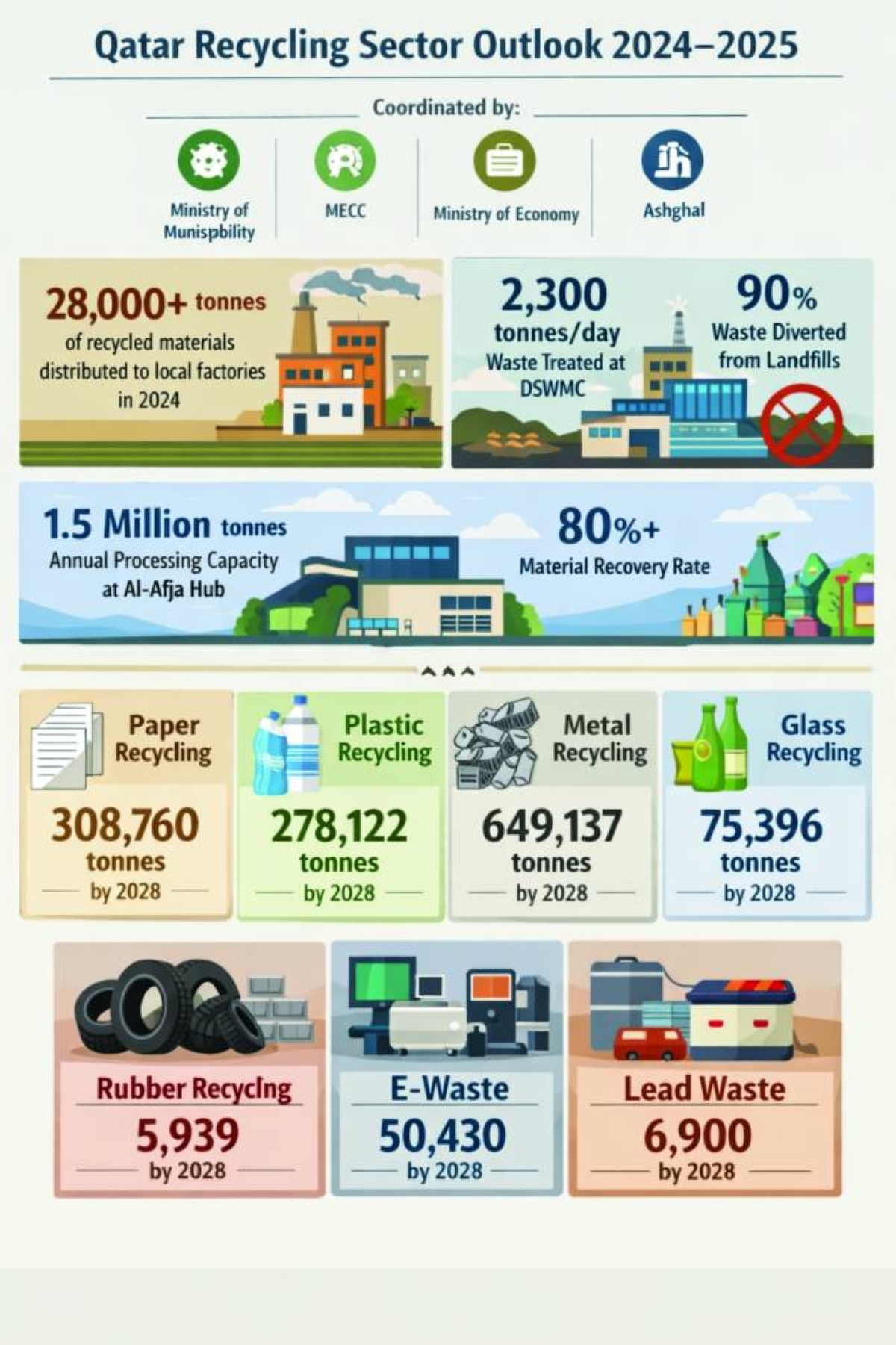
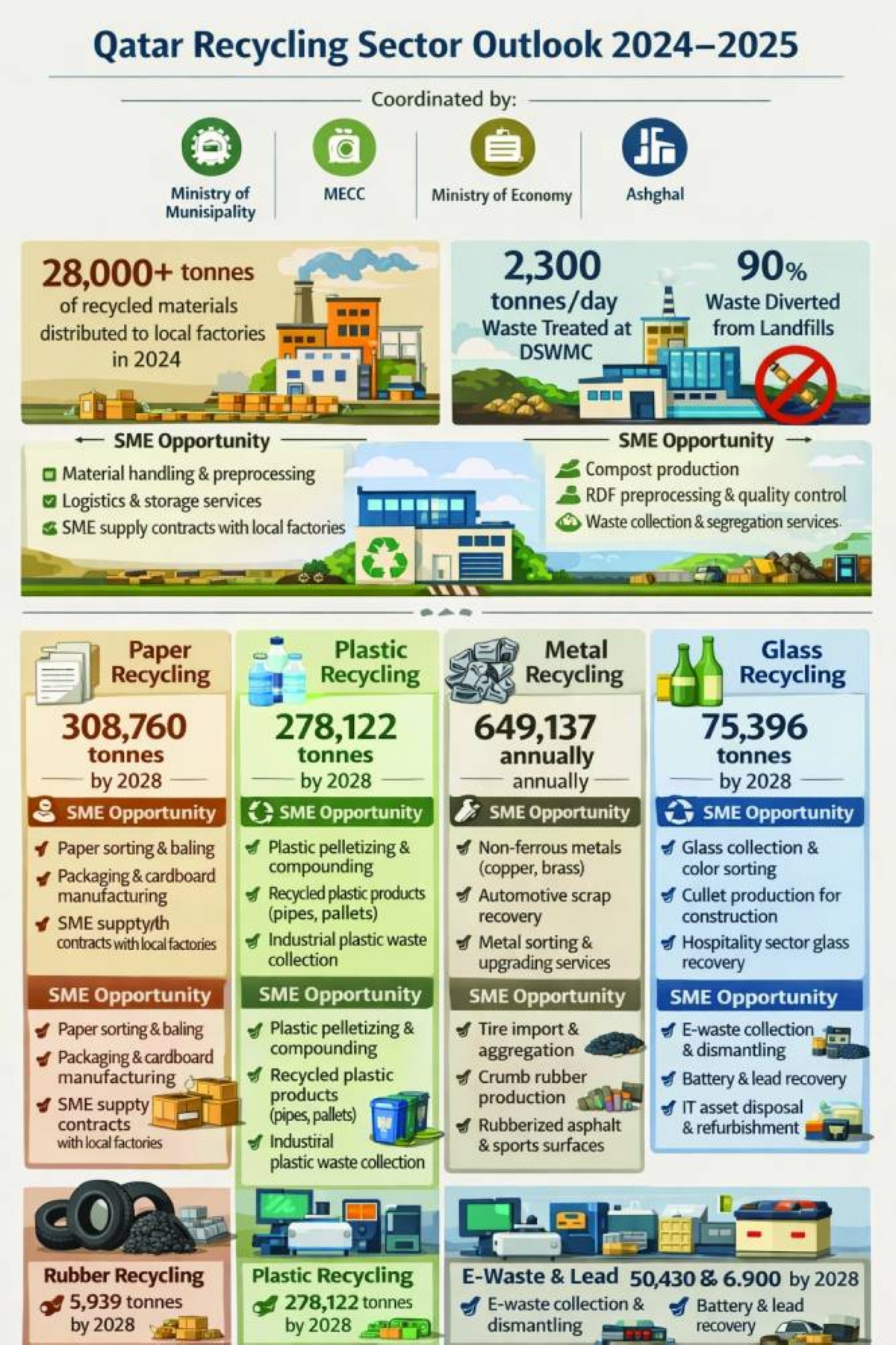
The Ministry of Municipality supported the private sector by distributing over 28,000 tonnes of recycled materials for free to local factories in 2024. In particular, the Domestic Solid Waste Management Center (DSWMC) and Al-Afja Recycling Hub, which features over 50 designated plots for recycling oil, metals, plastics, tires, and construction waste, with over 21 operational factories, nine factories under construction, and 21 other planned projects, have played pivotal role in the recycling ecosystem of the country.
Over the past two years DSWMC has treated 2,300 tonnes per day of municipal solid waste, making it one of the largest integrated waste facilities in the region. Accordingly more than 90% of the incoming municipal solid waste was spared from ending up in the designated landfills. This helped in recovering different types of materials mainly paper, plastics, metals and glass. Besides, organic waste treatment created new industries where some of these were converted into compost and others into refuse-derived fuel (RDF). Such efforts eventually reduced dependency on landfills and helped in producing more energy that contributed to the national electricity supply.
Meanwhile, Al-Afja Recycling Hub has achieved an annual processing capacity exceeding 1.5 million tonnes of recyclable materials with recovery rates surpassing 80% for several material streams. These have supplied the local market with valuable sources of recycled raw materials produced from paper and cardboard processing, tire recycling, metal recovery, wood waste processing and construction waste recycling.
QDB report indicates that the paper recycling sector in Qatar includes two primary companies operating at 80% of their total industry capacity. Qatar also exports the majority of its recycle paper products, which is a potential opportunity for more SMEs to invest in this field. The paper recycling sector is expected to generate around 308,760 tonnes by 2028.
Plastic recycling is considered well-developed industry in the country undertaken by a considerable number of factories with more potential for SMEs investments in the future. The plastic recycling sector is expected to amount to 278,122 tonnes by 2028. The produced materials are exported to some international markets, while the growing local related manufacturing continues to absorb larger amounts of the locally recycled plastic.
Similarly, metal waste is projected to grow at a Compound Annual Growth Rate (CAGR) of 4.23% mainly driven by construction, industrial activities and automotive scrap recovery. However, steel is expected to be the dominant accounting for more than 649,137 tonnes annually by 2018. Investment in this field by SMEs faces various challenges and needs certain approvals, and official procedures, yet it is considered one of the promising areas, especially away from steel and aluminum such as copper.
Glass waste recycling holds great investment opportunities for the SMEs in Qatar as this sector remains currently untapped, while Qatar's landfills contain large amounts of glass waste that need to be explored through sophisticated collection, sorting and recycling systems. The glass waste in the country is expected to amount to 75,396 tonnes by 2028.
Rubber waste in the country is expected to amount to 5,939 tonnes in 2028, driven mostly by supplies of waste tires. The report indicates that the local supply is not enough to drive more expansion in rubber recycling and SMEs should look for ways to import from outside the country to feed up the needs of local recycling companies.
Further, Waste Electrical and Electronic Equipment is to set to amount 50,430 tonnes and Lead waste to more than 6,900 tonnes by 2028, mostly driven by the anticipated increase in the automotive sector in the country. This sector presents SMEs with multiple investment opportunities as it is still not much explored.