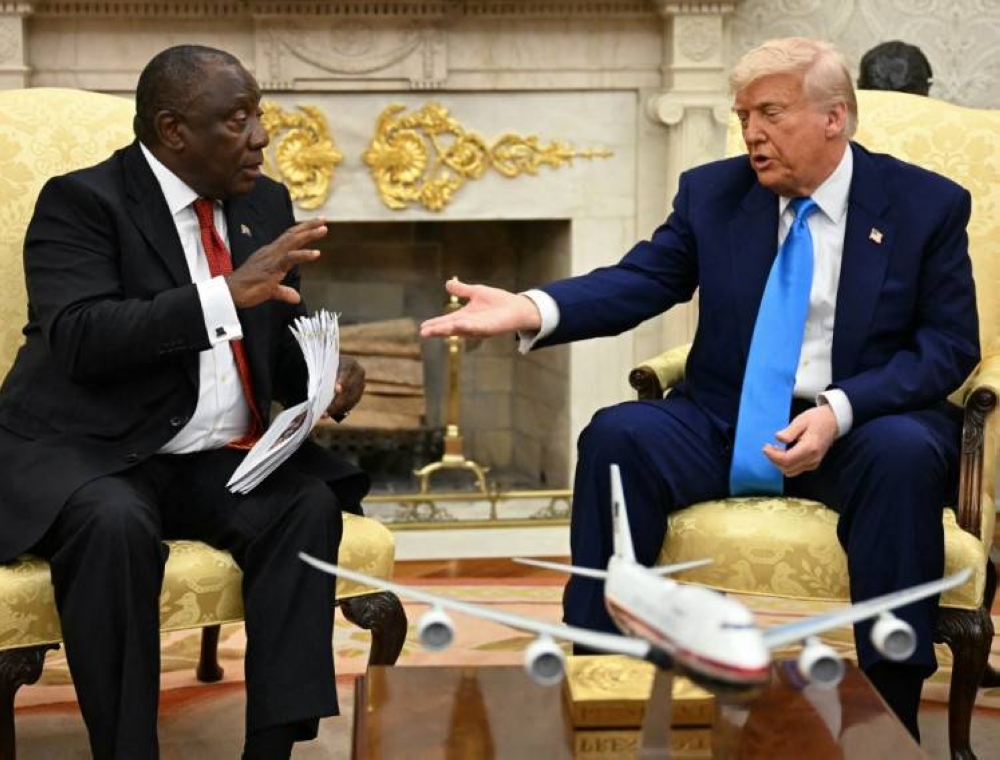
Facing a barrage of debunked claims from US President Donald Trump that white people were being persecuted in his country, South African President Cyril Ramaphosa remained composed, pushed back politely and even tried to joke with Trump.
Ramaphosa may have drawn on his experience as the African National Congress (ANC)’s lead negotiator in talks that led to the peaceful end of apartheid in 1994 during Wednesday’s televised confrontation in the Oval Office.
“His conduct was in keeping with the proud diplomatic tradition of President Nelson Mandela,” said the ANC, invoking the legacy of the revered liberation struggle leader and South Africa’s first black president.
Repeatedly interrupted by Trump, Ramaphosa calmly challenged claims that minority Afrikaners were the targets of a “white genocide”.
The once fringe theory has been exponentially amplified by Trump and his South African-born ally Elon Musk.
“There is criminality in our country. People who do get killed, unfortunately, through criminal activity are not only white people. Majority of them are black people,” said Ramaphosa.
The way he handled Trump’s onslaught was mostly drawing praise back home yesterday.
“President Ramaphosa did well to maintain a calm demeanour and he did well to stick to the facts as close as possible,” said author Pieter du Toit.
Political analyst Ralph Mathekga said Ramaphosa kept sight of the bigger picture and did not take the bait.
“There was never a sense of arrogance on the side of Ramaphosa. He managed his emotions in a tactful way,” he said.
Ramaphosa would have been braced for a hostile reception given Trump has cut aid to South Africa, threatened it with a 30% trade tariff under his “Liberation Day” regime, expelled its ambassador and offered refuge to Afrikaners based on claims of persecution that Ramaphosa’s government says are unfounded.
Expectations of what the visit might achieve were therefore measured.
“Few of those who watched the spectacle would have been left with the impression that SA-US relations are set to improve,” said Louw Nel, senior political analyst at Oxford Economics.
“The South African president ... is considered a master negotiator and his ability to charm audiences is well-known. But even he must be wondering if it was wise visiting the White House at this time,” he wrote in a note.
Ramaphosa, 72, rose to prominence during apartheid as a mining union leader.
After helping bring white minority rule to an end, he became a successful businessman before returning to frontline politics and becoming president in 2018.
His extensive network was evident in the Oval Office, where he was accompanied by luxury goods billionaire Johann Rupert, South Africa’s richest man, and by champion golfers Ernie Els and Retief Goosen.
“It was pragmatic of him to bring the golfers and Rupert, they are the sort of people Trump likes to speak with,” said Mathekga.
That pragmatism extended to inviting the three men and Agriculture Minister John Steenhuisen, all of whom are white, to address Trump, who listened to them without interrupting – in contrast to how he treated Ramaphosa.
“I’ll give it a 7/10 which is high for a Trump meeting,” said Phumzile van Damme, a former lawmaker from Steenhuisen’s party the Democratic Alliance, which is part of Ramaphosa’s coalition government.
“President Ramaphosa I’m sure wanted to avoid a Zelensky moment and that’s why he batted to Rupert and John (Steenhuisen),” she added, referring to Trump’s shouting match with Ukrainian President Volodymyr Zelensky in February.