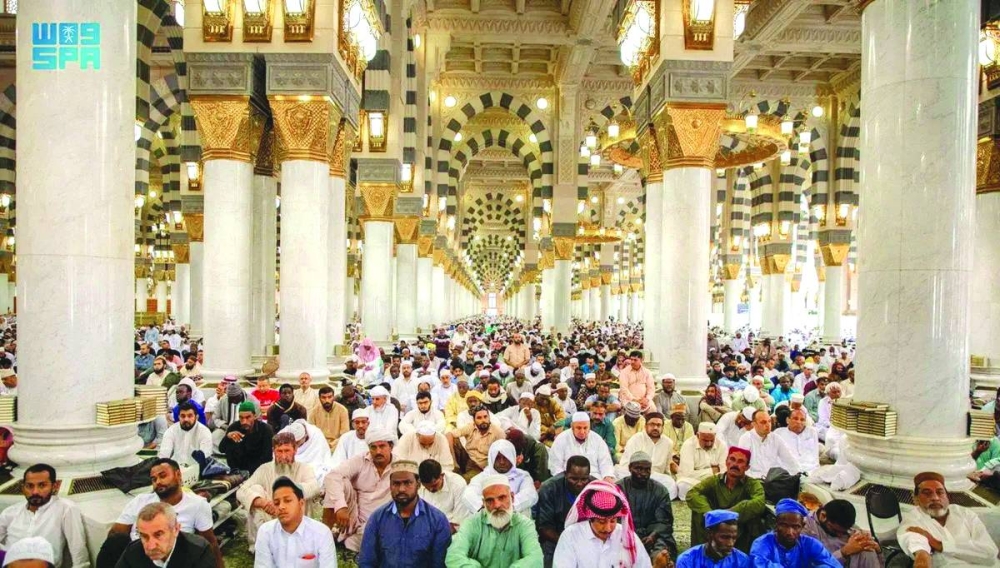
Enormous crowds of worshippers thronged Makkah, Islam’s holiest city, yesterday for the biggest Haj pilgrimage in years, with more than 2mn expected to brave the scorching Saudi Arabian heat.
Pilgrims in white robes and sandals packed the ancient city, now dotted with luxury hotels and air-conditioned shopping malls, after arriving on planes, buses and trains for the annual rites.
This year’s Haj — one of the world’s biggest annual religious gatherings — could break attendance records, officials said.
“As the Haj draws near, the Kingdom of Saudi Arabia prepares... for the largest Islamic gathering in history,” Minister of Haj and ‘Umrah Tawfiq al-Rabiah said in a video published by the ministry this week. More than 2mn people from more than 160 countries will attend, Rabiah said — a dramatic increase on the 926,000 from last year, when numbers were capped at 1mn following the Covid-19 pandemic. About 1.5mn pilgrims from abroad had already arrived by Wednesday evening, Saudi authorities have said.
In 2019, about 2.5mn people took part. Only 10,000 were allowed in 2020, at the height of the coronavirus pandemic, rising to nearly 59,000 a year later.
Travellers from around the world have been pouring into Jeddah’s modernised airport, some of them using streamlined visa services to disembark from planes straight onto buses to their accommodation.
Some 24,000 buses will be in service to ferry the pilgrims, as well as 17 trains capable of moving 72,000 people every hour, officials said.
“It is an unbelievable feeling that is very emotional,” Souad bin Oueis, a 60-year-old Moroccan pilgrim, said after arriving on her first visit to Saudi Arabia along with her husband.
This year, the maximum age limit has also been scrapped, meaning thousands of elderly will be among those contending with Saudi summer temperatures. The Haj rituals begin on Monday. The worshippers will spend Monday night in Mina tents and head to Mount Arafat on Tuesday, the climax of the Haj.
After casting pebbles in the “stoning of the devil” ritual on Wednesday, marking the start of the Eid al-Adha holiday, pilgrims return to Makkah to perform a farewell “tawaf” — circling seven times around the Ka’aba.
Makkah pilgrimages are a major source of income for Saudi Arabia, which is embarking on an ambitious plan to overhaul its largely oil-dependent economy. The Haj and year-round ‘Umrah rituals generate an estimated $12bn annually. An expansion project that involves scaling up infrastructure and transport supporting Makkah and Madinah, is a key part of the economic plan as the kingdom looks to increase visitor numbers.
More than 32,000 health workers will be on hand to help fend off heatstroke, dehydration and exhaustion.
Ahead of the Haj, security forces held a military parade in Makkah, including soldiers in full camouflage.
Umer Karim, a doctoral researcher focusing on Saudi foreign policy at Britain’s University of Birmingham, said hosting the Haj is a matter of prestige for Saudi rulers, the custodians of the holy sites.