


The European Central Bank cut interest rates further below zero and will start open-ended bond purchases after president Mario Draghi overcame critics of his stimulus policies to make a final run at reflating the euro-area economy.
The ECB reduced the deposit rate to minus 0.5% from minus 0.4%, while giving banks an exemption from the charge for some of their deposits after an outcry from lenders about the squeeze on profitability. It will buy debt at a pace of €20bn ($22bn) a month starting November 1.
“We have headroom to keep going on for some time at this rhythm,” Draghi, whose eight-year term ends next month, said at his press conference in Frankfurt. “We still think the probability of recession for the euro area is small, but it’s gone up.”
European government bonds rallied, led by a surge in Italian securities that sent 10-year yields to a record low, and credit spreads tightened. The dovish policy shift weighed on the euro, which weakened against its major counterparts, while the Stoxx Europe 600 Index rose to its highest level since July.
Italian lenders were among the biggest gainers in the Bloomberg European Banks index, after the ECB made its long-term loans cheaper.
“The risks surrounding the euro-area growth outlook remain tilted to the downside. These risks mainly pertain to the prolonged presence of uncertainties, related to geopolitical factors, the rising threat of protectionism and vulnerabilities in emerging markets,”
Draghi in his press conference yesterday.
The ECB also changed its guidance on interest rates to say they’ll stay at present or lower levels until the outlook for inflation “robustly” converges to its goal of just below 2%. It previously expected borrowing costs to stay unchanged until mid-2020. It also scrapped a 10-basis point rate premium previously attached to its long-term loan programme.
US President Donald Trump tweeted that the ECB is “acting quickly” while the Federal Reserve “sits, and sits, and sits.” He has previously cited loose ECB policy in his calls for the Fed to cut rates aggressively. Questioned on that tweet, Draghi said “we don’t target exchange rates. Period.”
The Fed is likely to lower borrowing costs next week for the second time this year, as central banks around the world ease to combat the spreading weakness.
The ECB’s announcement of a new stimulus package is a remarkable turn of events, just nine months after it signalled it was done with ever-looser policy. Now inflation is running at barely half the goal, and the manufacturing sector is in a contraction that risks spreading to the rest of the economy.
Hours before the decision, industrial-production figures showed the third quarter off to a weak start with eurozone output dropping 0.4% in July, more than expected. The decline was led by Germany, which is on the verge of a recession as a global slowdown in trade caused by the US-China standoff and the uncertainties surrounding Brexit hurts its exporters.
The approval of such broad measures is a win for Draghi in his penultimate meeting. Governors from core economies including Germany and the Netherlands pushed back against the resumption of quantitative easing, saying it should be a last resort in case the outlook worsens.
He acknowledged the “diversity of views” on asset purchases but said that “in the end the consensus was so broad there was no need to take a vote.” He also said there was “no appetite” to raise the self-imposed limits on how much debt the ECB can buy, a key sticking point among critics who see QE as blurring the line between monetary and fiscal policy.
Still, there are doubts the ECB’s latest measures will prove as effective as hoped. Longer-term bond yields have already fallen sharply because of the economic slowdown, and another round of debt purchases might not exert much more downward pressure.
Academics have questioned the effectiveness of negative rates, with a recent study published by the University of Bath finding they decreased lending. The fact that the latest rate cut is accompanied by exemptions to soften the impact on banks will fuel those concerns. Lenders say they’re forced to absorb most of the cost of negative rates, a charge on their overnight deposits at the central bank, because they can’t easily be passed onto ordinary customers.
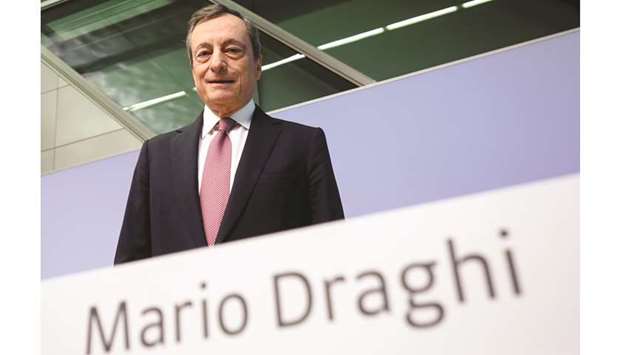
ECB president Mario Draghi attends a news conference on the outcome of the meeting of the Governing Council, in Frankfurt yesterday. The ECB reduced the deposit rate to minus 0.5% from minus 0.4%, while giving banks an exemption from the charge for some of their deposits after an outcry from lenders about the squeeze on profitability.