


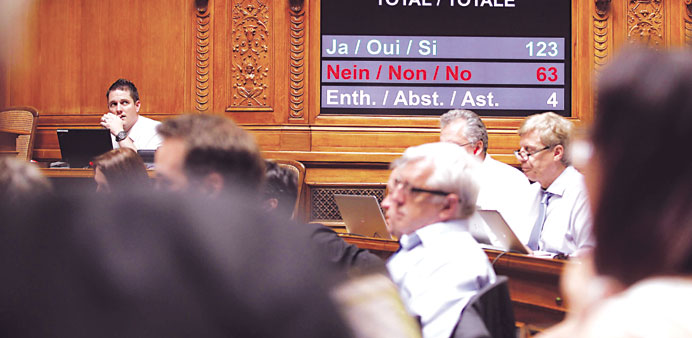
A display is seen yesterday after the Swiss National Council vote against the Swiss-US tax agreement in Bern.
DPA/Reuters/Basel, Switzerland
A bill that would have allowed Swiss banks to settle a major tax evasion dispute with the US was definitively defeated yesterday when the lower house of the nation’s parliament defeated it for the second time in two days.
The lower house had already voted the measure down on Tuesday.
Parliamentary procedure meant it then went back to the upper house, which approved it for a second time yesterday morning, before it returned to the lower house.
The second defeat means the government-drafted bill fails.
The new law would have made it possible for Swiss banks to provide information about tax-evading US clients to US authorities, which they are not allowed to do under current secrecy rules.
The US has offered 14 banks a deal, under which they would share information about foreign accounts and would have to pay fines, while evading criminal prosecution.
Many legislators in the parliament in Bern have warned that other countries would ask for similar deals and criticized that the amount of the fines has been kept secret by the US.
There is a risk that the US withdraws its offer, Swiss business law scholar Peter Kunz was quoted as saying by the Swiss daily Tages-Anzeiger, while acknowledging that it was unclear what yesterday’s decision means for the 14 banks that include Credit Suisse.
“No one knows. Neither the government, nor the banks, nor parliament. The US possibly don’t know, either,” he said.
Earlier yesterday, the Swiss parliamentary economics committee again urged the lower house to reject the draft law, recommending by 16 votes to nine that the lower house should refuse to debate the legislation.
The government’s attempt to fast-track the legislation through parliament to meet a US ultimatum angered many lawmakers in this fiercely independent country.
While right-wing lawmakers have opposed the bill on the grounds that it could set a precedent that might prompt other countries to seek similar concessions from Switzerland, the centre-left has rejected it on the grounds that Swiss banks should be forced to face the music for aiding tax evasion.
Switzerland’s biggest bank, UBS, was forced in 2009 to pay a fine of $780mn and deliver the names of more than 4,000 clients to avoid indictment, giving the US authorities information that allowed them to pursue other banks.
Since then, the government has been engaged in protracted negotiations to try to reach a settlement for the whole financial industry but has been hamstrung by Swiss secrecy laws and bickering among banks over who should pay the heavy fines.
The protection of client information has helped to make Switzerland the world’s biggest offshore financial centre, with $2tn in assets. But the haven has come under fire as other countries have sought to plug budget deficits by clamping down on tax evasion, with authorities probing Swiss banks in Germany and France as well as the US.
US authorities have more than a dozen banks under formal investigation, including Credit Suisse, Julius Baer, the Swiss arm of Britain’s HSBC, privately held Pictet in Geneva and local government-backed Zuercher Kantonalbank and Basler Kantonalbank.
An indictment felled Wegelin & Co this year. The bank paid a $58mn fine and closed its doors for good after pleading guilty to helping wealthy Americans evade taxes through secret accounts.
Swiss President and Finance Minister Eveline Widmer-Schlumpf warned on Tuesday that some banks might have to close down if they are indicted, as this would results in a cut-off from the dollar currency trade and from doing business in the US.
The affected banks can now ask the Swiss government to waive the secrecy rules on a case-by-case basis, but they have no guarantee that the government will be able to grant permission to provide all the data requested by the US.