


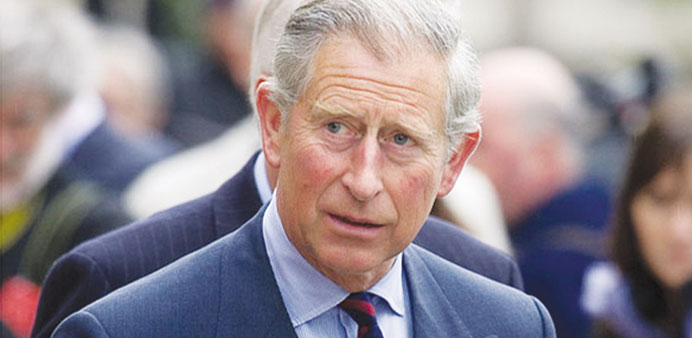
Guardian News and Media/London
Prince Charles has become embroiled in the parliamentary battle against tax avoidance after the powerful public accounts committee demanded the government justify tax exemptions enjoyed by his £728mn hereditary estate.
Margaret Hodge, who chairs the Commons committee that last year investigated tax avoidance by Google and Amazon and accused Starbucks of “immoral” behaviour, has asked ministers if they can still defend an arrangement that allows the Duchy of Cornwall not to pay corporation tax or capital gains tax on trading that last year provided Prince Charles with an £18.3m private income.
The public accounts committee (PAC) said it made the move after more than 30 MPs and members of the public complained about the duchy’s arrangements.
A full inquiry is likely to be launched into the matter, a committee source said.
The PAC is also likely to investigate the wider royal finances including public spending on the Queen and Prince Charles’s travel and official homes.
Hodge said she has written to Greg Clark, the financial secretary to the Treasury, stating that “in view of the committee’s and the public’s concern on this matter” he should clarify “why the tax treatment of the duchy remains defensible”.
“A lot of the work we are doing is around tax collection and this is another element the taxpayer has an interest in,” said Hodge.
“Taxpayers are concerned that everyone pays their fair share.” Any change to the duchy’s tax status threatens to reduce the annual surplus paid to the prince for his private and official spending.
The duchy asserts that the estate is “not a separate legal entity for tax purposes” allowing Charles to use its gross profits to fund his private and official spending including 26 valets, gardeners and farm staff.
In the past five years he has received more than £86mn from the arrangement.
Clarence House strongly denies any suggestion of tax avoidance. The duchy owns 53,000 hectares of land in 23 counties, including Prince Charles’s Gloucestershire home of Highgrove.
The PAC also wants the Treasury to explain “the impact of this favourable tax position on the duchy’s competitive position in markets in which it operates”.
A Clarence House spokesperson said: “The duchy is not a company and is not therefore liable to pay corporation tax. The prince voluntarily pays income tax on income generated by the duchy. Should the prince pay corporation tax as well, this would result in double taxation.”
It also said the duchy is exempt from capital gains tax, saying Charles is not entitled to capital gains and therefore it would not be appropriate for him to pay.
The duchy’s insistence that it should not pay corporation tax because it is indivisible from the Duke of Cornwall — currently Prince Charles — appears to have been challenged by a court ruling.
In late 2011 John Angel, principal judge at the information rights tribunal, who was tasked with deciding if the duchy should publish information about its environmental impact, ruled it must be considered a separate legal body from the prince because of “the differentiation of the duchy and duke in commercial and tax matters as well as under legislation and the contractual behaviour of the duchy”.