


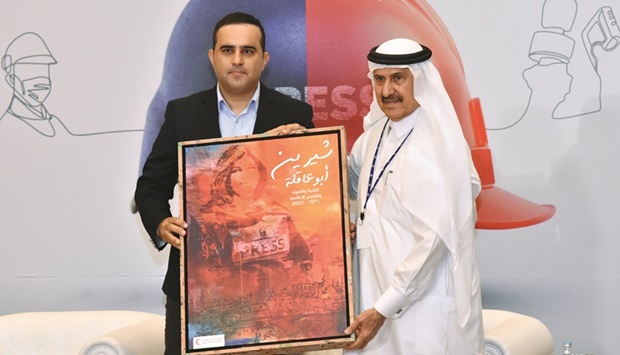
Qatar Red Crescent Society (QRCS) and the Al Jazeera Public Liberties and Human Rights Centre on Sunday held a regional symposium on 'Journalists and Humanitarian Workers: Present Situation and Challenges'.
It was held in co-operation with Al Jazeera Mubasher channel to mark the International Day of Charity.
During the symposium, the late Al Jazeera correspondent Shireen Abu Akleh was honoured.
In his opening remarks, Dr Mostefa Souag, acting director-general of Al Jazeera Media Network, said: “This symposium takes place on the eve of the International Day of Charity, which is celebrated by the world in order to enhance solidarity and joint action among media and charitable organisations. It plays a key role in enhancing the human dignity of victims of armed conflicts, natural disasters and extreme poverty."
During the symposium, the late Al Jazeera correspondent Shireen Abu Akleh was honoured.
In his opening remarks, Dr Mostefa Souag, acting director-general of Al Jazeera Media Network, said: “This symposium takes place on the eve of the International Day of Charity, which is celebrated by the world in order to enhance solidarity and joint action among media and charitable organisations. It plays a key role in enhancing the human dignity of victims of armed conflicts, natural disasters and extreme poverty."


He added, “This symposium is a reminder of legal protection standards promulgated by international conventions and treaties of international humanitarian law (IHL) and human rights. It looks at the challenges to the enforcement of such standards, given that journalists are civilians, and that attacks against them constitute war crimes, just like humanitarian aid workers."
Ali bin Hassan al-Hammadi, secretary-general of QRCS, said: “This symposium tackles a very important topic for those concerned with humanitarian action, human rights and International Humanitarian Law: shedding light on the violations threatening the safety and lives of journalists and field relief workers. It seeks also to re-emphasise the importance of compliance with the standards and warranties stipulated in international instruments and conventions to ensure the legal protection of journalists and humanitarian workers in conflict and/or disaster zones”.
Dr Omar Makki, regional adviser for IHL for the Middle East and North Africa at the International Committee of the Red Cross (ICRC), said: “It is crucial for IHL and Geneva Conventions to protect and respect journalists reporting news and relief workers delivering humanitarian aid so long as they are not engaged in hostilities."
Mamadou Sow, head of the ICRC regional delegation in the GCC, said: “This is an attempt to understand the challenges to the protection of civilians at times of war. We can see specific characteristics on the field. Conflicts are very complex and involve many actors and variables. Many conflicts are regional."
Dr Younis al-Khatib, president of Palestine Red Crescent Society (PRCS), gave examples of restrictions on PRCS personnel and other humanitarian organisations, as well as the tragedies revealed by psychological support programmes that treat civilians affected by human rights violations.
He explained, “All protected groups, including journalists, relief workers and civilians, are especially protected against attack under the legal framework of IHL, the Hague Conventions, and human rights law."
Dr Mohamed Salah Ibrahim, director of the Relief and International Development Division at QRCS, recalled, “Our office in Gaza was bombed on May 17, 2021, which halted the work and affected our personnel, but they managed to go ahead and continue to deliver aid to those in need."
Khadija Patel, chair for the International Press Institute (IPI), spoke about IPI’s 72-year history, working to ensure accountability for killings of hundreds of journalists every year and warned against impunity.
Guilherme Canela, chief of the Section of Freedom of Expression and Safety of Journalists at the United Nations Educational, Scientific and Cultural Organisation (Unesco), emphasised the importance of humanitarian aid during crises and disasters, as well as the protection of the press, which shares the reality with the world and rectifies misconceptions.
Ahmed Fal Ould Dine, senior reporter at Al Jazeera, described journalism as a form of humanitarianism, as it serves humanity by communicating reality as it is.
The symposium concluded with the following recommendations:
1. To emphasise the role of the media in contributing directly to shedding light on humanitarian crises and drawing the attention of decision-makers to the need for concerted efforts and mobilisation of as much international support as possible to protect journalists while performing their job.
2. Not only to focus on enacting new laws to protect journalists and relief workers, but also to call for implementing such laws and getting culprits punished, to avoid impunity, which would encourage more crimes.
3. To promote and raise awareness about IHL standards at all levels, especially among the parties to conflicts, as well as integrate such guarantees into national laws to help take war crimes reports to court.
4. To continue to work in order to alleviate the impact of war on those affected, as well as protect relief worker while helping them and journalists to get their voices heard and telling their stories to the world.
5. To call upon parties to conflicts to allow humanitarian corridors during crises, to deal with such situations in a purely humanitarian manner and launch emergency aid programmes without any political complications.
6. To stress that charitable work is apolitical for the interest of parties to conflicts, as well as to put an end to smear campaigns that stigmatise humanitarian work as non-neutral.
7. To seek integration between political and humanitarian intervention through humanitarian diplomacy, a beneficial strength for humanitarian action through reconciliation.
8. To recall that the right to freedom of expression is an integral part of human rights, just like the right to health and education.
9. To warn against concealing of facts or misinformation and to call for policies that protect journalists and help to strengthen the best practices of journalism.
10. To advise journalists to take necessary measures for personal protection, ensure their safety, and comply with professional editorial standards while doing their job, particularly where there are no governments and the situation is volatile, which makes their job even harder.