


Debt to finance companies’ plans to reduce pollution is likely the next phase in the environmental, social and governance-labelled debt markets in Canada, one of the world’s largest oil and natural gas producers.
Several companies are laying the groundwork to issue transition bonds by building frameworks, which typically detail criteria and investor disclosures needed to sell the debt, said Jonathan Hackett, head of sustainable finance and co-head of the Energy Transition Group at Bank of Montreal’s capital markets unit. The lender and Royal Bank of Canada advised Export Development Canada on a framework that enables the agency to eventually sell that type of debt, opening a path for other institutional borrowers considering it.
“Transition-label bonds are likely the next evolution,” Hackett said in an interview. “We hear from investors that there’s demand” for such instruments.
Canadian dollar ESG bond sales reached C$17.8bn ($13.7bn) so far this year, up from C$17.6bn in the same time period last year after CPPIB Capital, a unit of the country’s largest pension fund manager, raised C$1bn on August 24 by selling green bonds due in 2028. Among major developments this year, Canada’s federal government sold its inaugural green bond and Ontario Power Generation sold the country’s second nuclear-power green notes. More recently, UK’s Anglian Water Services Financing Plc became the first non-Canadian corporate issuer to sell green bonds in loonies and Capital Power sold the first green hybrid transaction in the Canadian currency.
Japanese oil driller Idemitsu Kosan Co Ltd and Italian natural gas distributor Snam SpA have issued transition bonds, which remain a small pocket of the ESG debt markets with around $15bn of such bonds issued worldwide since 2017, according to Bloomberg data. For context, sales of green bonds out of corporate and public sector issuers so far this year add up to almost $289bn. Transition bonds could be particularly meaningful in Canada as they can help industries such as oil and gas producers, the nation’s largest emitters of greenhouse gases, to incorporate technologies to reduce pollution. Apart from potential sales of transition bonds, institutional borrowers are also looking to a wide the range of programs to impact climate and social goals. For instance, Ontario, Canada’s largest issuer of green bonds, has been working for over a year on a sustainable debt programme.
Capital Power, a power producer that’s phasing out coal by the end of 2023, is considering adding a sustainability-linked bond framework, CFO Sandra Haskins said.
While proceeds from sustainability-linked bonds can be used as long-term financing for the issuer’s general funding needs, the debt’s interest rates face a potential step-up should the borrower fail to meet a target, such as a reduction of carbon emissions by a set date.
“There is an opportunity to look at that as part of our financing programme,” said Haskins in an interview last week. Such a transaction could potentially take place as early as next year, she said.
As the range of ethical securities is widening, investors are also working to more closely track how borrowers’ environmental plans such as net-zero emissions commitments are currently being implemented. Investment managers of over C$3tn of assets grouped in an initiative known as Climate Engagement Canada are reaching out to boards of some of Canada’s largest polluters.
The CEC, whose founding parties include RBC Global Asset Management and Manulife Investment Management, has contacted at least 25 out of a list of 40 Canadian-listed companies to establish communication in June and July, Daniel Fuentes, the group’s administrative director said in an e-mailed statement.
That’s on top of six Canadian companies including Enbridge Inc and Canadian Natural Resources Ltd which have been subject to the scrutiny of a global investor-led initiative known as Climate Action 100+, which inspired CEC.
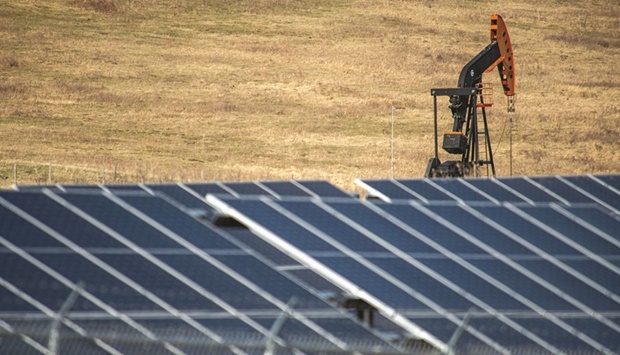
An oil pumpjack behind a bank of solar panels near Longview, Alberta, Canada. Debt to finance companies’ plans to reduce pollution is likely the next phase in the environmental, social and governance-labelled debt markets in Canada, one of the world’s largest oil and natural gas producers.