


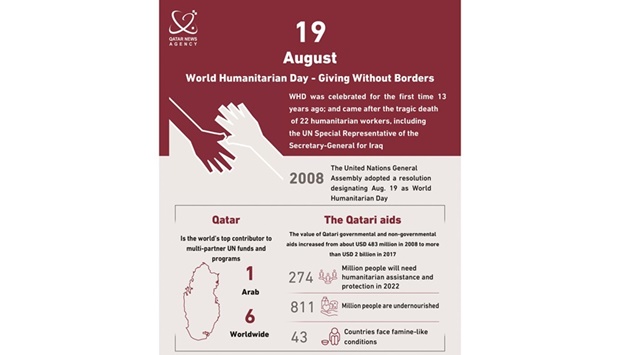
Qatar is celebrating, with the rest of the world on Friday, the World Humanitarian Day (WHD), which falls on August 19 each year. WHD was celebrated for the first time 13 years ago; and came after the tragic death of 22 humanitarian workers, including the UN Special Representative of the Secretary-General for Iraq Sergio Vieira de Mello, during a suicide attack on the United Nations compound in the Iraqi capital, Baghdad in 2003.
On 2008, the United Nations General Assembly (UNGA) adopted a resolution designating August 19 as World Humanitarian Day. Each year, WHD focuses on a theme, bringing together partners from across the humanitarian system to advocate for the survival, well-being and dignity of people affected by crises, and for the safety and security of aid workers.
With record-high humanitarian needs around the world, WHD 2022 builds on this metaphor of collective endeavour to grow global appreciation of humanitarian work. The WHD 2022 campaign shines a light on the thousands of volunteers, professionals and crisis-affected people who deliver urgent healthcare, shelter, food, protection, water and much more. In various situations and occasions, Qatar affirms its commitment to continue providing humanitarian support and contributing to international efforts to alleviate human suffering and other challenges facing humanity and move forward with the implementation of the sustainable development plan for 2022. Qatar is at the forefront of countries providing humanitarian and development assistance at the bilateral level, through the United Nations and in all regions of the world, especially for developing countries facing crises and natural disasters.
In light of Qatar's large humanitarian contributions, the State is a member of the Board of Directors of the UN Central Emergency Response Fund (CERF). Qatar is the world's top Arab and sixth largest contributor to multi-partner UN funds and programs -- it is also among the 10 largest contributors to the UN Office for the Coordination of Humanitarian Affairs (OCHA). The value of Qatari governmental and non-governmental aids increased from about $483mn in 2008 to more than $2bn in 2017. In 2020, the total fund committed by Qatar reached more than $533mn, by allocating fund for the benefit of many partners in the field of development and humanitarian aid. In 2019 it was more than $577mn.
The total contributions of Qatar Fund for Development to support and relief operations in 2021 exceeded $550mn. According to UN reports, a total of 274mn people will need humanitarian assistance and protection in 2022. This number is a significant increase from the 235mn people who were in need in 2021, which was already the highest number in decades. The UN and partner organisations aim to assist 183mn people in need in 63 countries, which would require $41bn.
The UN is grateful for the generous contributions of donors who provide unearmarked or core funding to humanitarian partners. Humanitarian aid covers many areas suffering from crises and disasters, including Yemen, Syria, Iraq, the occupied Palestinian territories, Sudan, South Sudan, Somalia, Afghanistan, the Democratic Republic of the Congo, Ethiopia, Nigeria, Venezuela, and Myanmar. Under-Secretary-General for Humanitarian Affairs and Emergency Relief Coordinator Martin Griffiths says that 2021 was a challenging and rewarding year as humanitarian needs continued to increase, driven by conflicts, the climate crisis, and Covid-19, noting that children in particular have missed out on the opportunity to learn, while multiple famines loomed.
The Under-Secretary-General added that the lives and livelihoods of individuals, national and regional stability, and decades of development are in danger, warning that the cost of inaction to meet these challenges would be prohibitive. Griffiths also noted that 2021 had seen the humanitarian system progress up to the challenge, overcoming seemingly insurmountable obstacles, and demonstrating the international community's ability to act when in solidarity. Thanks to the generous donors, the humanitarian system has provided food, medicine, health care, and other essential assistance to 107mn people with humanitarian action receiving hundreds of millions of dollars in cash assistance directed to people struggling to survive, Griffiths noted, emphasising that the challenges are enormous, and that funding is still far short of what is needed.
International reports warn that without sustainable and urgent action, 2022 may become catastrophic. The Covid-19 pandemic has destroyed economies and livelihoods in many regions, which has led to increased humanitarian needs and fueled conflict, in addition to hunger and food insecurity which reached unimaginable levels. Almost 811mn people are undernourished, while famine-like conditions in 43 countries seem possible.
More than 1% of the world's population is displaced, and about 42% of them are children. By 2050, 216mn people may be forced to move within their own countries due to the effects of climate change. One in 29 people around the world needs help, while the proportion during the year 2020 was one in every 33 and one in every 45 needed help in 2019.
On 2008, the United Nations General Assembly (UNGA) adopted a resolution designating August 19 as World Humanitarian Day. Each year, WHD focuses on a theme, bringing together partners from across the humanitarian system to advocate for the survival, well-being and dignity of people affected by crises, and for the safety and security of aid workers.
With record-high humanitarian needs around the world, WHD 2022 builds on this metaphor of collective endeavour to grow global appreciation of humanitarian work. The WHD 2022 campaign shines a light on the thousands of volunteers, professionals and crisis-affected people who deliver urgent healthcare, shelter, food, protection, water and much more. In various situations and occasions, Qatar affirms its commitment to continue providing humanitarian support and contributing to international efforts to alleviate human suffering and other challenges facing humanity and move forward with the implementation of the sustainable development plan for 2022. Qatar is at the forefront of countries providing humanitarian and development assistance at the bilateral level, through the United Nations and in all regions of the world, especially for developing countries facing crises and natural disasters.
In light of Qatar's large humanitarian contributions, the State is a member of the Board of Directors of the UN Central Emergency Response Fund (CERF). Qatar is the world's top Arab and sixth largest contributor to multi-partner UN funds and programs -- it is also among the 10 largest contributors to the UN Office for the Coordination of Humanitarian Affairs (OCHA). The value of Qatari governmental and non-governmental aids increased from about $483mn in 2008 to more than $2bn in 2017. In 2020, the total fund committed by Qatar reached more than $533mn, by allocating fund for the benefit of many partners in the field of development and humanitarian aid. In 2019 it was more than $577mn.
The total contributions of Qatar Fund for Development to support and relief operations in 2021 exceeded $550mn. According to UN reports, a total of 274mn people will need humanitarian assistance and protection in 2022. This number is a significant increase from the 235mn people who were in need in 2021, which was already the highest number in decades. The UN and partner organisations aim to assist 183mn people in need in 63 countries, which would require $41bn.
The UN is grateful for the generous contributions of donors who provide unearmarked or core funding to humanitarian partners. Humanitarian aid covers many areas suffering from crises and disasters, including Yemen, Syria, Iraq, the occupied Palestinian territories, Sudan, South Sudan, Somalia, Afghanistan, the Democratic Republic of the Congo, Ethiopia, Nigeria, Venezuela, and Myanmar. Under-Secretary-General for Humanitarian Affairs and Emergency Relief Coordinator Martin Griffiths says that 2021 was a challenging and rewarding year as humanitarian needs continued to increase, driven by conflicts, the climate crisis, and Covid-19, noting that children in particular have missed out on the opportunity to learn, while multiple famines loomed.
The Under-Secretary-General added that the lives and livelihoods of individuals, national and regional stability, and decades of development are in danger, warning that the cost of inaction to meet these challenges would be prohibitive. Griffiths also noted that 2021 had seen the humanitarian system progress up to the challenge, overcoming seemingly insurmountable obstacles, and demonstrating the international community's ability to act when in solidarity. Thanks to the generous donors, the humanitarian system has provided food, medicine, health care, and other essential assistance to 107mn people with humanitarian action receiving hundreds of millions of dollars in cash assistance directed to people struggling to survive, Griffiths noted, emphasising that the challenges are enormous, and that funding is still far short of what is needed.
International reports warn that without sustainable and urgent action, 2022 may become catastrophic. The Covid-19 pandemic has destroyed economies and livelihoods in many regions, which has led to increased humanitarian needs and fueled conflict, in addition to hunger and food insecurity which reached unimaginable levels. Almost 811mn people are undernourished, while famine-like conditions in 43 countries seem possible.
More than 1% of the world's population is displaced, and about 42% of them are children. By 2050, 216mn people may be forced to move within their own countries due to the effects of climate change. One in 29 people around the world needs help, while the proportion during the year 2020 was one in every 33 and one in every 45 needed help in 2019.