


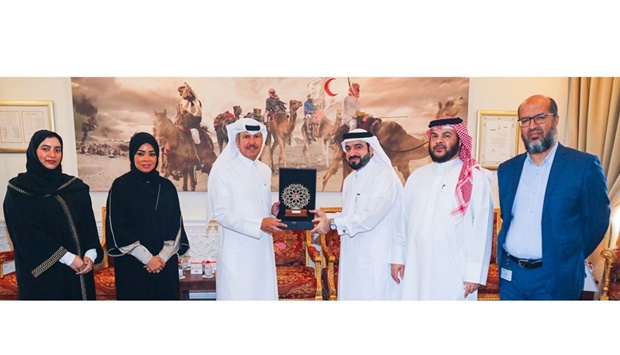
Qatar Red Crescent Society (QRCS) is partnering with ExxonMobil Qatar to the school community. QRCS CEO Faisal Mohamed al-Emadi has received ExxonMobil Qatar's Government and Public Affairs vice-president and director Saleh bin Saad al-Mana in this connection.
They discussed the outcomes of bilateral cooperation, joint projects in various areas of QRCS’s work, its local and international services, last year’s achievements, and future plans, especially in relation to local and community development activities, a statement said.
ExxonMobil Qatar had provided support to the QRCS School Programme during the academic year 2021-2022, aimed at investing in the youth, with training courses and educational lectures to protect the school and local communities, create a new generation equipped to deal with risks and accidents, and promote a culture of first aid in case of injury.
Since the beginning of the current academic year, the QRCS School Programme’s team has carried out first-aid training and health education lectures at 68 schools across the country. More than 2,800 students and teachers learned about the principles of first aid and how to provide emergency care for oneself and others.
Under an agreement with the Ministry of Education and Higher Education (MoEHE), staff of the ministry’s Health and Safety Department are trained to obtain paramedic licensing, which is accredited by the Ministry of Public Health (MoPH).
According to the plan agreed upon with ExxonMobil Qatar, the second part of the program, the 'Safe School', will be resumed by the beginning of the academic year 2022-2023. Its target is to train more than 5,000 students in preparedness for earthquakes and disasters, amid strict precautionary measures to ensure maximum safety and health protection.
Al-Emadi said he was proud of the strong partnership and fruitful cooperation with ExxonMobil Qatar, describing it as a major contributor to humanitarianism, sponsoring many of QRCS’s development and social activities.
“QRCS and ExxonMobil Qatar share the same vision of community development that is based on transfer of knowledge, volunteerism, constant pursuit of excellence, and youth capacity-building in various fields, towards the community of awareness sought by Qatar National Vision 2030,” he added.
Al-Mana said ExxonMobil Qatar is pleased to work with QRCS on its school programme, which will allow 10,000 students, educators, and administrative staff at 100 schools to gain the skills and knowledge that ensure their preparedness to respond to any incident within their community.
“We have been working with QRCS since 2010, mostly in education, inspired by our national strategy of community outreach, as well as our firm commitment to contributing to the goals of Qatar National Vision 2030. We are proud to be part of the success of such effective and far-reaching initiatives, which would help empower a resourceful generation that can overcome future challenges”.
Accredited by MoEHE, the QRCS School Programme provides extracurricular activities to give school students the set of preventive skills that will last throughout their academic, social, and professional lives. Every year, it receives applications from many schools to train their students, teachers, and administrative staff in these skills, given their importance for the protection of student, teachers, staff, and the public.
It involves two aspects: (1) Health Component (first-aid training and health education) and (2) “Safe School" (risk reduction, disaster response, and promotion of safety standards in case of earthquake).
ExxonMobil Qatar had provided support to the QRCS School Programme during the academic year 2021-2022, aimed at investing in the youth, with training courses and educational lectures to protect the school and local communities, create a new generation equipped to deal with risks and accidents, and promote a culture of first aid in case of injury.
Since the beginning of the current academic year, the QRCS School Programme’s team has carried out first-aid training and health education lectures at 68 schools across the country. More than 2,800 students and teachers learned about the principles of first aid and how to provide emergency care for oneself and others.
Under an agreement with the Ministry of Education and Higher Education (MoEHE), staff of the ministry’s Health and Safety Department are trained to obtain paramedic licensing, which is accredited by the Ministry of Public Health (MoPH).
According to the plan agreed upon with ExxonMobil Qatar, the second part of the program, the 'Safe School', will be resumed by the beginning of the academic year 2022-2023. Its target is to train more than 5,000 students in preparedness for earthquakes and disasters, amid strict precautionary measures to ensure maximum safety and health protection.
Al-Emadi said he was proud of the strong partnership and fruitful cooperation with ExxonMobil Qatar, describing it as a major contributor to humanitarianism, sponsoring many of QRCS’s development and social activities.
“QRCS and ExxonMobil Qatar share the same vision of community development that is based on transfer of knowledge, volunteerism, constant pursuit of excellence, and youth capacity-building in various fields, towards the community of awareness sought by Qatar National Vision 2030,” he added.
Al-Mana said ExxonMobil Qatar is pleased to work with QRCS on its school programme, which will allow 10,000 students, educators, and administrative staff at 100 schools to gain the skills and knowledge that ensure their preparedness to respond to any incident within their community.
“We have been working with QRCS since 2010, mostly in education, inspired by our national strategy of community outreach, as well as our firm commitment to contributing to the goals of Qatar National Vision 2030. We are proud to be part of the success of such effective and far-reaching initiatives, which would help empower a resourceful generation that can overcome future challenges”.
Accredited by MoEHE, the QRCS School Programme provides extracurricular activities to give school students the set of preventive skills that will last throughout their academic, social, and professional lives. Every year, it receives applications from many schools to train their students, teachers, and administrative staff in these skills, given their importance for the protection of student, teachers, staff, and the public.
It involves two aspects: (1) Health Component (first-aid training and health education) and (2) “Safe School" (risk reduction, disaster response, and promotion of safety standards in case of earthquake).