


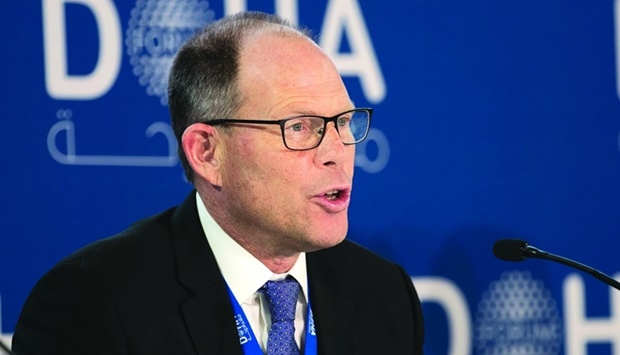
The world is not yet ready to tackle a future pandemic equitably within its systems, noted the Bill and Melinda Gates Foundation CEO Mark Suzman in a panel discussion on the distribution of Covid-19 vaccines at this year’s Doha Forum.
“Health inequity is not new. There was a vision early on to make Covid-19 the first global health crisis dealt with equitably. We can now say that vision has failed and we are still not ready to tackle a future pandemic equitably within our systems, ” he said.
The panel, hosted by the World Innovation Summit for Health (WISH) discussed ways in which public and private sectors can collaborate to address vaccine inequality, the threats that it poses to vulnerable communities, and ways to tackle vaccine hesitancy.
Dr Jerome Kim, director general of the International Vaccine Institute, chaired the panel and highlighted the importance of building capacity locally for vaccine production to help achieve an equitable system for the distribution of vaccines around the world.
Even as global vaccination rates continue to rise, the gap between developed and developing nations remains stark. More than 7bn doses have been administered globally, but just a small percentage of those have gone to people in poorer countries, according to the World Health Organisation (WHO).
Also speaking on the panel was Carl Bildt, Sweden’s former prime minister, and the current WHO Special Envoy for the Access to Covid-19 Tools Accelerator (ACT-Accelerator), a major multi-stakeholder framework aimed at achieving equitable access to Covid-19 health technologies. He said: “The pandemic has provided us with a success of science and a failure of politics that has left us with vast vaccine inequity.”
Lady Roslyn Morauta, vice-chair of the Board of The Global Fund to Fight Aids, Tuberculosis and Malaria, which mobilises and invests more than $4bn donated by governments and other public and private organisations annually, set out the important role that people and communities can play in promoting vaccine equity within their own environments.
The panel, hosted by the World Innovation Summit for Health (WISH) discussed ways in which public and private sectors can collaborate to address vaccine inequality, the threats that it poses to vulnerable communities, and ways to tackle vaccine hesitancy.
Dr Jerome Kim, director general of the International Vaccine Institute, chaired the panel and highlighted the importance of building capacity locally for vaccine production to help achieve an equitable system for the distribution of vaccines around the world.
Even as global vaccination rates continue to rise, the gap between developed and developing nations remains stark. More than 7bn doses have been administered globally, but just a small percentage of those have gone to people in poorer countries, according to the World Health Organisation (WHO).
Also speaking on the panel was Carl Bildt, Sweden’s former prime minister, and the current WHO Special Envoy for the Access to Covid-19 Tools Accelerator (ACT-Accelerator), a major multi-stakeholder framework aimed at achieving equitable access to Covid-19 health technologies. He said: “The pandemic has provided us with a success of science and a failure of politics that has left us with vast vaccine inequity.”
Lady Roslyn Morauta, vice-chair of the Board of The Global Fund to Fight Aids, Tuberculosis and Malaria, which mobilises and invests more than $4bn donated by governments and other public and private organisations annually, set out the important role that people and communities can play in promoting vaccine equity within their own environments.