


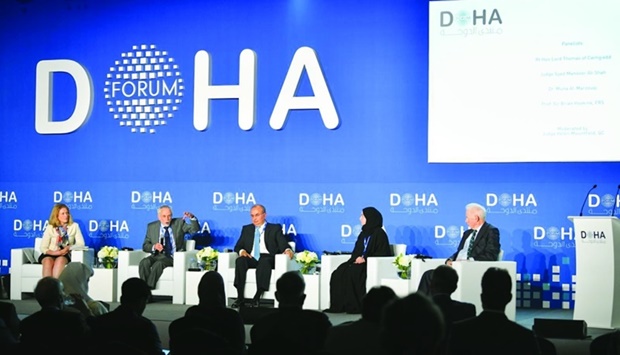
The Qatar International Court and Dispute Resolution Centre (QICDRC) held a panel discussion titled ‘Litigation to Enforcement: Mobilising the Rule of Law in Response to the Climate Crisis’ at the 20th edition of the Doha Forum Sunday.
Addressing one of this year’s Doha Forum focus areas, climate change, and sustainability, the panellists discussed the importance of enforcement of environmental laws to mitigate the global effects of climate change.
On the future of greenhouse gas emissions, Professor Sir Brian Hoskins, Royal Society fellow and chair of the Grantham Institute for Climate Change at Imperial College London, said: “Net-zero is the only way to stop the global temperature increase, which would effectively cause sea levels to rise for centuries.”
Justice Syed Mansoor Ali Shah, former chief justice of the Lahore High Court and presently a justice of the Supreme Court of Pakistan, noted: “Science must come into the courtroom if we are to deal with climate change cases. A failure to implement these policies would affect the right to life and dignity.”
Dr Muna al-Marzouqi, a judge of the QFC Regulatory Tribunal, commented: “Private sectors have to protect human rights, including the right to a healthy and safe environment for current and future generations.” Lord Thomas of Cwmgiedd, president of the Court, added that a “delivery of promises for change can only come about through the Rule of Law.”
QICDRC’s participation at the Doha Forum is part of its ongoing engagement with local and international leaders and policymakers to jointly find solutions that can uphold the rule of law, as well as promote public trust in the legal, regulatory and judicial environment.
Addressing one of this year’s Doha Forum focus areas, climate change, and sustainability, the panellists discussed the importance of enforcement of environmental laws to mitigate the global effects of climate change.
On the future of greenhouse gas emissions, Professor Sir Brian Hoskins, Royal Society fellow and chair of the Grantham Institute for Climate Change at Imperial College London, said: “Net-zero is the only way to stop the global temperature increase, which would effectively cause sea levels to rise for centuries.”
Justice Syed Mansoor Ali Shah, former chief justice of the Lahore High Court and presently a justice of the Supreme Court of Pakistan, noted: “Science must come into the courtroom if we are to deal with climate change cases. A failure to implement these policies would affect the right to life and dignity.”
Dr Muna al-Marzouqi, a judge of the QFC Regulatory Tribunal, commented: “Private sectors have to protect human rights, including the right to a healthy and safe environment for current and future generations.” Lord Thomas of Cwmgiedd, president of the Court, added that a “delivery of promises for change can only come about through the Rule of Law.”
QICDRC’s participation at the Doha Forum is part of its ongoing engagement with local and international leaders and policymakers to jointly find solutions that can uphold the rule of law, as well as promote public trust in the legal, regulatory and judicial environment.