


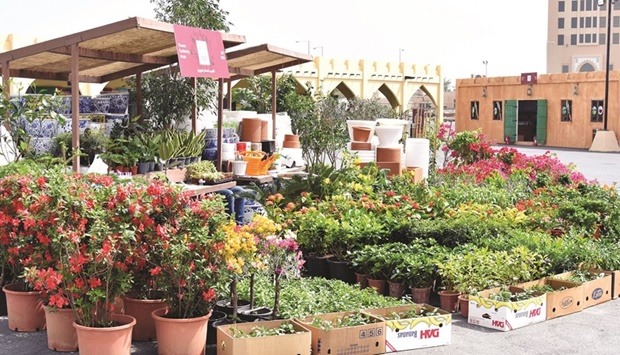
The sixth edition of Mahaseel Festival got under way on Monday at the southern area of Katara - the Cultural Village.
Organised by Katara in co-operation with the Agricultural Affairs Department of the Ministry of Municipality will run until March 12.
The opening ceremony was attended by Katara General Manager Dr Khalid bin Ibrahim al-Sulaiti, Director of the Agricultural Affairs DepartmentYousuf Khalid al-Khulaifi, Chairman of the festival organising committee Salman al-Nuaimi, a number of Qatari farm owners, and representatives of participating national companies.
The festival will be attended by 38 companies, including 25 local farms and seven national companies specialised in poultry, meat, and dairy, and seven nurseries, and will run until March 12 and will then continue on Thursdays, Fridays and Saturdays until May 15 from 9am to 9pm.
The General Manager of Katara said the cultural village is keen to support and promote local agricultural and food products that meet the highest quality and competitive standards, praising the Qatari farms and national companies taking part in the festival.
He also said that the Mahaseel Festival confirms Katara's continued support and encouragement to farmers to market their products, noting that Katara has provided farmers with a forum to exchange experiences, which will contribute to the development of local agricultural production.
In a statement to Qatar News Agency (QNA), the Director of the Agricultural Affairs Department al-Khulaifi said that the festival is held in co-operation between Katara and the Ministry of Municipality, stressing the ministry's keenness to participate and co-ordinate with Katara, for a number of reasons, including Katara's status as a distinct tourist destination, in addition to providing all the requirements of the offer and its method.
He said that local products are of high quality, pointing out that the Mahaseel Festival is a platform for marketing the national products including vegetables, dates, poultry, meat, milk, and dairy products.
Salman al-Nuaimi said that due to the precautionary measures in place in the country to prevent the spread of Covid-19, all workshops and artistic activities that accompany the market each year, including children's games, are cancelled and limited to the buying and selling process.
Since the early hours of its opening, the festival has seen large numbers of visitors, particularly with many varieties of fresh vegetables, dates, and honey, sheep meat, cows, calves, eggs, poultry, milk and its derivatives, as well as platforms of eight nurseries showcasing their products of flowers, roses, and ornamental plants, where participants compete in marketing methods, presentations, and packaging.
Festival organisers are counting on the festival to achieve its objectives and highlight the importance of diverse and growing agricultural and food products and contribute to the marketing of Qatari farm products, which have achieved their wide fame and good reputation at competitive prices, in light of the continued support for agriculture, local food production and livestock, in an effort to achieve sustainability in this vital economic sector, provide self-sufficiency and support food security in the country, as well as increase the size and quality of local production.(QNA)
The opening ceremony was attended by Katara General Manager Dr Khalid bin Ibrahim al-Sulaiti, Director of the Agricultural Affairs DepartmentYousuf Khalid al-Khulaifi, Chairman of the festival organising committee Salman al-Nuaimi, a number of Qatari farm owners, and representatives of participating national companies.
The festival will be attended by 38 companies, including 25 local farms and seven national companies specialised in poultry, meat, and dairy, and seven nurseries, and will run until March 12 and will then continue on Thursdays, Fridays and Saturdays until May 15 from 9am to 9pm.
The General Manager of Katara said the cultural village is keen to support and promote local agricultural and food products that meet the highest quality and competitive standards, praising the Qatari farms and national companies taking part in the festival.
He also said that the Mahaseel Festival confirms Katara's continued support and encouragement to farmers to market their products, noting that Katara has provided farmers with a forum to exchange experiences, which will contribute to the development of local agricultural production.
In a statement to Qatar News Agency (QNA), the Director of the Agricultural Affairs Department al-Khulaifi said that the festival is held in co-operation between Katara and the Ministry of Municipality, stressing the ministry's keenness to participate and co-ordinate with Katara, for a number of reasons, including Katara's status as a distinct tourist destination, in addition to providing all the requirements of the offer and its method.
He said that local products are of high quality, pointing out that the Mahaseel Festival is a platform for marketing the national products including vegetables, dates, poultry, meat, milk, and dairy products.
Salman al-Nuaimi said that due to the precautionary measures in place in the country to prevent the spread of Covid-19, all workshops and artistic activities that accompany the market each year, including children's games, are cancelled and limited to the buying and selling process.
Since the early hours of its opening, the festival has seen large numbers of visitors, particularly with many varieties of fresh vegetables, dates, and honey, sheep meat, cows, calves, eggs, poultry, milk and its derivatives, as well as platforms of eight nurseries showcasing their products of flowers, roses, and ornamental plants, where participants compete in marketing methods, presentations, and packaging.
Festival organisers are counting on the festival to achieve its objectives and highlight the importance of diverse and growing agricultural and food products and contribute to the marketing of Qatari farm products, which have achieved their wide fame and good reputation at competitive prices, in light of the continued support for agriculture, local food production and livestock, in an effort to achieve sustainability in this vital economic sector, provide self-sufficiency and support food security in the country, as well as increase the size and quality of local production.(QNA)