


• Biden unveils sanctions on Russian businesses
• EU leaders agree ‘sanctions that bite’ Russia
President Joe Biden hit Russia with a wave of sanctions yesterday after Moscow invaded Ukraine, measures that impede Russia’s ability to do business in major currencies along with sanctions against banks and state-owned enterprises.
Meanwhile, EU leaders gathered for an emergency summit yesterday agreed to punish Russia for its invasion of Ukraine with “severe” sanctions targeting its financial, energy and transport sectors.
During White House remarks and answers to reporters’ questions, Biden described Russian President Vladimir Putin as an aggressor with a “sinister vision of the world” and a misguided dream of recreating the Soviet Union.
However, he held back for now from imposing sanctions on Putin himself and from disconnecting Russia from the SWIFT international banking system, amid differences between the United States and its allies over how far to go at this juncture and criticism at home that he should have done more.
Biden said that there is now a complete rupture in US-Russian relations if Moscow continues on the path it is on, and that more sanctions are being planned.
Ukrainian forces battled Russian invaders on three sides yesterday after Moscow mounted an assault by land, sea and air, prompting tens of thousands of people to flee their homes.
After Putin declared war in a pre-dawn televised address, explosions and gunfire were heard throughout the morning in Kyiv, a city of 3mn people.
Missiles rained down on Ukrainian targets and authorities reported columns of troops pouring across Ukraine’s borders from Russia and Belarus to the north and east, and landing on the southern coasts from the Black Sea and Azov Sea.
“This is a premeditated attack,” Biden said. “Putin is the aggressor. Putin chose this war. And now he and his country will bear the consequences.”
As the assault began, President Volodymyr Zelenskiy declared martial law and accused Russia of acting like “Nazi Germany” – but asked people not to panic and promised victory.
He called on Ukrainians to defend their country and said arms would be given to anyone prepared to fight.
“What we have heard today are not just missile blasts, fighting and the rumble of aircraft,” he said. “This is the sound of a new Iron Curtain, which has come down and is closing Russia off from the civilised world.”
Biden said the sanctions were designed to have a long-term impact on Russia and to minimise the impact on the United States and its allies.
And he said Washington is prepared to do more.
The steps included targeting five major Russian banks, including state-backed Sberbank and VTB, as well as members of the Russian elite and their families.
Sberbank, Russia’s largest lender, will no longer be able to transfer money with the assistance of US banks.
The sanctions are aimed at limiting Russia’s ability to do business in dollars, euros, pounds and yen, Biden said.
The White House also announced sweeping export restrictions against Russia aimed at restricting its access to global exports of everything from commercial electronics and computers to semiconductors and aircraft parts.
Biden said that the North Atlantic Treaty Organisation (Nato) would meet today to map out further measures.
He reiterated that the United States would not engage in war with Russia, but that it would meet its Article 5 commitments to defend Nato partners.
Biden said this was “a dangerous moment for all of Europe” and that he had authorised troops that had been placed on standby to deploy to Germany.
He declined to comment on whether he would urge China to join the West’s drive to isolate Russia.
“Putin’s aggression against Ukraine will end up costing Russia dearly,” Biden said. “Putin will be a pariah on the international stage.”
The US president met with his counterparts from the Group of Seven allies earlier yesterday to map out more severe measures against Russia after Putin launched the attack.
Biden, who spoke with Ukrainian President Zelenskiy late on Wednesday, also convened his National Security Council yesterday to discuss the situation.
His announcement represented the second major tranche of sanctions against Russia since Putin earlier this week declared two breakaway regions of Ukraine independent and sent troops there.
The United States had warned it would initiate waves of sanctions against Moscow if it further invaded Ukraine, and Russia’s full-on military assault launched yesterday led to the latest round of Western penalties.
Britain unveiled new measures targeting banks, members of Putin’s inner circle and the very wealthy who enjoy high-rolling London lifestyles.
Prime Minister Boris Johnson told parliament that leaders had agreed to work together to “maximise the economic price” Putin will pay.
On Wednesday Washington imposed sanctions on the company in charge of building Russia’s Nord Stream 2 gas pipeline, and on Tuesday it sanctioned two large Russian financial institutions and Russian sovereign debt along with some members of the Russian elite and their family members.
In Brussels, Belgian Prime Minister Alexander De Croo said “we need sanctions that bite” as he went into the meeting of EU leaders.
The leaders quickly agreed “further restrictive measures that will impose massive and severe consequences on Russia for its action”.
Summit conclusions published at the start of the meeting said “these sanctions cover the financial sector, the energy and transport sectors, dual-use goods as well as export and export financing, visa policy”, as well as adding more Russian individuals to an EU travel ban and asset freeze list.
The sanctions – which come on the heels of a smaller packet of measures adopted by the EU late on Wednesday, just before the Russian invasion – will come into effect once legal texts are drawn up and formally approved by member states’ envoys and published in the EU’s official journal.
That was expected to happen as early as today.
After the conclusions were published, the summit continued with the leaders discussing how to ramp up political, economic and humanitarian support for Ukraine.
Earlier, European Commission President Ursula von der Leyen said the proposed sanctions package aims to hobble economic growth in Russia, make borrowing more costly, raise inflation, intensify capital outflows and “gradually erode its industrial base”.
The EU also agreed to prepare fresh sanctions against Belarus for serving as a launchpad for part of Moscow’s assault on Ukraine.
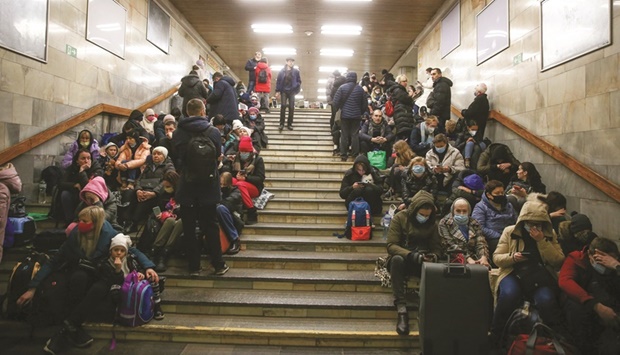
People take shelter in a subway station in Kyiv after Russian President Vladimir Putin authorised a military operation in eastern Ukraine.