


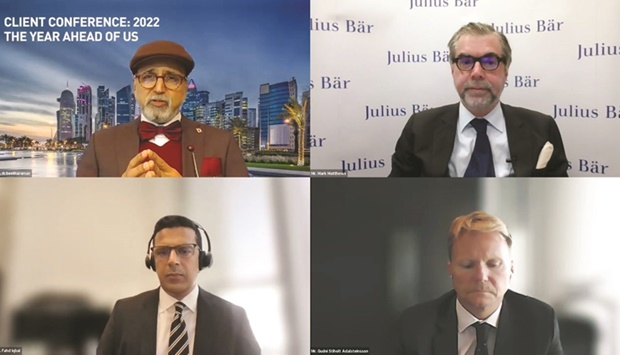
Growth forecasts on GCC economies have taken off due to effective vaccination drives and high oil prices, an industry expert has said during a virtual client conference hosted recently by Doha Bank.
Under the theme ‘2022 – The Year Ahead of Us’, Fahd Iqbal, head of Middle East Research at Credit Suisse, stated that fiscal balances are also expected to improve and that the GCC monetary environment “remains loose with lending activity health and improving.”
He said, “The real interest rates continue to contract. The inflation in GCC is picking up and dependence of food imports is a risk. The GCC has continued to strongly outperform EMs. The valuations are no longer cheap. Foreign inflows are robust but mostly passive.
“In Qatar, long-term Capex is the key; carbon prices are important for equities. In Saudi Arabia, the Shareek programme bodes positively, and significant growth potential in Capex spending. In the UAE, Dubai is cementing its position as a regional hub, enjoying a strong post-Covid recovery and Abu Dhabi is ramping up oil production capacity.”
Mark Matthews, head of research for Asia at Julius Baer, said the Bank of America Fund Survey indicated that hawkish central bank rate hikes, inflation, and asset bubbles are the biggest perceived risks.
“The market looks for 6.4 hikes of 25 basis points to the Fed Funds rate this year, which would take it to 1.85%. Covid is still the chief reason, directly or indirectly, for the rise in inflation. In the US, cases are down 70% from their peak in mid-January and falling in 49 out of 50 states.
“In England, Covid’s 7-day case fatality rate is currently approximately similar to the average range for the seasonal flu, of one death in 150 cases. The inflow of immigrants into the US halted for almost two years, and there are 2mn fewer working-age immigrants than there would be if the trend had continued,” Matthews said.
He added: “Commodities prices, which rose 27% last year, are up another 10% year-to-date. Energy is a third of the index. Non-profitable tech stocks are back at pre-pandemic levels relative to NASDAQ.
“Bank of America Fund survey positioning versus an average of last 10 years indicate investors remain cyclical (i.e. banks, materials, commodities) relative to history but have increased defensiveness (i.e. cash), while at the same time very underweight assets that are to interest rate hikes (i.e. bonds, tech, emerging markets).”
Doha Bank CEO Dr R Seetharaman said, “According to IMF January 2022, global growth is expected to moderate from 5.9% in 2021 to 4.4% in 2022. Advanced economies growth is expected to moderate from 5% in 2021 to 3.9% in 2022.
“Emerging economies growth is expected to moderate from 6.5% in 2021 to 4.8% in 2022. The emergence of new Covid-19 variants could prolong the pandemic and induce renewed economic disruptions.”
He added: “Moreover, supply chain disruptions, energy price volatility, and localised wage pressures mean uncertainty around inflation and policy paths is high. US Fed expected to begin monetary tightening in March 2022. Bank of England already commenced its monetary tightening.”
Gudni Stiholt, chief treasury and investments officer, Doha Bank, delivered the introduction during the event.
He said, “The real interest rates continue to contract. The inflation in GCC is picking up and dependence of food imports is a risk. The GCC has continued to strongly outperform EMs. The valuations are no longer cheap. Foreign inflows are robust but mostly passive.
“In Qatar, long-term Capex is the key; carbon prices are important for equities. In Saudi Arabia, the Shareek programme bodes positively, and significant growth potential in Capex spending. In the UAE, Dubai is cementing its position as a regional hub, enjoying a strong post-Covid recovery and Abu Dhabi is ramping up oil production capacity.”
Mark Matthews, head of research for Asia at Julius Baer, said the Bank of America Fund Survey indicated that hawkish central bank rate hikes, inflation, and asset bubbles are the biggest perceived risks.
“The market looks for 6.4 hikes of 25 basis points to the Fed Funds rate this year, which would take it to 1.85%. Covid is still the chief reason, directly or indirectly, for the rise in inflation. In the US, cases are down 70% from their peak in mid-January and falling in 49 out of 50 states.
“In England, Covid’s 7-day case fatality rate is currently approximately similar to the average range for the seasonal flu, of one death in 150 cases. The inflow of immigrants into the US halted for almost two years, and there are 2mn fewer working-age immigrants than there would be if the trend had continued,” Matthews said.
He added: “Commodities prices, which rose 27% last year, are up another 10% year-to-date. Energy is a third of the index. Non-profitable tech stocks are back at pre-pandemic levels relative to NASDAQ.
“Bank of America Fund survey positioning versus an average of last 10 years indicate investors remain cyclical (i.e. banks, materials, commodities) relative to history but have increased defensiveness (i.e. cash), while at the same time very underweight assets that are to interest rate hikes (i.e. bonds, tech, emerging markets).”
Doha Bank CEO Dr R Seetharaman said, “According to IMF January 2022, global growth is expected to moderate from 5.9% in 2021 to 4.4% in 2022. Advanced economies growth is expected to moderate from 5% in 2021 to 3.9% in 2022.
“Emerging economies growth is expected to moderate from 6.5% in 2021 to 4.8% in 2022. The emergence of new Covid-19 variants could prolong the pandemic and induce renewed economic disruptions.”
He added: “Moreover, supply chain disruptions, energy price volatility, and localised wage pressures mean uncertainty around inflation and policy paths is high. US Fed expected to begin monetary tightening in March 2022. Bank of England already commenced its monetary tightening.”
Gudni Stiholt, chief treasury and investments officer, Doha Bank, delivered the introduction during the event.