


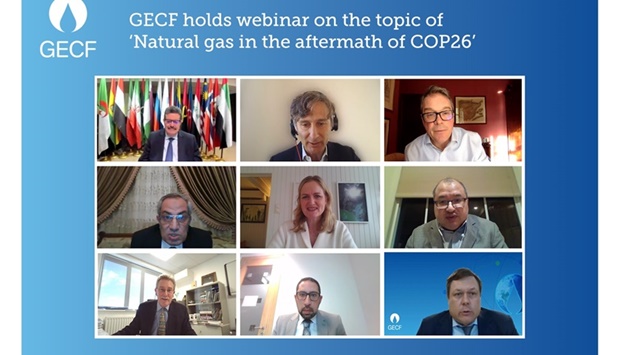
As the world takes decisive steps on climate change, the ensuing policy changes and their effect on the world’s fastest growing fossil fuel, natural gas, were examined at an event held by the Gas Exporting Countries Forum (GECF) recently.
Entitled ‘Natural gas in the aftermath of COP26’, the two-part webinar saw the participation of speakers representing exporting countries, academia, business, and service providers.
The first session reviewed the main COP26 outcomes, including possible impacts on the energy sector, in particular natural gas.
The second part focused on the responses of the gas sector to what came out of Glasgow in November 2021 and on what might be on cards as the industry head towards COP27.
GECF secretary-general Mohamed Hamel underscored that the COP26 recommended phasedown of coal consumption could “definitely benefit natural gas”.
“Coal-to-gas switching is the least costly mitigation option in many developing countries, including in countries with large populations, and it is a key component in their Nationally-Determined Contributions (NDCs).
“However, the impact of the development of carbon markets on natural gas is a more complex question to answer,” he cautioned, adding that “it is important to consider these questions in a multifaceted and holistic manner, taking into account the necessity of a delicate balance between the three pillars of sustainable development, namely economic development, social progress and the protection of the environment, whilst responding to the need for an affordable, reliable, predictable and secure supply of energy to end-users.”
Ahmed Abdrabo, assistant chief (Environmental Affairs) Ministry of Petroleum & Mineral Resources, Egypt, noted that the current discourse may lead to stifled funding for new hydrocarbon projects as well as new carbon taxes on all fossil fuels.
The COP27 will be held in Egypt in the later part of 2022.
“We have to consider natural gas as the cleanest fossil fuel and we have to publicise this fact and try to enhance its footprint in this way,” said Abdrabo.
This resilience of gas was highlighted by the next speaker, Massimo Di Odoardo, vice president ( Gas and LNG Research) at Wood Mackenzie, who asserted that COP26 delivers a positive outcome for the gas industry.
The evolution of carbon markets was explored by Haege Fjellheim, director (Carbon Research) at Refinitiv, who pointed to Europe as a realistic example of carbon pricing in motion.
Arthur Lee, fellow and principal advisor (Corporate Strategy and Sustainability) at Chevron, and who also serves on the board of International Emissions Trading Association, delved deeper into Article 6 of the 2015 Paris Agreement to explore its economic potential and implementation challenges on natural gas.
Tim Dixon, general manager IEA Greenhouse Gas R&D Programme, shed light on the prospects for carbon capture utilisation and storage (CCUS) in light of COP26.
Ahmed Osman, business development manager (Middle East) at Equinor, reaffirmed the climate ambitions of the company.
Sid-Ahmed Hamdani, Energy, Environment and Policy analyst at GECF summarised the myriad steps being taken by GECF Member Countries to improve their carbon footprint as well as to enhance further the environmental credentials of natural gas.
“CCS and CCUS as well as carbon-neutral supply chain and methane emissions reduction are possible avenues,” he said.
Dmitry Sokolov, head, GECF Energy Economics and Forecasting Department thanked the record number of attendees, the participants as well as the moderator, Axel Threlfall, editor-at-large at Reuters.
The first session reviewed the main COP26 outcomes, including possible impacts on the energy sector, in particular natural gas.
The second part focused on the responses of the gas sector to what came out of Glasgow in November 2021 and on what might be on cards as the industry head towards COP27.
GECF secretary-general Mohamed Hamel underscored that the COP26 recommended phasedown of coal consumption could “definitely benefit natural gas”.
“Coal-to-gas switching is the least costly mitigation option in many developing countries, including in countries with large populations, and it is a key component in their Nationally-Determined Contributions (NDCs).
“However, the impact of the development of carbon markets on natural gas is a more complex question to answer,” he cautioned, adding that “it is important to consider these questions in a multifaceted and holistic manner, taking into account the necessity of a delicate balance between the three pillars of sustainable development, namely economic development, social progress and the protection of the environment, whilst responding to the need for an affordable, reliable, predictable and secure supply of energy to end-users.”
Ahmed Abdrabo, assistant chief (Environmental Affairs) Ministry of Petroleum & Mineral Resources, Egypt, noted that the current discourse may lead to stifled funding for new hydrocarbon projects as well as new carbon taxes on all fossil fuels.
The COP27 will be held in Egypt in the later part of 2022.
“We have to consider natural gas as the cleanest fossil fuel and we have to publicise this fact and try to enhance its footprint in this way,” said Abdrabo.
This resilience of gas was highlighted by the next speaker, Massimo Di Odoardo, vice president ( Gas and LNG Research) at Wood Mackenzie, who asserted that COP26 delivers a positive outcome for the gas industry.
The evolution of carbon markets was explored by Haege Fjellheim, director (Carbon Research) at Refinitiv, who pointed to Europe as a realistic example of carbon pricing in motion.
Arthur Lee, fellow and principal advisor (Corporate Strategy and Sustainability) at Chevron, and who also serves on the board of International Emissions Trading Association, delved deeper into Article 6 of the 2015 Paris Agreement to explore its economic potential and implementation challenges on natural gas.
Tim Dixon, general manager IEA Greenhouse Gas R&D Programme, shed light on the prospects for carbon capture utilisation and storage (CCUS) in light of COP26.
Ahmed Osman, business development manager (Middle East) at Equinor, reaffirmed the climate ambitions of the company.
Sid-Ahmed Hamdani, Energy, Environment and Policy analyst at GECF summarised the myriad steps being taken by GECF Member Countries to improve their carbon footprint as well as to enhance further the environmental credentials of natural gas.
“CCS and CCUS as well as carbon-neutral supply chain and methane emissions reduction are possible avenues,” he said.
Dmitry Sokolov, head, GECF Energy Economics and Forecasting Department thanked the record number of attendees, the participants as well as the moderator, Axel Threlfall, editor-at-large at Reuters.