


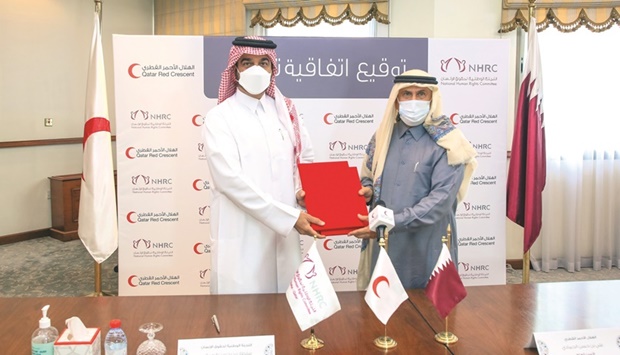
The Qatar Red Crescent Society (QRCS) and the National Human Rights Committee (NHRC) in Qatar yesterday signed a framework co-operation agreement to strengthen bilateral partnership.
The collaboration capitalises on the QRCS and NHRC’s expertise and resources towards a sustainable and effective response to all humanitarian and human rights activities within the competencies of the two parties.
The agreement also aims to intensify co-operation to develop each party’s strategies and action plans, as well as mutual benefit from their respective technical and organisational expertise.
The agreement was signed by QRCS secretary-general Ali bin Hassan al-Hammadi and NHRC secretary-general Sultan bin Hassan al-Jamali at a ceremony attended by QRCS Volunteering and Local Development Division executive director Muna Fadel al-Sulaiti, QRCS Communication and Public Relations director Mohamed Rashid al-Marri, and Dr Fawzi Oussedik, head of International Relations and International Humanitarian Law (IHL) at the QRCS.
Al-Hammadi commended the efforts of the NHRC, which shares with the QRCS the same charitable/humanitarian mandates and goals.
“We have already worked together, especially in the wake of the coronavirus (Covid-19) pandemic,” he said. “The agreement seeks to build on this, through closer co-ordination and better-regulated relations on existing and new activities, projects, and events. We will agree on an annual plan to enforce the role of human rights in serving all components of the Qatari community.”
In a statement, al-Jamali said that he considers the agreement as a “significant step towards stronger joint work, by creating an institutional framework to organise co-operation, inspired by the willingness to raise awareness and implement projects in relation to promotion and protection of human rights in Qatar”.
The NHRC secretary-general emphasised the importance of such agreements to co-define the main points of action and identify each party’s roles and responsibilities.
The NHRC, al-Jamali added, always seeks to step up co-operation with various organisations and NGOs in Qatar, as part of its corporate social responsibility.
“We believe in the vital role played by QRCS in comprehensive development and humanitarian work locally and internationally,” he said.
Under the three-year agreement, the QRCS and NHRC will work together to promote human rights, IHL, volunteerism, and humanitarian work; support capacity-building and exchange of experience on human rights and humanitarian work; provide mutual assistance in this regard within the limits of both parties’ capacities; and co-ordinate joint programmes/projects in the fields of education, family, children, and workers.
In addition, the scope of the agreement includes jointly holding specialised conferences, seminar, and workshops related to humanitarian work and human rights, disseminating the values of human rights and IHL, conducting scientific research and humanitarian studies, organising an annual conference on these topics, co-operation on the Family Links Programme, and supporting development programmes that promote health and education (such as the Patient Assistance Fund, QRCS School Programme and social care centres).
The agreement also aims to intensify co-operation to develop each party’s strategies and action plans, as well as mutual benefit from their respective technical and organisational expertise.
The agreement was signed by QRCS secretary-general Ali bin Hassan al-Hammadi and NHRC secretary-general Sultan bin Hassan al-Jamali at a ceremony attended by QRCS Volunteering and Local Development Division executive director Muna Fadel al-Sulaiti, QRCS Communication and Public Relations director Mohamed Rashid al-Marri, and Dr Fawzi Oussedik, head of International Relations and International Humanitarian Law (IHL) at the QRCS.
Al-Hammadi commended the efforts of the NHRC, which shares with the QRCS the same charitable/humanitarian mandates and goals.
“We have already worked together, especially in the wake of the coronavirus (Covid-19) pandemic,” he said. “The agreement seeks to build on this, through closer co-ordination and better-regulated relations on existing and new activities, projects, and events. We will agree on an annual plan to enforce the role of human rights in serving all components of the Qatari community.”
In a statement, al-Jamali said that he considers the agreement as a “significant step towards stronger joint work, by creating an institutional framework to organise co-operation, inspired by the willingness to raise awareness and implement projects in relation to promotion and protection of human rights in Qatar”.
The NHRC secretary-general emphasised the importance of such agreements to co-define the main points of action and identify each party’s roles and responsibilities.
The NHRC, al-Jamali added, always seeks to step up co-operation with various organisations and NGOs in Qatar, as part of its corporate social responsibility.
“We believe in the vital role played by QRCS in comprehensive development and humanitarian work locally and internationally,” he said.
Under the three-year agreement, the QRCS and NHRC will work together to promote human rights, IHL, volunteerism, and humanitarian work; support capacity-building and exchange of experience on human rights and humanitarian work; provide mutual assistance in this regard within the limits of both parties’ capacities; and co-ordinate joint programmes/projects in the fields of education, family, children, and workers.
In addition, the scope of the agreement includes jointly holding specialised conferences, seminar, and workshops related to humanitarian work and human rights, disseminating the values of human rights and IHL, conducting scientific research and humanitarian studies, organising an annual conference on these topics, co-operation on the Family Links Programme, and supporting development programmes that promote health and education (such as the Patient Assistance Fund, QRCS School Programme and social care centres).