


The Federal Reserve’s shift towards a major reduction of its footprint in the US bond market this year has upended expectations for sustained cutbacks to the Treasury’s quarterly sales of longer-term debt – forcing dealers to gird for bigger auction sizes down the road.
With pandemic-relief spending tailing off, the Treasury in November began scaling back what had been record so-called refundings of longer-term securities. That set of auctions saw the first cutback since 2016, and the Treasury at the time hinted at further reductions, saying any such decision would be revealed “in subsequent refunding statements.”
This week’s statement – due on Wednesday – will indeed showcase another reduction, dealers say, but after that the Treasury may stand pat. That’s thanks to Fed policy makers, who’ve telegraphed shrinking their bond portfolio later this year.
The upcoming quarterly refunding, which includes three-, 10- and 30-year debt, is widely seen at a total of $110bn – some $10bn less than in November.
“Treasury will likely do cuts this time similar to those it did at its November refunding,” said Subadra Rajappa, head of US rates strategy at Societe Generale SA. “But all bets are off after May, because the Fed is going to discuss balance-sheet runoff over the next couple meetings. And Treasury needs will have to rise commensurately.”
Ira F Jersey and Angelo Manolatos at Bloomberg Intelligence forecast that the Fed will shrink its $8.9tn balance sheet by $2.8tn by end-2024 through allowing its holdings to mature without replacement – with about two-thirds of that contraction coming via Treasuries.
The duo sees the process beginning in July, with monthly runoff caps in time being expanded to reach $60bn for Treasuries and $30bn for mortgage securities.
One official, Federal Reserve Bank of Atlanta President Raphael Bostic, favours reducing the balance sheet “as quickly as” possible without impairing market functioning, the Financial Times said last week, citing an interview.
But with that Fed process still likely to be months away, the Treasury is left for the moment with auction sizes that are probably too big for its spending needs.
“At this point, the pace of supply is still set to outstrip financing needs, so further cuts to nominal coupons across the curve are warranted,” said Jonathan Cohn, head of rates trading strategy at Credit Suisse Group AG. Looking forward, “both the timing, as well as the pace of the Fed’s balance sheet runoff will be very consequential for the Treasury in deciding on future auction sizes.”
That’s something the department is well aware of. It asked dealers in its usual survey ahead of Wednesday’s funding what their views were on how Fed plans would affect “financing needs and issuance decisions.” The Treasury could opt to boost its bill offerings instead. “Yes, the Treasury is going to have to do more issuance” as the Fed’s footprint shrinks, said Aneta Markowska, chief US financial economist at Jefferies. “But I think it makes perfect sense for them to do all of that in Treasury bills.”
She pointed to abundant liquidity in money markets – with some $1.6tn in cash parked in the Fed’s reverse repo facility – that could flow to short-term Treasuries instead. Markowska sees longer-term debt sales scaled back again in the May refunding.
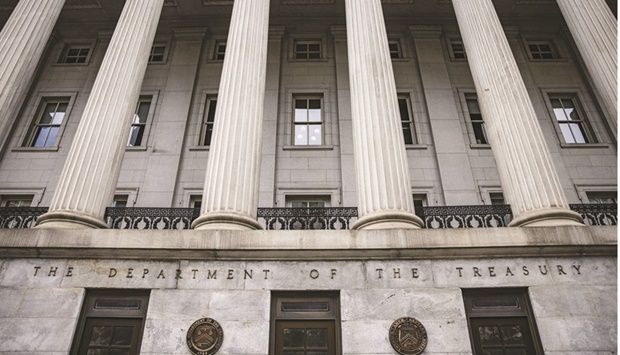
The US Treasury building in Washington, DC. The Fed’s shift towards a major reduction of its footprint in the US bond market this year has upended expectations for sustained cutbacks to the Treasury’s quarterly sales of longer-term debt u2013 forcing dealers to gird for bigger auction sizes down the road.