


Just as investors were wrapping up this year’s trading, the threat of new lockdowns sent shock waves through markets across the world.
Sentiment in stocks and bonds remained on the back foot, though US stock index futures and 10-year Treasury yields pared declines after Moderna Inc said a third dose of its Covid-19 vaccine increased antibody levels against the Omicron variant.
Lockdown risks are rising, with the UK Health Secretary Sajid Javid refusing to rule out stronger measures before Christmas and the Netherlands said on Saturday it’s going to a full lockdown until at least January 14. Senator Joe Manchin’s rejection of the US spending package at the heart of President Joe Biden’s economic agenda also weighed on sentiment.
“The market is lowering its expectations for growth due to Omicron and lower liquidity as the year is ending is potentially amplifying the moves, so we have to be a bit careful of reading too much into the weakness,” said Peter Garnry, head of equity strategy at Saxo Bank.
Volatility surged, with the Euro Stoxx 50 Volatility VSTOXX Index and the VIX Index both jumping to the highest in two weeks.
S&P 500 e-mini futures fell 1.2% in New York, after earlier sliding as much as 1.8%. The Stoxx Europe 600 Index trimmed earlier declines to 1.5%.
“I remain constructive for 2022, given a health situation that seems under control, with admittedly high transmissibility but mild symptoms; an environment of interest rates increasing but nonetheless contained, as well as an inflation that seems under control,” said Michel Keusch, a portfolio manager at Bellevue Asset Management. “I would not sell in this environment.” Yields on 10-year Treasuries traded at 1.38%, paring declines to two basis points. Risk-sensitive currencies underperformed, with the New Zealand and Canadian dollars leading losses in the Group of 10.
“The selloff is influenced by year-end volatility and new fears on growth due to the Omicron variant,” said Antonio Amendola, a portfolio manager at AcomeA Sgr. “That said, we need to remain selective on stories with greater solidity and ability to preserve margins in inflationary contexts. At the relative level, small and mid-caps are better than large caps.”
Morgan Stanley strategists led by Michael Wilson recommended that US stock investors stay defensive, and while Omicron adds to economic concerns, they’re more focused on risks of supply picking up while consumption fades.
“The market is very jittery and obviously the news flow on Omicron is not good,” said Charles Diebel, a money manager at Mediolanum. “But I’m not sure the impact will last too long. I think the combination of infections and boosters means this abates relatively quickly, i.e. by February, so I wouldn’t be buying bonds on the back of it.”
Goldman Sachs Group Inc cut its forecast for US economic growth in the wake of Manchin’s move against the Biden administration’s roughly $2tn tax-and-spend program.
Goldman slashed its real gross domestic product projection for the first quarter to 2% from 3% previously.
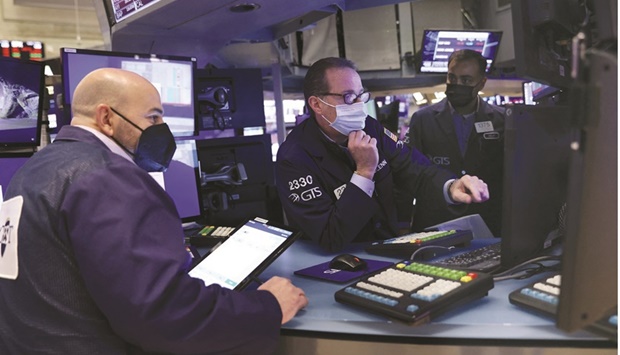
Traders wearing face masks work on the trading floor at the New York Stock Exchange yesterday. Just as investors were wrapping up this year’s trading, the threat of new lockdowns sent shock waves through markets across the world.