


Leaders of the Group of 20 major economies agreed on a final statement yesterday that urged “meaningful and effective” action to limit global warming but offered few concrete commitments and disappointed climate activists.
The result of days of tough negotiation among diplomats leaves huge work to be done at a broader UN COP26 climate summit in Scotland, to where most of the G20 leaders will fly directly from Rome.
UN Secretary-General Antonio Guterres, who warned on Friday that the world was rushing headlong towards climate disaster, said the Rome summit neither fulfilled his hopes nor buried them.
“While I welcome the #G20’s recommitment to global solutions, I leave Rome with my hopes unfulfilled — but at least they are not buried,” he said in a tweet.
“Onwards to #COP26 in Glasgow to keep the goal of 1.5 degrees alive and to implement promises on finance and adaptation for people & planet.”
The 1.5C threshold is what UN experts say must be met to avoid a dramatic acceleration of extreme climate events like droughts, storms and floods, and to reach it they recommend net zero emissions should be achieved by 2050. The stakes are huge — among them the very survival of low-lying countries, the impact on economic livelihoods the world over and the stability of the global financial system.
“This was a moment for the G20 to act with the responsibility they have as the biggest emitters, yet we only see half-measures rather than concrete urgent action,” said Friederike Roder, vice president of sustainable development advocacy group Global Citizen.
The G20 bloc, which includes Brazil, China, India, Germany and the United States, accounts for an estimated 80% of global greenhouse gas emissions.
The final document says current national plans on how to curb emissions will have to be strengthened “if necessary” and makes no specific reference to 2050 as a date to achieve net zero carbon emissions.
“We recognise that the impacts of climate change at 1.5°C are much lower than at 2°C. Keeping 1.5°C within reach will require meaningful and effective actions and commitment by all countries,” the communique said.
The leaders only recognised “the key relevance” of halting net emissions “by or around mid-century”, a phrase that removed the 2050 date seen in previous versions of the final statement so as to make the target less specific.
China, the world’s biggest CO2 emitter, has set a target date of 2060, and other large polluters such as India and Russia have also not committed to the 2050 target date.
UN experts say that even if current national plans are fully implemented, the world is headed for global warming of 2.7C, with catastrophic consequences.
The final G20 statement includes a pledge to halt financing of overseas coal-fired power generation by the end of this year, but set no date for phasing out coal power, promising only to do so “as soon as possible”.
This replaced a goal set in a previous draft of the final statement to achieve this by the end of the 2030s, showing how strong the push-back from some coal-dependent countries is.
The G20 also set no date for phasing out fossil fuel subsidies, saying they will aim to do so “over the medium term”.
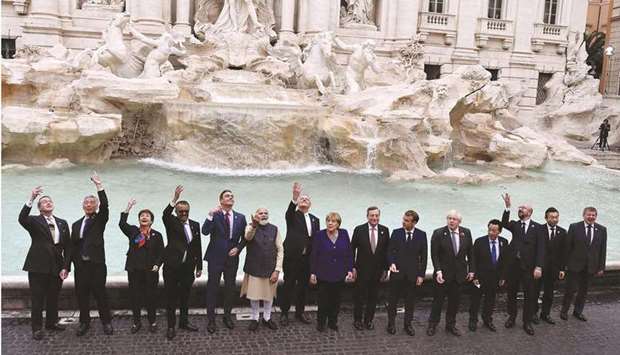
(From second left) Singaporean Prime Minister Lee Hsien Loong; International Monetary Fund (IMF) Managing Director, Kristalina Georgieva; World Health Organisation DG Tedros Adhanom Ghebreyesus; Spanish Prime Minister Pedro Sanchez; Indian Prime Minister Narendra Modi; Australian Prime Minister Scott Morrison; German Chancellor Angela Merkel; Italian Prime Minister Mario Draghi; French President Emmanuel Macron; British Prime Minister Boris Johnson; Food and Agriculture Organisation DG Qu Dongyu; President of the European Council Charles Michel; and Japan’s Senior Deputy Foreign Minister for Economic Affairs Hiroshi Suzuki throw a coin in the water during a visit to the Trevi fountain in central Rome yesterday on the sidelines of the G20 of World Leaders Summit. (AFP)