


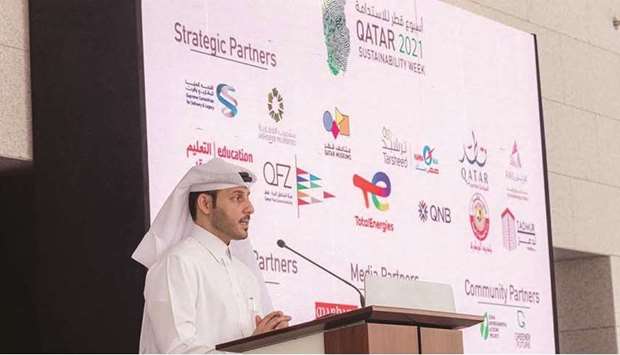
Qatar Green Building Council (QGBC), a member of Qatar Foundation (QF), has hosted three Focus Days as part of Qatar Sustainability Week (QSW), taking place until October 30.
Along with several of its strategic partners, QGBC held three physical and virtual Focus Days between October 24 – 25. The first two were centred on how organising the FIFA World Cup Qatar 2022 presented a great opportunity to accelerate and effectively drive the implementation of a sustainability-conscious development in Qatar, specifically regarding the events and hospitality sectors, and were run in partnership with the Supreme Committee for Delivery and Legacy (SC) and Qatar Tourism ( QT).
The first one focused on World Cup and how it addresses the role of the hospitality sector and supports green hotel programmes as a key pillar in achieving a holistically sustainable tournament. Speakers from QGBC, SC, QT, Qatar Museums and the Ministry of Public Health discussed broadening the application of sustainability practices in hotels supporting the delivery of FIFA World Cup Qatar 2022 to drive the decision-making process and national policies towards a sustainability paradigm shift in the hospitality sector.
A report of the findings, best practices and policy recommendations has now been published by QGBC and SC. Meshal al-Shammari, director of QGBC, commented: “This report marks another important milestone for expanding hospitality sector in Qatar. The report proposes the steps that this industry can take to align itself with international best practices and transform itself into a green sector. We are confident that the recommendations will spur sustainable evolution of the national hospitality sector to support Qatar in hosting global events, including the FIFA World Cup Qatar 2022.”
Qatar has become an outstanding MICE (Meetings, Incentives, Conferencing, Exhibitions) destination of international repute over the past decade and a framework to guide organisers on how to run eco-friendly events is a necessity. The second session enabled those in the events industry to learn about resolving current operational challenges in collaboration with national stakeholders and examine best practices, via discussions with QGBC, QT, Qatar 2022 LLC, fischerAppelt Marketing and Unwasted.
Additionally, QGBC presented the Eco-Event certification as a tool that provides measurable guidelines for organising low carbon events in Qatar. The award scheme has scalable guidance aligned with established international standards, it aims to encourage event owners and organisers to deliver environmentally sustainable events regardless of scale.
Focus Day Three ran in partnership with the Embassy of France and Doha Institute. It examined how the impact of climate change upon coastal cities is often simply portrayed as a ‘battle against sea-level rise’ but recent predictions also show that there are likely to be more extreme weather events and an increase in annual temperature. Unless adaptive urban strategies are implemented, this will greatly challenge human comfort and health in Qatar and the GCC region.
Speakers including the French ambassador Jean-Baptiste Faivre and those from QGBC, Global Green Growth Institute, The World Bank, Doha Institute, French National School of Architecture at Marne La Vallée and Leigh and Orange Middle East explored the adaptive strategies necessary to deliver future resilient and sustainable urban environments in the region’s hot and arid climates.
The first one focused on World Cup and how it addresses the role of the hospitality sector and supports green hotel programmes as a key pillar in achieving a holistically sustainable tournament. Speakers from QGBC, SC, QT, Qatar Museums and the Ministry of Public Health discussed broadening the application of sustainability practices in hotels supporting the delivery of FIFA World Cup Qatar 2022 to drive the decision-making process and national policies towards a sustainability paradigm shift in the hospitality sector.
A report of the findings, best practices and policy recommendations has now been published by QGBC and SC. Meshal al-Shammari, director of QGBC, commented: “This report marks another important milestone for expanding hospitality sector in Qatar. The report proposes the steps that this industry can take to align itself with international best practices and transform itself into a green sector. We are confident that the recommendations will spur sustainable evolution of the national hospitality sector to support Qatar in hosting global events, including the FIFA World Cup Qatar 2022.”
Qatar has become an outstanding MICE (Meetings, Incentives, Conferencing, Exhibitions) destination of international repute over the past decade and a framework to guide organisers on how to run eco-friendly events is a necessity. The second session enabled those in the events industry to learn about resolving current operational challenges in collaboration with national stakeholders and examine best practices, via discussions with QGBC, QT, Qatar 2022 LLC, fischerAppelt Marketing and Unwasted.
Additionally, QGBC presented the Eco-Event certification as a tool that provides measurable guidelines for organising low carbon events in Qatar. The award scheme has scalable guidance aligned with established international standards, it aims to encourage event owners and organisers to deliver environmentally sustainable events regardless of scale.
Focus Day Three ran in partnership with the Embassy of France and Doha Institute. It examined how the impact of climate change upon coastal cities is often simply portrayed as a ‘battle against sea-level rise’ but recent predictions also show that there are likely to be more extreme weather events and an increase in annual temperature. Unless adaptive urban strategies are implemented, this will greatly challenge human comfort and health in Qatar and the GCC region.
Speakers including the French ambassador Jean-Baptiste Faivre and those from QGBC, Global Green Growth Institute, The World Bank, Doha Institute, French National School of Architecture at Marne La Vallée and Leigh and Orange Middle East explored the adaptive strategies necessary to deliver future resilient and sustainable urban environments in the region’s hot and arid climates.