


A warning shot buried deep in the Bank of England’s policy documents two weeks ago indicating that interest rates could rise as early as this year suddenly is becoming a more distinct possibility.
In the past few days alone, natural gas prices have surged at an alarming rate, investors’ expectations for rising costs have reached the highest in 13 years, and domestic firms have said they are more worried about the outlook than ever.
The UK government has fanned those concerns by talking up the merits of pay increases in the face of supply-chain chaos.
Any of those factors alone is enough to ring alarm bells at the central bank. Their combination may be enough to force officials to acknowledge that rising inflation will prove more than just transitory. Markets have responded by almost fully pricing in a rate hike this year – a move that was unthinkable just a few months ago – and putting the odds of a 15-basis-point increase as soon as next month above 50%.
With the economy slowing and Britain’s exit from the European Union still causing friction, the UK has become “the epicentre of market fears of stagflation,” said Aaron Rock, an investment director at Standard Life Investments in Edinburgh. “If it’s going to occur anywhere in developed-market economies, we are likely to see it here.”
The result may be inflation even worse than the BoE forecast in August, when it predicted a reading above 4% by the end of this year that may linger at that level well into 2022.
On Wednesday, Bank of America Merrill Lynch said it now expects inflation to peak at 5.1% next April, almost a full percentage point higher than its previous forecast.
“A move this year requires three ingredients – an unexpectedly rapid surge in inflation, a very resilient jobs market, and an economy on course to pass its pre-pandemic level in the fourth quarter”, says Dan Hanson, Bloomberg Economics.
Among the toxic mix of recent developments, it may be the jump in inflation expectations that’s most troubling for the BoE. Governor Andrew Bailey said last week that the outlook consumers have for how strongly prices will rise is a key metric for policy makers worried about a self-reinforcing upward spiral.
“The most commonly talked about mechanism goes from higher inflation expectations, to companies feeling able to raise prices and employees asking for higher wages, to wage pressure and more persistent inflation,” Bailey said last week. “In this way, what start out as relative changes in price levels for some goods and services can become generalised and turn into persistent inflation. I take this risk very seriously.”
Markets are implying that the Retail Price Index – used to set increases in train fares and student loan interest payments – will average almost 7% in the next three months, and around 4% over the course of 10 years.
A British Chambers of Commerce survey this week found more manufacturing businesses than ever are planning price increases. Even before the those developments, British households were gearing up for more inflation, with expectations of price growth over the next 12 months in a YouGov survey increasing at a record rate in September.
“Indicators of inflation expectations in the UK are flashing at least amber, putting the Bank of England on alert for possible early rate hikes,” Krishna Guha, head of central bank strategy at Evercore ISI in Washington, wrote in a note to clients on Wednesday.
While officials have also said they are watching developments in the labour market and the economy’s recovery from the pandemic – both of which may tilt views against a move – those pieces of the jigsaw are likely to remain unclear for the rest of 2021, leaving inflation the key variable. That may prove persuasive, especially if the BoE wants to assert its authority over the issue in financial markets.
The BoE may think “if they hike sooner, then can crush inflation expectations and hence may not need to hike a lot,” said Rishi Mishra, an analyst at Futures First. “With the market already pricing the lift-off, the ‘shock and awe’ effect is gone now, unless they surprise everyone with a 25-basis-point hike in November or December.”
What the Bank of England said ...The BoE opened the door to an interest rate rise as soon as November at its September meeting, writing in paragraph 65 of the minutes taken at the meeting that any future tightening should start with a rate hike even if a move “became appropriate” before its bond-buying programme finishes around the end of the year.
Economists read that as a hint that policy makers would act on rates at their next meeting if necessary. That walked back the view that the BoE would finish its asset purchase programme before adjusting rates. Most economists, who tend to change predictions at a slower pace than investors, don’t see hikes starting until 2022.
The government seems more relaxed about inflation, with Prime Minister Boris Johnson this week batting away concerns about an economic crisis and talking up the merits of a high-wage economy.
That’s prompted concerns at the Confederation of British Industry, with Director General Tony Danker warning that “ambition on wages without action on investment and productivity is ultimately just a pathway for higher prices.”
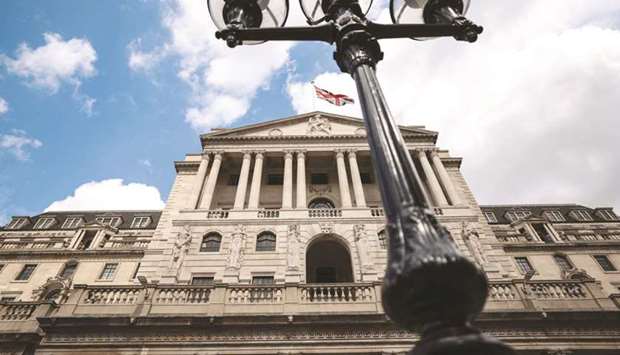
The Bank of England headquarters in the City of London. A warning shot buried deep in the BoE’s policy documents two weeks ago indicating that interest rates could rise as early as this year suddenly is becoming a more distinct possibility.