


Outgoing German chancellor Angela Merkel has made an implicit call on politicians to overcome their differences, as talks between parties to choose her successor got under way following last week’s close election.
The centre-left Social Democrats (SPD) and their candidate Olaf Scholz narrowly won the September 26 vote with 25.7%.
Merkel’s conservative CDU-CSU (Christian Democratic Union/Christian Social Union) alliance plunged to an all-time low of 24.1%, as she prepares to leave the stage after 16 years in power.
While the result leaves the SPD in pole position to form a government, conservative leader Armin Laschet has also vowed to begin coalition talks in a last-ditch effort to keep the ailing CDU-CSU in power.
Speaking in front of party leaders at celebrations in Halle to mark German reunification in 1990, Merkel said the country once again had the opportunity to “shape” its next chapter.
“We can argue over exactly how in the future, but we know that the answer is in our hands, that we have to listen and speak with each other, that we have differences, but above all things in common,” Merkel said, in a clear reference to negotiations at hand.
In the complex calculations for a coalition, the make-up of the next German government essentially hinges on which of the two main parties can persuade the Greens and the liberal FDP to sign up for a partnership.
The SPD held talks with the FDP (Free Democratic Party), described as “very constructive” by the Social Democrats’ general secretary Lars Klingbeil in a statement afterwards.
His FDP counterpart Volker Wissing said the parties’ “substantive positions on important points differ”, but also stressed that a reforming government needed to be formed to take on Germany’s biggest challenges.
The SPD subsequently had talks with the Greens, while their rivals, the CDU-CSU, also met with the FDP in the evening.
They will speak to the Greens tomorrow.
The Social Democrats have discovered new momentum since snatching the close election win.
A poll for the Bild am Sonntag newspaper yesterday showed that 28% of the public would vote SPD if the election were rerun, up 2% from the election itself.
The conservative bloc meanwhile lost three percentage points.
Some 76% of respondents said they thought Scholz should be the next German chancellor, with just 13% backing Laschet.
In an interview with Der Spiegel on Friday, Scholz said it was “clear from every poll that people don’t want the (CDU-CSU) to be part of the next government”.
“The election result is clear. The CDU and CSU have suffered a historic defeat and have been voted out,” he said.
The FDP party is closer politically to the CDU than the SPD, but ahead of ahead of the talks, their leader Cristian Lindner, put pressure on the conservatives.
In an interview with the Bild am Sonntag newspaper, Lindner called on them to clarify whether they “really” wanted to govern.
However, the conservatives are not giving up, CSU general secretary Markus Blume insisting on Friday that a conservative-led coalition had a chance.
In what was billed as perhaps her last major speech as chancellor, Merkel appealed yesterday to her successors to defend democracy amid the scramble to form a government.
“We sometimes take our democratic accomplishments too lightly,” Germany’s long-standing leader said in her speech.
She called on the public to “reject radicalisation”, while referring to a neo-Nazi attack on a synagogue in the city where she was speaking two years previous.
“Diversity and difference” were not threats to society, Merkel added, as Germany had shown in the years since the fall of the Berlin Wall.
The veteran politician, who lived in the communist east before reunification, was visibly moved as she described her own struggles with prejudice and called for more “respect” for the personal histories of east Germans.
Merkel appeared close to tears during the address to mark the 31st anniversary of reunification.
She said the freedoms that came with German reunification 31 years ago had brought “so many new opportunities” for people from the former Communist East, where she grew up, but that many of them suddenly “found themselves in a dead end”.
With a voice that betrayed her emotion, she recalled how a journalist had written last year that she “wasn’t a true born German” after she told reporters in 2015 that “if we have to start apologising” for showing a friendly face during the refugee crisis,
“then this is not my country”.
“Are there two kinds of Germans and Europeans – the original and the acquired, who have to prove their affiliation every day anew and can fail the exam with a sentence like the one in the press conference?” she asked.
The 2015 refugee crisis, when Merkel opened Germany’s doors to some 1mn migrants fleeing war and poverty in the Middle East, was the most controversial act of her time in power and fuelled the rise of the far-right Alternative for Germany (AfD).
Asking, “what is my country?”, Merkel said “each and every individual must be able to feel heard and belong”.
She called for a Germany “in which we shape the future together”, adding: “Be open to encounters, be curious about one another, tell each other your stories, and tolerate your differences. This is the lesson from 31 years of German unity.”
Merkel described her decision last year, on the 30th anniversary of Germany’s reunification, to restrict civil liberties to curb the spread of the coronavirus as “one of the most difficult experiences” of her time as chancellor.
Merkel took power in 2005 – when George W Bush was US president, Jacques Chirac in the Elysee Palace in Paris and Tony Blair British prime minister.
She plans to step down once a new government is formed.
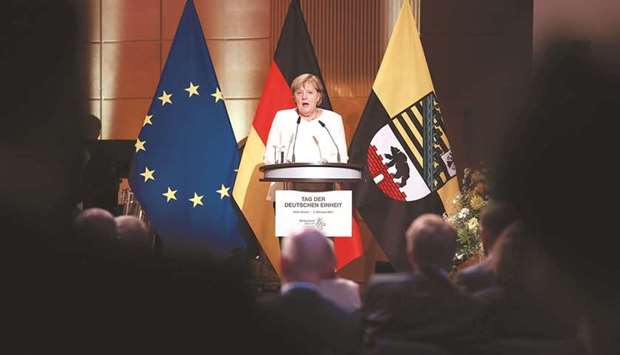
Merkel speaks at a ceremony as part of the 31st anniversary of Germany’s Unification Day, in the city of Halle, yesterday.