


British Prime Minister Boris Johnson’s plan to hike taxes to fund social care has provoked fury among many of his own lawmakers, who fear that such a clear violation of his election promises shows he is happy to oversee a sweeping expansion of the state.
After the fiscal splurge on the Covid-19 pandemic, Johnson is now addressing Britain’s creaking social care system, whose costs will soar as the population ages, while facing numerous other thorny policy matters.
Johnson wants to raise the national insurance (NI) tax paid by working people to subsidise care for pensioners, including wealthy retirees, according to British media.
But many lawmakers from Johnson’s own Conservative Party worry this will hurt younger, low-income workers and breach his 2019 election guarantee not to raise the rate of NI — which still adorns the Conservatives’ website.
“The proposal will be aimed at supporting the more affluent, but the tax will be paid by lower income earners. That’s unfair,” one Conservative lawmaker, who declined to be named, said.
“We shouldn’t break solemn election promises unless there are hugely good reasons to do so.”
Like many other Western leaders, Johnson is facing demands to spend more on welfare after government borrowing ballooned to 14.2% of economic output — a level last seen at the end of World War II.
The row over his planned tax hike comes after charges that Britain was unprepared for the chaotic fall of Afghanistan, while the country is also facing labour shortages and supply chain problems exacerbated by Brexit, as well as a high Covid-19 death toll.
Details of the NI hike are likely to today.
For years, British leaders have been trying to find a way to pay for social care without endangering support by hiking taxes.
Johnson said he had a plan for social care in 2019.
British ministers are still thrashing out the details but Johnson had been expected to announce a roughly 1 percentage point increase on the rate of NI paid by workers and their employers, which official estimates show would raise around £10bn a year.
“With regards to our plans for social care, we are committed to setting out long-term sustainable reform of the sector and that is what we will do,” Johnson’s spokesman told reporters yesterday.
The finance ministry declined to comment.
While Johnson’s huge majority of 80 in parliament means a defeat may be unlikely, members of his own cabinet have hinted at their opposition to tax hikes.
House of Commons leader Jacob Rees-Mogg on Sunday invoked former US president George H W Bush, who came to regret saying “Read my lips: no new taxes” during the 1988 election campaign.
“(Voters) remembered those words after president Bush had forgotten them,” Rees-Mogg wrote in a Sunday Express opinion piece.
Many of Johnson’s lawmakers fear raising taxes will alienate many of the voters in northern England who supported him in the 2019 election, when he promised explicitly not to raise income tax, value-added tax or national insurance.
Johnson also promised in 2019 to maintain the “triple lock”, which annually links the state pension to whichever is highest out of inflation, earnings or a 2.5% increase.
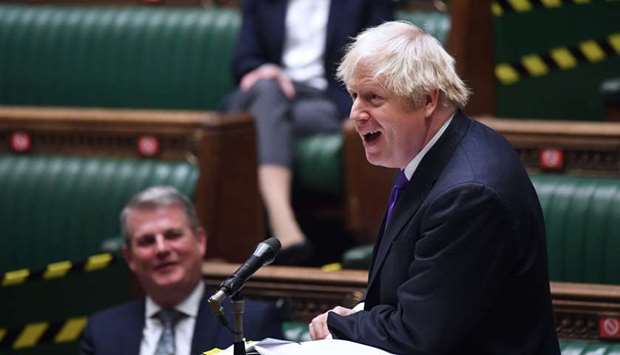
(File photo) British Prime Minister Boris Johnson (right).