


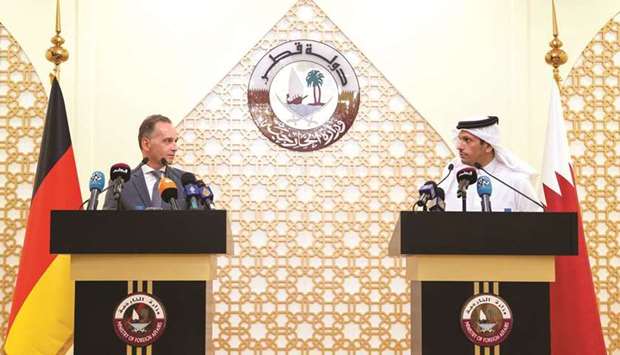
HE the Deputy Prime Minister and Minister of Foreign Affairs Sheikh Mohamed bin Abdulrahman al-Thani met with German Minister of Foreign Affairs Heiko Maas. During their meeting in Doha, the two sides reviewed bilateral relations and the latest security and political developments in Afghanistan.
Speaking at a press conference with the German FM, HE Sheikh Mohamed highlighted Qatar's position calling on all Afghan parties to form an expanded government, with the necessity of not excluding any party, considering that this matter will represent a very important yardstick for the international community. He said that during the talks Qatar held with the Taliban, the latter did not react, either positively or negatively, to this issue, pointing in the same context to the Taliban's assertion of their openness to any proposals.
The FM said that the issue of international recognition of the Taliban government is not an emergency issue, noting that the issue of communication with the Taliban is the most important issue now, and this is what the friendly and allied countries stress on.
Qatar is focused on the issue of communication with the Taliban, based on the Qatari mediation in the talks between them and the United States, and the facilitation of the intra-Afghan talks, stressing that Qatar will continue to open channels of communication with all parties in Afghanistan, whether with the Taliban or the others. He expressed hope for a national reconciliation in Afghanistan in order to maintain the gains of the Afghan people and their rights.
HE Sheikh Mohamed explained that the policy of isolation is useless, noting that the experiences of the past years have proven that the isolation of the Taliban in 1996 led to the current situation and underlined that interaction with the Taliban may lead to positive results, noting that in the last 10 days, since the Taliban took control of Kabul, there has been a great interaction with them in order to organise the evacuation process and combat terrorism. This interaction has led to positive results, adding, "if we started imposing conditions and obstructing this interaction, we will leave a void, and the question here is: Who will fill this void?"
Qatar maintains open channels with every party that wants communication and dialogue, he said, stressing that this is the foreign policy pursued by the country for decades. Urging other countries to continue interacting and communicating with the Taliban, he stressed that without this communication, no progress can be reached, whether in the political, economic or social aspect in Afghanistan. He noted that this is the position of Qatar which is common with its allies and partners.
On the talks regarding the management of Kabul airport, HE Sheikh Mohamed said that the issue is still in the process of discussion and evaluation, stressing that there are many aspects that need to be evaluated, whether in the security or technical aspects.
During the press conference, the FM said that his meeting with German Foreign Minister Heiko Maas was very important as the two sides discussed bilateral relations and ways of developing them, in addition to the developments in the region, with a focus on Afghanistan. He said that the two sides agreed on the need to unify international efforts to deal with field developments in the Afghan issue and their repercussions on the international arena. The two sides also focused on the most important security and political developments and the need to protect civilians and ways to reach a peaceful transfer of power and maintain the gains of the Afghan people.
Qatar is ready to cooperate in strengthening regional and international consensus in order to achieve stability in Afghanistan, the FM said, stressing the importance of preserving the basic rights of all the Afghan people. He noted that his meeting with the German FM discussed means of co-operation and combining efforts to avoid any humanitarian crisis in Afghanistan by providing development assistance, stressing the importance of co-operation in the fight against terrorism. He noted that Afghanistan is going through a critical stage, affirming the importance for the Taliban to cooperate and fulfill its obligations.
For his part, Maas praised the role of Qatar as a mediator in the Afghan crisis, and its humanitarian efforts which contributed to the evacuation of thousands of people from Afghanistan and transporting them to Doha before their final destinations. He indicated that Qatar enabled the transfer of a large number of German and Afghan employees who were working with German companies, in addition to other Afghan citizens who were agreed to be received in Germany. He underlined that Doha was a strategic centre in this process, whether through the evacuation operations or the negotiations with the Taliban.
The German FM noted that his recent talks which he held in a number of countries in the region focused on how to move forward in this process and how to ensure air and land transportation, given that the matter needs coordination with countries neighbouring Afghanistan and other countries, adding that Qatar plays a major role in the field of air transport and evacuations, but the important thing now is to ensure the continued operation of Kabul airport with the aim of humanitarian operations and the evacuation of people.
On the other hand, the German FM noted the importance of communication and talks with the Taliban, referring to different points of view regarding communication with the Taliban or not. He stressed the importance of continuing the talks with the Taliban in order to find practical solutions to the challenges at Kabul Airport, warning that instability in Afghanistan cannot be tolerated because it will undoubtedly serve terrorism. He stressed the need to express to the Taliban the expectations and the limits, and not to judge them by their words but by their actions. He noted that the German ambassador in Qatar is holding talks with the Taliban, and that the entire Afghan crisis needs international co-operation, without which the current situation cannot be controlled.
Speaking at a press conference with the German FM, HE Sheikh Mohamed highlighted Qatar's position calling on all Afghan parties to form an expanded government, with the necessity of not excluding any party, considering that this matter will represent a very important yardstick for the international community. He said that during the talks Qatar held with the Taliban, the latter did not react, either positively or negatively, to this issue, pointing in the same context to the Taliban's assertion of their openness to any proposals.
The FM said that the issue of international recognition of the Taliban government is not an emergency issue, noting that the issue of communication with the Taliban is the most important issue now, and this is what the friendly and allied countries stress on.
Qatar is focused on the issue of communication with the Taliban, based on the Qatari mediation in the talks between them and the United States, and the facilitation of the intra-Afghan talks, stressing that Qatar will continue to open channels of communication with all parties in Afghanistan, whether with the Taliban or the others. He expressed hope for a national reconciliation in Afghanistan in order to maintain the gains of the Afghan people and their rights.
HE Sheikh Mohamed explained that the policy of isolation is useless, noting that the experiences of the past years have proven that the isolation of the Taliban in 1996 led to the current situation and underlined that interaction with the Taliban may lead to positive results, noting that in the last 10 days, since the Taliban took control of Kabul, there has been a great interaction with them in order to organise the evacuation process and combat terrorism. This interaction has led to positive results, adding, "if we started imposing conditions and obstructing this interaction, we will leave a void, and the question here is: Who will fill this void?"
Qatar maintains open channels with every party that wants communication and dialogue, he said, stressing that this is the foreign policy pursued by the country for decades. Urging other countries to continue interacting and communicating with the Taliban, he stressed that without this communication, no progress can be reached, whether in the political, economic or social aspect in Afghanistan. He noted that this is the position of Qatar which is common with its allies and partners.
On the talks regarding the management of Kabul airport, HE Sheikh Mohamed said that the issue is still in the process of discussion and evaluation, stressing that there are many aspects that need to be evaluated, whether in the security or technical aspects.
During the press conference, the FM said that his meeting with German Foreign Minister Heiko Maas was very important as the two sides discussed bilateral relations and ways of developing them, in addition to the developments in the region, with a focus on Afghanistan. He said that the two sides agreed on the need to unify international efforts to deal with field developments in the Afghan issue and their repercussions on the international arena. The two sides also focused on the most important security and political developments and the need to protect civilians and ways to reach a peaceful transfer of power and maintain the gains of the Afghan people.
Qatar is ready to cooperate in strengthening regional and international consensus in order to achieve stability in Afghanistan, the FM said, stressing the importance of preserving the basic rights of all the Afghan people. He noted that his meeting with the German FM discussed means of co-operation and combining efforts to avoid any humanitarian crisis in Afghanistan by providing development assistance, stressing the importance of co-operation in the fight against terrorism. He noted that Afghanistan is going through a critical stage, affirming the importance for the Taliban to cooperate and fulfill its obligations.
For his part, Maas praised the role of Qatar as a mediator in the Afghan crisis, and its humanitarian efforts which contributed to the evacuation of thousands of people from Afghanistan and transporting them to Doha before their final destinations. He indicated that Qatar enabled the transfer of a large number of German and Afghan employees who were working with German companies, in addition to other Afghan citizens who were agreed to be received in Germany. He underlined that Doha was a strategic centre in this process, whether through the evacuation operations or the negotiations with the Taliban.
The German FM noted that his recent talks which he held in a number of countries in the region focused on how to move forward in this process and how to ensure air and land transportation, given that the matter needs coordination with countries neighbouring Afghanistan and other countries, adding that Qatar plays a major role in the field of air transport and evacuations, but the important thing now is to ensure the continued operation of Kabul airport with the aim of humanitarian operations and the evacuation of people.
On the other hand, the German FM noted the importance of communication and talks with the Taliban, referring to different points of view regarding communication with the Taliban or not. He stressed the importance of continuing the talks with the Taliban in order to find practical solutions to the challenges at Kabul Airport, warning that instability in Afghanistan cannot be tolerated because it will undoubtedly serve terrorism. He stressed the need to express to the Taliban the expectations and the limits, and not to judge them by their words but by their actions. He noted that the German ambassador in Qatar is holding talks with the Taliban, and that the entire Afghan crisis needs international co-operation, without which the current situation cannot be controlled.