


Warren Buffett’s Berkshire Hathaway Inc is reaping the benefits of the US economic recovery. The conglomerate’s collection of manufacturers and retailers bounced back during the second quarter after being hit hard as the pandemic ripped through the US last year.
That group of businesses posted its second-highest quarterly profit in data going back to the middle of 2009 and helped fuel a 21% gain in Berkshire’s total operating profit during the period.
“It’s all of the other old economy, manufacturing, service, retailing, transportation businesses that just really reflect the broad economic recovery driving this performance this quarter,” Jim Shanahan, an analyst at Edward Jones, said in a phone interview. “There’s a housing angle here which I think was a really strong contributor this quarter.”
Buffett has built Berkshire into a broad business with footholds in industries including insurance, energy and retail. But that exposure to a wide slice of the US economy weighed on it last year with businesses including See’s Candies having to furlough workers at the start of the shutdowns. Now, the outlook appears brighter. “Many of our businesses generated significantly higher earnings over the first half of 2021 compared to 2020, which included significant adverse effects from the pandemic,” Berkshire said in a regulatory filing Saturday. “Earnings of our manufacturing, service and retail businesses in 2021 benefited from higher customer demand in many of our businesses and exceeded earnings in 2019 as well.”
Berkshire’s group of building products companies accounted for a particular source of strength during the quarter. Earnings at those operations were up nearly 40% helped by the boon in housing construction in the US. Tom Russo, a Berkshire shareholder, said the strength of those businesses combined with the challenge of disrupting them through technology makes them a good part of Berkshire’s composition.
“The businesses have a certain underlying recurrence that I think makes them attractive,” Russo, who oversees $10bn including investments in Berkshire shares at Gardner Russo & Quinn LLC, said in a phone interview.
Still, Berkshire wasn’t immune to the supply chain pressures that have been a persistent economic theme since the early days of the outbreak. Higher costs for certain materials such as lumber and steel caused some of those operations to ramp up their own prices, Berkshire said.
Not every Berkshire business bounced back fully. Precision Castparts, which makes parts for aircraft and suffered a large write-down last year, reported revenue declines during the period even as earnings climbed slightly due to efforts to restructure the business. And Berkshire warned that supply chain issues could continue to weigh on that business.
“The Covid-19 pandemic contributed to material declines in commercial air travel and aircraft production in 2020,” Berkshire said in the filing. “While air travel in the US is increasing in 2021, we do not expect significant increases in PCC’s aerospace demand to occur in the near term due to the inventory levels currently within the industry supply chain. Consequently, we anticipate PCC’s revenues and earnings in 2021 will be below pre-pandemic levels.”
Berkshire pulled back on one of Buffett’s more heavily used capital deployment levers in recent years. The conglomerate bought back $6bn of stock, down from the $6.6bn repurchased during the first three months of the year, with June being the busiest month for repurchases for the company.
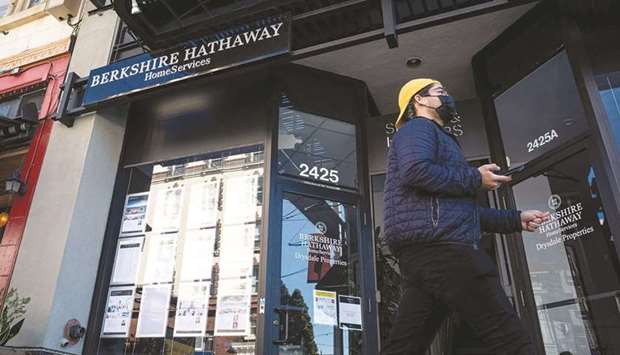
A pedestrian wearing a protective mask walks past a Berkshire Hathaway HomeServices real estate office in San Francisco. The conglomerate’s collection of manufacturers and retailers bounced back during the second quarter after being hit hard as the pandemic ripped through the US last year.