


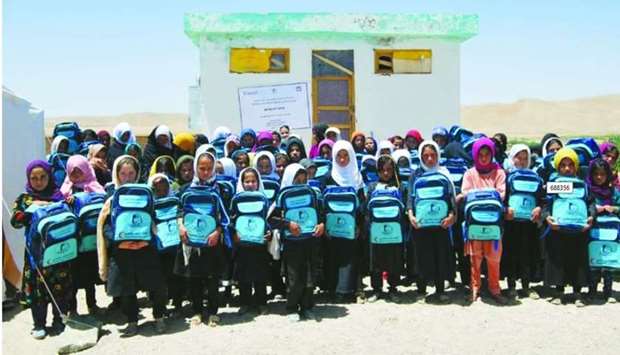
Qatar Red Crescent Society (QRCS) inaugurated the delivery of educational aid to schools in Afghanistan's Ghor Province aimed at supporting education in remote areas.
The aid, which forms part of the QRCS phase 3 project pegged at $343,521, involves providing 480 double seats and desks, 49 classroom tents, 955 school bags with stationery, and 520 kits of teaching aids for five schools. Also, a teacher training centre was constructed and furnished in Firuzkoh, the capital of Ghor.
A team of six trainers was created, and 110 teachers in Ghor and Kapisa Provinces received capacity-building training to improve their teaching performance and enhance the quality of education.
According to QRCS, this phase is estimated to benefit 955 students and 116 teachers in Firuzkoh. It was implemented in partnership with the Afghan Welfare Society, the Ministry of Education’s offices in Ghor and Kapisa, the provincial governments, and local community leaders.
A ceremony was held to launch the educational aid distributions and lay the foundation stone of the teacher training centre. Earlier, all logistics were arranged to transport the materials from Kabul to the capital of Ghor, in co-ordination with the competent provincial authorities.
In Afghanistan, the education system suffers from poor infrastructure and a lack of basic educational resources. Despite the significant progress made in the last few years, it remains one of the world’s weakest education systems.
QRCS noted that many challenges are yet to be resolved, citing only 50% of school-age children attend schools, and around 3mn million have no access to education, mostly in remote, mountainous, insecure, or unstable areas. Hundreds of schools are either destroyed or closed and there are insufficient numbers of schools, teachers, and textbooks. Most schools work for multiple shifts, and teacher qualification is of low standard.
QRCS stressed that the project is an essential support to the government’s efforts in meeting the educational needs and creating a suitable and encouraging school environment, particularly in remote and underdeveloped areas of the country. Generally, education is key to development and stability.
Asia Mohamed Amir, a 6-grader, said she was so happy and hoped that QRCS’ aid would enable her and other girls to attend school in quiet and favourable conditions. She also hopes to find pure drinking water at the school and to have a school building one day.
Amanullah Mohamed Rahim, a senior teacher, said he and all teachers and students felt happy with the new educational provisions, such as the tents, seats, and desks. He thanked Qatar and QRCS and called for more aid in education and other sectors for the population of the province and elsewhere in the country.
Mohamed Ayoub Mayar Mohamed Wazir, a parent and member of a parent council, saw this project as an elevated tangible example of humanitarian and development assistance that addresses the needs of people.
Abdul-Zahir Faidzadah, Governor of Ghor, thanked Qatar, QRCS, and the Afghan Welfare Society, saying that QRCS was one of the most active international humanitarian providers in Ghor.
He commended the project’s mechanism of delivery of aid to the eligible beneficiaries despite the schools were remote and inaccessible.
Meer Ahmed Husaini, education director in Ghor, said: “This is phase 2 of educational aid for the province. In Phase 1, four schools were covered. This time, another three were reached out. The intervention not only secures the basic educational needs but also pays attention to capacity-building for female and male teachers, especially in the earlier grades”.
A team of six trainers was created, and 110 teachers in Ghor and Kapisa Provinces received capacity-building training to improve their teaching performance and enhance the quality of education.
According to QRCS, this phase is estimated to benefit 955 students and 116 teachers in Firuzkoh. It was implemented in partnership with the Afghan Welfare Society, the Ministry of Education’s offices in Ghor and Kapisa, the provincial governments, and local community leaders.
A ceremony was held to launch the educational aid distributions and lay the foundation stone of the teacher training centre. Earlier, all logistics were arranged to transport the materials from Kabul to the capital of Ghor, in co-ordination with the competent provincial authorities.
In Afghanistan, the education system suffers from poor infrastructure and a lack of basic educational resources. Despite the significant progress made in the last few years, it remains one of the world’s weakest education systems.
QRCS noted that many challenges are yet to be resolved, citing only 50% of school-age children attend schools, and around 3mn million have no access to education, mostly in remote, mountainous, insecure, or unstable areas. Hundreds of schools are either destroyed or closed and there are insufficient numbers of schools, teachers, and textbooks. Most schools work for multiple shifts, and teacher qualification is of low standard.
QRCS stressed that the project is an essential support to the government’s efforts in meeting the educational needs and creating a suitable and encouraging school environment, particularly in remote and underdeveloped areas of the country. Generally, education is key to development and stability.
Asia Mohamed Amir, a 6-grader, said she was so happy and hoped that QRCS’ aid would enable her and other girls to attend school in quiet and favourable conditions. She also hopes to find pure drinking water at the school and to have a school building one day.
Amanullah Mohamed Rahim, a senior teacher, said he and all teachers and students felt happy with the new educational provisions, such as the tents, seats, and desks. He thanked Qatar and QRCS and called for more aid in education and other sectors for the population of the province and elsewhere in the country.
Mohamed Ayoub Mayar Mohamed Wazir, a parent and member of a parent council, saw this project as an elevated tangible example of humanitarian and development assistance that addresses the needs of people.
Abdul-Zahir Faidzadah, Governor of Ghor, thanked Qatar, QRCS, and the Afghan Welfare Society, saying that QRCS was one of the most active international humanitarian providers in Ghor.
He commended the project’s mechanism of delivery of aid to the eligible beneficiaries despite the schools were remote and inaccessible.
Meer Ahmed Husaini, education director in Ghor, said: “This is phase 2 of educational aid for the province. In Phase 1, four schools were covered. This time, another three were reached out. The intervention not only secures the basic educational needs but also pays attention to capacity-building for female and male teachers, especially in the earlier grades”.