


“When I first came to Qatar in 1970, I and my accompanying friend thought that we would set aside some money to buy a return ticket soon but we have not been able to purchase the ticket till today.”
Pakistani expatriate Nazakat Hussain, who landed in Qatar on January 9, 1970, said this with a smile on his face. Recalling old memories, he said that initially he thought he would stay for a short period of time here but has spent over 50 years. The longtime resident in a recent interview with Gulf Times shared his memories of arriving in Qatar and how his life moved on in the country.
While working at a five-star hotel in Karachi during late 1960s, Nazakat was impressed by the visitors coming from the Gulf states.
“Our guests from the Gulf countries used to be well-dressed and well-mannered. Being in the hospitality sector, I was keen to improve myself and have a better opportunity. I and my friend Siraj Khan used to speak to the guests asking about life and the hospitality industry in the Gulf. One day, a visitor asked us to send our applications at PO Box 710, if we are interested. We did so and after two weeks, we got the reply asking us to send our passport copies for the visa. It was quite unexpected for me.”
Nazakat was also pushed by financial responsibilities that he had towards his family to come to Qatar. “My grandfather came from the part of Kashmir under Indian control currently, to visit the Pakistan side. When he heard that some people had burnt his family house back there, he decided to stay in the Pakistani part of Kashmir, in district Bagh. We did not own much land to cultivate in the village and I had to go to Karachi looking or a job when I was a teenager. I worked in the hotel industry for a few years before I moved to Qatar.” Nazakat and his friend Siraj were hired by Doha Palace Hotel and both took a PIA flight from Karachi to Doha for a new beginning.
“We were received at the airport by an employee of the hotel. He dropped us at our hotel room and asked us to see the general manager next morning. When we reached at the office of the GM, we were surprised to see that it was the GM who received us at the airport. It was very pleasant and a relaxing revelation for both of us. The GM was from Lebanon and had very good nature. On the second day of our job, the GM took us to the owner of the hotel – a Qatari Sheikh, who welcomed us warmly and we had lunch with him.”
Nazakat, who was promoted to the position of shift in-charge in a restaurant after four months, stayed with the same sponsor for over 50 years.
Reminiscing about his early days’ life in Qatar, he said: “Air conditioners were not very common those days. Sometimes, I used to take a pillow and a shawl and would sleep in the open near Corniche at night. But soon, we got both AC and refrigerator in our room. Monthly salaries used to start from QR200. The salary of the GM was QR800 those days. A brand new Mercedes could be bought for QR8,000. In 1970, the expat population mainly consisted of Iranians, Indians, Bangladeshis and Pakistanis. People from Nepal, Sri Lanka and Filipinos started coming to Qatar later during the 1980s.”
Nazakat worked with Doha Palace Hotel from 1970 to 1984 and then with Sofitel Hotel till his retirement. “Initially, I and Siraj thought to have money saved to purchase a return ticket as we were of the opinion that we would not stay in Qatar for a longer time. But so far, I have not been able to buy my return ticket (smiles). I got married in 1975. I have four children. I retired after reaching the age of superannuation soon after the pandemic broke out.” Further sharing his old memories, the longtime resident recalled what he and his friend used to do during leisure.
“We used to play chess a lot with friends. We would start on a Thursday evening and would get up on Saturday morning. Sometimes, we would forget to have our dinner or lunch. There used to be big maintenance garages in different areas of Doha. The garages used to run films for workers. Cinemas started appearing later in the country. There were no high-rise buildings in Qatar when I came here. We often used to go for fishing but seldom got some catch. “There were no driving schools in the 1970s. You could learn how to drive while sitting with a driver in a car carrying the sign of ‘taleem’. Most of the policemen were Palestinians those days. Only available public transport was cabs. The fare was just QR2. Ramadan used to be like a festival. A drummer used to visit every street before Iftar and Suhoor.”
Nazakat speaks very high about the positive conduct and hospitality of Qatari nationals. “During my long stay here, I have always found local people very welcoming and helpful. Once, I got a fracture in my leg and I had to walk with a stick in my hand for a few weeks. One day, a Qatari woman saw me walking with the stick and pushing my shopping trolley towards the cash counter in a mart, she came forward, helped me and paid for my items despite my insistence that I can afford to pay. She was kind towards me as she saw an old man walking with a stick.
“The country’s healthcare facilities are wonderful. It is safe and secure here. After coming to Qatar, my financial situation improved. I started helping my other relatives particularly on special occasions such as Eid and Ramadan.”
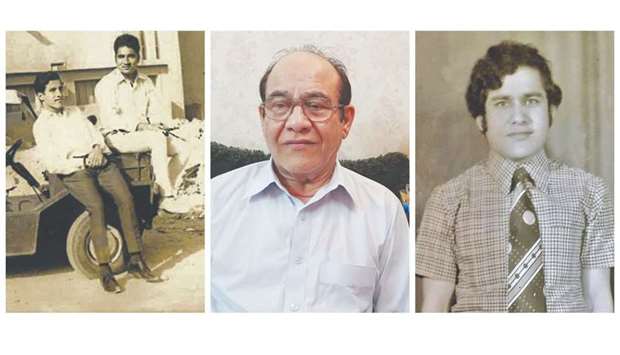
Pakistani expatriate Nazakat Hussain, a longtime resident in a recent interview with Gulf Times shared his memories of arriving in Qatar and how his life moved on in the country.