


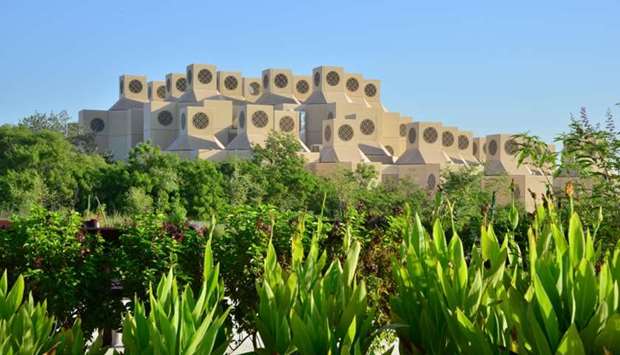
Qatar University (QU) celebrated the ninth edition of World Radio Day, which is marked on February 13 worldwide.
The 2021 edition of World Radio Day is based around three sub-themes: evolution, innovation and connection.
QU marked the day to shed light on importance of radio, which remains the medium to reach the widest audience and is currently taking up new technological forms and devices.
Radio plays a vital role in emergency situations where it is used by emergency and security services to communicate in times when immediate assistance is required. Radio is also an effective low-cost medium to broadcast emergency news and updates, available everywhere and suitable to reach remote communities and vulnerable people such as the illiterate.
Several staff members at the Mass Communication Department at QU expressed their sentiments on the day. Dr Kamal Hamidou, Acting Department Head of Mass Communication at the College of Arts and Sciences QU, said: "Radio is a medium which will never die, even if we notice a significant decline in the number of people who use this news medium. Radio remains a medium which can be used during crises, pandemics and wars. Radio will be an ancient solution: to communicate with the masses to reassure and educate them.”
Dr Abdulrahman al-Shami, Associate Professor of Mass Communication at the College of Arts and Sciences QU, shed light on the importance of radio in the media, and the role of the podcast (podcasting) in the new era. He said radio plays an important role in raising awareness among public, despite all the technologies in the world. The podcast is one of the example of the adaptation. Through this technology, the radio has been able to find a place for itself in modern communication platforms in order to attract young generation towards this medium. As for the content, the podcast provided the radio with an opportunity to present various exciting topics, which raises awareness and builds knowledge among people.
Dr Fayez Shaheen, Assistant Professor of Mass Communication at College of Arts and Sciences QU, discussed about the popularity that radio still enjoys. “There is no doubt that the radio is still popular among the public worldwide, and even in the advanced European countries such as Germany. Radio comes in second place when it comes to the public choice. Radio educates masses from urban areas and is easily adapted. It plays an important role in developing people’s opinion on different issues.
“I think that just as cinema did not die after the invention of television, and television did not die after the invention of Internet, in a similar fashion, I also believe the radio will not die after the invention of podcasting on the Internet, but rather, it will extend its life for a long time,” he added.
“The radio remains a beautiful place for constructive dialogue and exchange of ideas within society as well as between people. We have to find ways to teach the children how to enjoy the radio,” said Chaker Ayadi, lecturer of Mass Communication at College of Arts and Sciences QU.
The purpose of World Radio Day is to raise greater awareness among the public and the media on the importance of radio. This is done in the hope that decision makers can be encouraged to establish and provide access to information through radio. It is also for improving networking and international co-operation between broadcasters.
QU marked the day to shed light on importance of radio, which remains the medium to reach the widest audience and is currently taking up new technological forms and devices.
Radio plays a vital role in emergency situations where it is used by emergency and security services to communicate in times when immediate assistance is required. Radio is also an effective low-cost medium to broadcast emergency news and updates, available everywhere and suitable to reach remote communities and vulnerable people such as the illiterate.
Several staff members at the Mass Communication Department at QU expressed their sentiments on the day. Dr Kamal Hamidou, Acting Department Head of Mass Communication at the College of Arts and Sciences QU, said: "Radio is a medium which will never die, even if we notice a significant decline in the number of people who use this news medium. Radio remains a medium which can be used during crises, pandemics and wars. Radio will be an ancient solution: to communicate with the masses to reassure and educate them.”
Dr Abdulrahman al-Shami, Associate Professor of Mass Communication at the College of Arts and Sciences QU, shed light on the importance of radio in the media, and the role of the podcast (podcasting) in the new era. He said radio plays an important role in raising awareness among public, despite all the technologies in the world. The podcast is one of the example of the adaptation. Through this technology, the radio has been able to find a place for itself in modern communication platforms in order to attract young generation towards this medium. As for the content, the podcast provided the radio with an opportunity to present various exciting topics, which raises awareness and builds knowledge among people.
Dr Fayez Shaheen, Assistant Professor of Mass Communication at College of Arts and Sciences QU, discussed about the popularity that radio still enjoys. “There is no doubt that the radio is still popular among the public worldwide, and even in the advanced European countries such as Germany. Radio comes in second place when it comes to the public choice. Radio educates masses from urban areas and is easily adapted. It plays an important role in developing people’s opinion on different issues.
“I think that just as cinema did not die after the invention of television, and television did not die after the invention of Internet, in a similar fashion, I also believe the radio will not die after the invention of podcasting on the Internet, but rather, it will extend its life for a long time,” he added.
“The radio remains a beautiful place for constructive dialogue and exchange of ideas within society as well as between people. We have to find ways to teach the children how to enjoy the radio,” said Chaker Ayadi, lecturer of Mass Communication at College of Arts and Sciences QU.
The purpose of World Radio Day is to raise greater awareness among the public and the media on the importance of radio. This is done in the hope that decision makers can be encouraged to establish and provide access to information through radio. It is also for improving networking and international co-operation between broadcasters.