


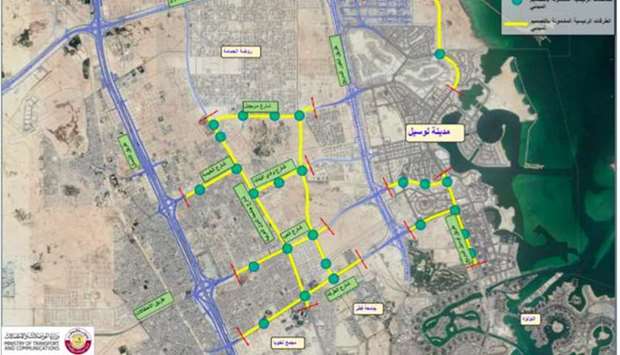
The Ministry of Transport and Communication (MoTC) has submitted to the Public Works Authority (Ashghal) the completed concept design of a project to connect Lusail City with the expressway network.
“The design, which involves 39km of roads and 25 junctions, has been submitted to Ashghal to develop detailed designs and begin execution,” a tweet by MoTC said.
The initiative comes as part of upgrading the existing transportation network to meet the growing demand for mobility and in preparation for hosting of key international events and bolstering the country's economic and urban development.
Some of the 25 junctions are grade separation junctions. The project also features connecting Al Shamal Road with Lusail City based on high speed free flow elevated expressways along Al Tarfa and Al Ebb corridors while connecting the internal street of Lusail with Al Majd Rd, thus ensuring a free flow of traffic.
This scheme will provide an integrated transportation network for all transport users including metro commuters, pedestrians and cyclists as well as safe and efficient traffic flow and enhanced connectivity between Doha and Lusail cities to keep up with the rapid population growth. It will also provide beautiful structures and landscaped areas that will enhance the overall look and feel of the region.
In August last year, MoTC signed an MoU with Ashghal for planning, studying, designing, maintaining and managing the road projects as part of upgrading the level of collaboration, joint efforts and constructive co-operation with the aim of providing a safe, integrated transportation system in line with best universal practices and standards.
MoTC and Ashghal look to develop and manage the mobility and transportation projects as an integrated network compatible with other modes of transportation in an efficient, economic, safe and environment-friendly fashion. The two sides aim to fulfill Qatar’s mobility and transportation needs in line with the Second National Development Strategy (2018-2022) and Qatar National Vision 2030.
The MoU defines and explains the roles, missions and responsibilities of the two sides based on the Amiri decisions in such a way that avoids duplication and limits overlapping through a joint working mechanism for planning, studying, designing, implementing, operating, maintaining and managing the road projects in the country according to approved development plans.
The MoU also covers activating community participation, facilitating co-operation, transferring knowledge and technology for supporting the efforts of achieving Qatar National Vision 2030 as well as realising mutual benefits, services and expertise that both parties can make available for each other.