


India will unveil its closely watched budget on Monday, expected to get it back on track as the world’s fastest-growing major economy by boosting spending on job-creation and rural development while battling back the coronavirus.
Finance Minister Nirmala Sitharaman will likely make a generous allocation for development, put more money in the hands of the average taxpayer to boost consumption and ease rules to attract foreign investments when she presents the budget at 11am in New Delhi.
“Expectations are high, going into this budget,” said Samiran Chakraborty, an economist with Citigroup Inc. “Expenditure profile could move from survival to revival as the focus on infrastructure increases.”
That spending may continue to keep the fiscal deficit far wider than the 3% of gross domestic product mandated by law. The budget gap for the year to March will probably be 7.25% of GDP, according to a Bloomberg survey. The same poll shows the target for the next fiscal year will likely be 5.5%.
Missing deficit goals will be the least of the worries for Prime Minister Narendra Modi’s government. It has to contend with creating jobs for the millions who lost their livelihoods to lockdowns to combat the world’s second-largest coronavirus outbreak, quelling protests by farmers against agriculture reforms and reviving growth in an economy headed for its biggest annual contraction on record.
India’s GDP will shrink 7.7% in the year ending March, according to the statistics ministry. The government estimates GDP will likely expand 11% next fiscal year, a forecast that will make the South Asian nation the world’s fastest-growing major economy ahead of China’s estimated 8.1% pace.
To help achieve this goal, Sitharaman said her budget would be unlike anything seen so far.
A pickup in tax collections in recent months will offer some respite for Sitharaman, who will also seek to raise record amounts by selling state assets in the new financial year starting April after the pandemic all but ruined disinvestment plans in the current year. Her efforts will also get a boost from the annual dividend paid to the government by the central bank, which is expected to also complement fiscal steps with more monetary stimulus when it meets later next week.
Opinion is divided about new tax measures in the budget, with some calling for a tax on the rich to fund pandemic-related expenditure and others opposing any such move.
“A 4% tax on the nation’s 954 richest families could raise the equivalent of 1% of India’s GDP,” Oxfam said in a report released on Monday. Economists including Nomura Holdings Inc’s Sonal Varma think a Covid levy is a bad idea given that the economy is still normalising after a strict and vast lockdown.
Still, improved tax collections and income from privatisation should help the finance minister pare borrowings next fiscal year.
She may announce a gross borrowing plan of 10.6tn rupees ($145bn) for the 12 months starting April, according to a median forecast of 15 analysts surveyed by Bloomberg News. That’s less than the record 13.1tn rupees estimated for the current year.
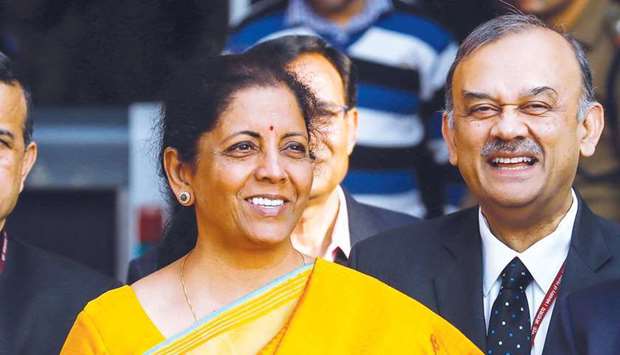
India’s Finance Minister Nirmala Sitharaman holds budget papers during a photo opportunity as she leaves her office to present the federal budget in the parliament in New Delhi on February 1, 2020. Sitharaman will likely make a generous allocation for development, put more money in the hands of the average taxpayer to boost consumption and ease rules to attract foreign investments when she presents this year’s budget on Monday.