


Britain yesterday became the first country in the world to approve AstraZeneca and Oxford University’s low-cost Covid vaccine, raising hopes it will help tackle surging cases and ease pressure on creaking health services.
The independent Medicines and Healthcare products and Regulatory Agency (MHRA) said the vaccine “met its strict standards of safety, quality and effectiveness”, and a roll-out was set for January 4.
Prime Minister Boris Johnson, who spent several days in intensive care with Covid earlier this year, called it “truly fantastic news” and “a triumph for British science”.
Britain has already approved the Pfizer/BioNTech vaccine for general use, and some 800,000 people have received a first dose in the country’s biggest ever vaccination drive.
But as daily Covid infection rates hit record highs, the government is pinning its hopes on the Oxford/AstraZeneca jab, which is cheaper to produce, and easier to store and transport.
Unlike the Pfizer-BioNTech vaccine, it does not require ultra-low freezing temperatures and can use normal refrigerated supply chains, making it a more attractive proposition globally.
The partners, who have billed it as a “vaccine for the world”, have also promised to provide it on a not-for-profit basis to developing nations, and hope to make up to three billion doses in 2021.
Britain is struggling with another surge in the virus, with another 981 deaths within 28 days of a positive test recorded yesterday, taking the overall death toll past 72,500.
The number of positive tests in 24-hours exceeded 50,000 for the second day running, with concern about the state-run National Health Service’s ability to cope during its busiest winter period.
Doctors say many frontline healthcare workers have been struck down with a new, potentially more contagious variant of the virus, which is blamed for the surge.
More than 24 million people, or 43% of England alone, are already living under strict stay-at-home measures, with bars, restaurants, pubs and other entertainment closed.
Health Secretary Matt Hancock said the move was “absolutely necessary” because of the rising number of cases, and the pressure on health services.
The government also delayed the return to school for secondary schoolchildren to allow for more preparations for a mass testing programme.
Hancock said approval of the new vaccine was a “way out of the pandemic”, adding: “Now we need to hold our nerve while we get through this together.”
Britain has ordered 100 million doses and the Department of Health expects four million doses to be ready by the end of the year, and 40 million by the end of March.
Regulators have advised that each person should receive two doses, two to four weeks apart.
It begins to provide immunity 22 days after the first dose, said Munir Pirmohamed, chairman of the Commission on Human Medicine Expert Working Group.
Wei Shen Lim, who heads the government’s Joint Committee on Vaccination and Immunisation, said efficacy at that point was around 70%.
The Oxford/AstraZeneca vaccine is based on a weakened version of a common cold virus (adenovirus) in chimpanzees which has been genetically changed to stop Covid-19 replicating in humans.
It delivers genetic cargo into cells, giving them instructions how to fight Sars-CoV-2.
The vaccine costs about £2.50 ($3.40, 2.75 euros) per dose — a fraction of the price of the Moderna and Pfizer/BioNTech drugs.
On Sunday, AstraZeneca chief executive Pascal Soriot said the vaccine would provide “100 percent protection” against severe Covid disease requiring hospitalisation.
He predicted trials would show his firm had achieved a vaccine efficacy equal to Pfizer/BioNTech at 95% and Moderna at 94.5%.
Earlier trials had shown varying outcomes in the AstraZeneca shot’s efficacy.
Initial large-scale trials in which volunteers in the UK and Brazil were given two full doses showed 62% effectiveness.
For volunteers who received a half-dose first and then a full dose one month later, however, the vaccine was found to have 90% efficacy.
But regulators have recommended two full doses as they believe an extended interval between shots may be responsible for the increased efficacy, not the reduced dosage.
Pirmohamed said more data was expected in early 2021 but the vaccine has been shown to be effective in older people, with no indications it would not work against the new strain.
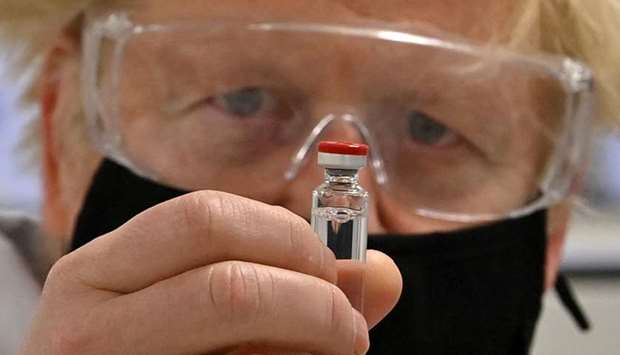
MILESTONE: British Prime Minister Boris Johnson with a vial of the AstraZeneca/Oxford University Covid-19 candidate vaccine, known as AZD1222, at Wockhardt’s pharmaceutical manufacturing facility in Wrexham, Wales, Britain, last month. (Reuters file photo)