


The meeting between a delegation of farmers’ leaders and Union Home Minister Amit Shah yesterday failed to arrive at a solution, with the government refusing to repeal the three farm laws, according to a participant.
All India Kisan Sabha leader Hannan Mollah said that the government only offered to carry out certain amendments, and in light of this, the farmers would decide on whether to participate in the next round of talks scheduled for today.
A meeting of the farmers’ union leaders would be held on the Singhu border at 12 noon today to decide the way ahead.
Farmers yesterday blocked railway tracks and highways across the country against the reforms deregulating the agriculture sector.
“We are worried, extremely worried. Our children will starve, what could be a bigger worry than this?,” farmer Ved Singh said ahead of the strike, echoing fears of his peers that large corporations would lower prices and destroy their livelihoods.
Protesters said late yesterday they would not give in until the laws are repealed.
“The government is testing our patience but we will not budge,” farmer Raminder Singh from Uttar Pradesh said. “This strike was symbolic and if the government doesn’t listen to us, we will shut the entire country in coming days.”
“We have been protesting for months but the government didn’t listen to us. They forced us to call for a strike,” added another Uttar Pradesh farmer, Mahesh Baliyan.
Some 200 more trucks carrying farmers and food supplies could also arrive at the blockade sites in the next few days, farmers at one of the sit-ins said.
Extra police had earlier been deployed in Delhi and security was boosted in the rest of the country in a bid to head off any trouble.
The farmers were supported in their call for action yesterday by railway workers, truck drivers, teachers and other unions.
In many eastern and western states, protesters blocked railway tracks, roads and halted trains.
The blockade and strike have taken on a political dimension with the national ruling Bharatiya Janata Party accusing opposition parties of opportunism by rejecting measures they had called for when in power.
Delhi Chief Minister Arvind Kejriwal’s Aam Aadmi Party said he had been placed “under house arrest” since Monday by Delhi Police, which is controlled by the national government, after he visited the farmers’ blockade site. Police denied the claim.
Five rounds of talks failed to narrow differences between farmers and ministers.
The laws will allow farmers to sell their produce on the open market - including to supermarket chains - instead of through state-run organisations that guarantee a minimum price.
But Sonipat Agricultural Market Traders Association president Pawan Goyal said the changes will “benefit a few companies, whether Indian or foreign”.
“If the law continues in future, the farmers will be reduced to labourers and only become workers for big companies.”
The government insists the changes are necessary to give agriculture - still the backbone of the Indian economy - a long-term future.
Prime Minister Narendra Modi on Monday said that “reforms are needed for development”.
“We cannot build the next century with the laws of the previous century,” he added, in remarks seen as alluding to the protests.
The blockade has already caused fruit and vegetable prices in Delhi to rise over restricted supplies.
The farmers are strongest in the north, but even the government in the southern Karnataka state suspended online school lessons for the day to show support.
Top athletes including wrestler Kartar Singh, who has won gold medals at the Asian Games, said they would return national awards in protest at the laws.
Meanwhile, Punjab Chief Minister Amarinder Singh yesterday said the unity showcased by the farmers through the countrywide shutdown has underscored the need for repealing the laws, followed by a detailed discussion on agricultural reforms.
The chief minister asked why the Centre could not heed the demands of the farmers, who are agitating across the country to scrap these laws and hold fresh talks with all the stakeholders.
“Had I been in their place, I would not have taken a minute to accept my mistake and revoke the laws,” he said.
Asserting that the whole country is standing with the farmers in their pain and in their fight for survival, Amarinder Singh said the Centre should allow the existing system to continue instead of scrapping the arhtiya and mandi system, as the farm laws are designed to do.
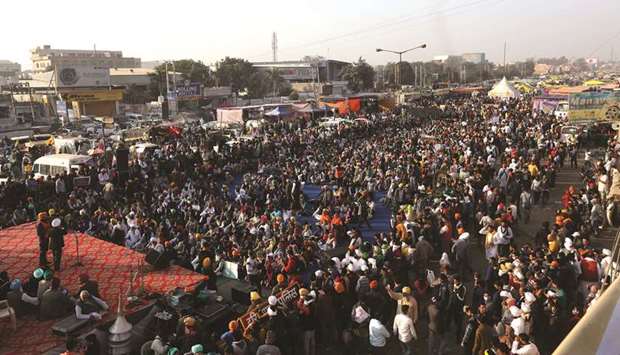
Farmers attend a protest during a nationwide strike against the newly passed farm bills at Singhu border near Delhi yesterday.