


Qatar University’s (QU) Health Cluster recently held an inter-professional activity on smoking cessation through Microsoft Teams.
Seventy-five QU students from the College of Pharmacy, College of Medicine, and College of Health Sciences attended the activity.
In addition, 16 facilitators from the QU, Weill Cornell Medicine – Qatar (WCM-Q), and University of Calgary facilitated the groups’ discussions.
The main objectives of the event were to help healthcare students from different professions understand and respect each other’s roles and responsibilities, while giving them the opportunity to interact and communicate at a professional level.
The activity allowed healthcare students to work inter-professionally on smoking cessation; tobacco dependence is a serious public health concern requiring healthcare professionals to work collaboratively to encourage teamwork and shared decision-making.
The inter-professional education (IPE) initiative started with an engagement activity, where students introduced themselves and their interests using Google Jamboard.
Further, the impact of tobacco on health and well-being were addressed.
After that, students went through a discussion on a case study about a 67-year-old woman who suffered from smoking effects.
Students worked inter-professionally to assess the status of their patient by studying the patient lab test results and their indications, and implemented a smoking cessation strategy (5As model and 5Rs strategy) to help in smoking withdrawal through role-play with the facilitators.
All of these activities were conducted virtually, which prepares students to act professionally under any circumstances, the QU said in a statement.
QU College of Health Sciences associate professor of Public Health Dr Lily O’Hara was the lead facilitator of the event.
An orientation session was delivered to all facilitators beforehand to explain the plan for the IPE session.
Dr O’Hara said: “When health professionals come together to learn from each other, there is an enormous benefit to society.”
“The use of tobacco is one of the leading preventable causes of death and disease around the world,” she explained. “The smoking cessation IPE activity demonstrated that all health professionals have a role to play in reducing the rates of smoking in our community.”
WCM-Q assistant dean for Medical Student Affairs Dr Mohamud Verjee, who was a facilitator at the event, said: “Smoking cessation teaching is a priority for health-related professions at an inter-professional level.
“The ‘stop smoking’ objectives were presented to the students, who were provided with background information followed by a problem-solving discussion with a simulated patient scenario.
“Students responded enthusiastically to the inter-professional event and hoped for more similar events.”
QU College of Medicine teaching assistant Noor Ahmed Adnan al-Wattary, who was also a facilitator, said: “I think it was an informative and beneficial experience in which students were able to learn, apply and solve an issue that might happen in their real-life settings.
“I was amazed by their approach of encouraging me to quit smoking in the role-play task; even when I gave them difficult answers, they tried to search for more cognitive social and psychological solutions.”
QU College of Health Science student Asraa Saad A H al-Baker added: “It is important for people in health professions to think of real-life solutions, accompanied with research results, to raise patient awareness of a certain risk.
“In order to help someone (who is) smoking, you have to figure out his main reason (for engaging in smoking) and, depending on that, think of solutions that may enhance his ability to quit smoking using the 5As model.”
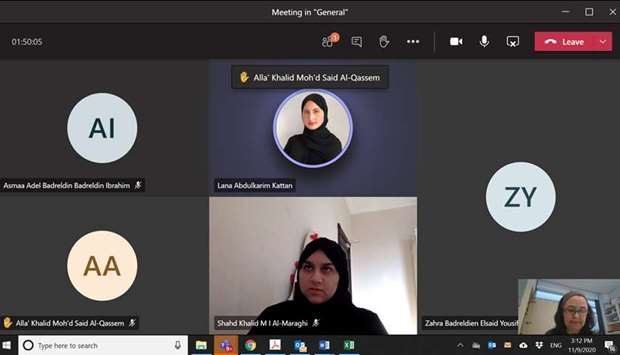
Snapshot from the event.