


Oil prices firmed yesterday, and were on track for a third consecutive weekly rise, buoyed by successful Covid-19 vaccine trials, while renewed lockdowns in several countries to limit the spread of the coronavirus capped gains.
Prospects for effective Covid-19 vaccines and hopes Opec and its allies will keep production in check have bolstered oil markets this week.
Brent crude futures were up 31 cents, or 0.7%, at $44.51 a barrel at 1357 GMT.
The more active US West Texas Intermediate (WTI) January crude contract gained 17 cents, or 0.4%, to $42.07 a barrel.
The WTI contract for December, which expired yesterday, was up 24 cents at $41.98.
Both benchmarks are up more than 4% so far this week.
“Concerns about demand, which have been weighing on prices since the spring, are now giving way to hopes of economic recovery, thanks in part to the imminent rollout of vaccines...” Commerzbank said.
Prices also found support from expectations the Organisation of the Petroleum Exporting Countries (Opec), Russia and other producers — a group known as Opec+ — will delay a planned production increase.
The group, which meets on November 30 and December 1, is looking at options to delay by at least three months from January the tapering of their 7.7mn barrel per day (bpd) cuts by around 2mn bpd.
“An assumed roll-over of current cuts by Opec+ to Q1 2021 is probably in today’s price of $44/barrel,” Nordic bank SEB said. Oil prices were getting some support from signs of movement on a stimulus deal in Washington after US Senate Republican Majority Leader Mitch McConnell agreed to resume discussions on providing more Covid-19 relief as cases surge across the United States.
Oversupply concerns, however, continue to weigh as Libya has raised production to pre-blockade levels of 1.25mn bpd.
Meanwhile, smaller Russian oil companies are still planning to pump more crude this year despite a global deal to cut production as they have little leeway in managing the output of start-up fields, a group representing the producers said yesterday.
Russia expects to reduce its oil and gas condensate production by around 10% this year to 507mn tonnes (10.15mn bpd). With its number one producer Rosneft agreeing heavy cuts to output, Russia’s compliance with the deal has been high, at 96% in October.
However, smaller firms say they will struggle to comply with caps proposed by the Russian oil ministry.
The AssoNeft group, made up of 130 small- and medium-sized oil and gas producers accounting for a little over 4% of total Russian output, told Reuters that the association plans to raise output to some 23.6mn tonnes from 22.8mn tonnes in 2019.
Director-general Elena Korzun said the rise will be driven by the ramp-up of output at east Siberia’s Srednebotuobinskoye oil field, owned by Moscow-based RNG, which started producing at the end of 2018.
RNG has already cut output from the level initially planned for 2020 by 13-14%, according to AssoNeft, but will still contribute to an overall increase in the group’s production.
“It’s extremely hard for independent producers with one field, which is at the start-up phase of production, to stick to obligations on output cuts,” Korzun said, adding that launching just one well could lead to a breach of production caps.
The Russian oil ministry did not immediately respond to a request for comment.
Opec+ is due to wind down output cuts that now stand at 7.7mn barrels per day (bpd) to 5.7mn bpd from January.
But a worsening demand outlook and rising supplies from countries such as Libya has prompted it to consider pushing back any increase.
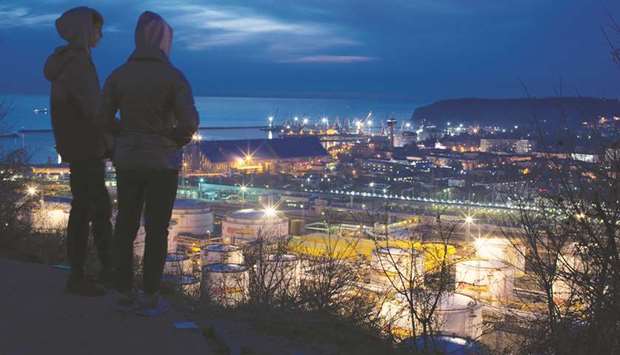
Oil storage tanks stand illuminated at night at the RN-Tuapsinsky refinery, operated by Rosneft Oil Co, in Tuapse, Russia. Opec+, which meets on November 30 and December 1, is looking at options to delay by at least three months from January the tapering of their 7.7mn barrel per day (bpd) cuts by around 2mn bpd.