


More than 450 international experts from more than 45 countries took part in a road safety online workshop, organised by the Qatar Transportation and Traffic Safety Centre (QTTSC) at Qatar University’s College of Engineering.
The workshop, titled “Role of Road Safety Audits in Improving Traffic Safety”, underscored the importance and benefits of Road Safety Audits (RSAs). It was held in collaboration with Qatar’s National Traffic Safety Committee, International Road Federation (IRF), World Conference on Transport Research Society and Khatib & Alami Consolidated Engineering.
In a statement, QTTSC director Dr Mohamed al-Qaradawi said the workshop is part of the centre’s continuous efforts to join expertise with international partners to disseminate knowledge and awareness in road safety. The workshop provided introductory knowledge on the scope and procedure of RSAs as well as the role and skills of the RSA team.
RSA is one of the main risks-assessment tools that can be applied at successive stages of road planning, design, and operations.
During the workshop, a group of distinguished experts from the IRF and members of the Spanish Association of Road Safety Auditors, delivered technical presentations addressing different issues related to road safety audits.
The workshop was co-ordinated and moderated by Dr Wael Alhajyaseen, QTTSC associate professor chair of the “Traffic Safety Analysis and Policy” group in the World Conference on Transport Research Society.
Engineer Francisco Javier Lopez Delgado, senior road safety specialist at the United Nations Office for Project Services, discussed Road Safety Management systems and the role of RSAs, highlighting the need to have a unified procedure and criteria for having accredited experts, well-trained and independent road safety auditors and senior road safety specialists.
IRF director-general Susanna Zammataro presented the ‘Ten Step Plan for Safer Road Infrastructure’ that was developed last year by the UN Road Safety collaboration group.
The framework, which aims to build institutional capacity and regulatory frameworks to support countries in achieving UN Targets 3 and 4 in relation to Safer Road Infrastructure – is being implemented as a pilot in Tanzania, thanks to the support of the UN Road Safety Fund and a strong coalition made up of IRF, iRAP, PIARC, TARA, and key agencies in Tanzania.
European engineer Miguel-Angel Serrano Santos, senior road safety specialist at the UN Office for Project Services, discussed the consideration of road safety during the road design stage. He emphasised that complying with the current design standards does not necessarily guarantee road safety. As such, it is very important that designers understand the analysis and comments made by road safety specialists when performing an RSA. This will enable them to incorporate, in advance of their proposed designs, the standard problems and comments usually identified by road safety auditors. Economically, this will save time and costs for all parties involved.
Road safety in tunnels, covered by senior road safety specialist engineer Guillermo Barreda Monteoliva, was the final topic in this workshop. He provided details for the construction elements and specific safety systems existing in tunnels.
He highlighted the need of sharing this knowledge with tunnel users, for them to behave in a rational and efficient way while driving or walking during an incident/accident inside the tunnel. Road safety auditors should be educated in the use of these safety systems to ensure the well-being of the operation of the tunnels, Monteoliva added.
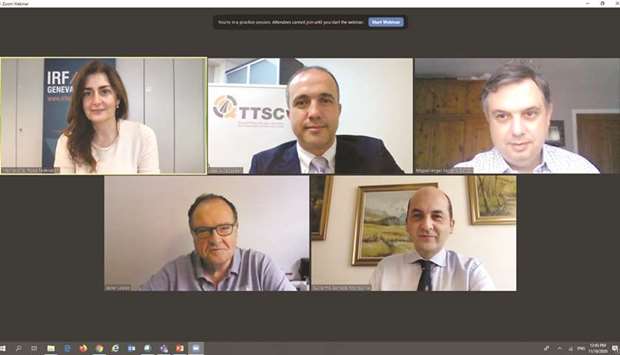
The road safety webinar in session.