


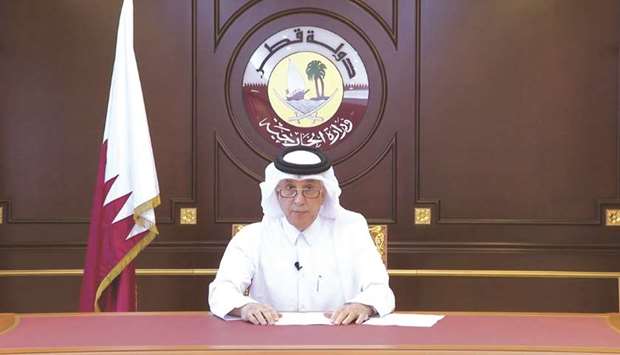
HE the Minister of State for Foreign Affairs Sultan bin Saad al-Muraikhi represented Qatar at the meeting.
Addressing the meeting, HE al-Muraikhi said that the conference is being held while the world is facing serious challenges due to the Covid-19 pandemic and which represents a global challenge and confirms the reality of the common destiny, not only for the Arab and European nations, but for all of humanity, noting that the coronavirus pandemic has had negative impacts on the economy, the commercial movement between countries, the movement of people across the world, and also the loss of many human lives.
Al-Muraikhi underlined the belief of Qatar that the countries of the Arab and European groups, with their common legacy of exchange, communication and strong historical ties, have solid foundations to provide role models for constructive partnerships. He valued the keenness to hold the EU-Arab World Summit, and commended the slogan of its fifth edition “A Strategic Partnership” which addresses the current situation, expresses the need of the peoples of the Arab and the European worlds at this stage, more than ever before, and contributes to the collective building of the future, noting that this requires achieving a qualitative transformation in the joint co-operation in pursuit of achieving the joint interests.
The Minister of State for Foreign Affairs underlined that the establishment of a strategic partnership between the Arab and the European worlds is a necessity imposed by the current political, economic, security and other challenges, which is in line with the policy of Qatar and one of the priorities sought by the State through joint action and contribution to solidarity, integration, co-operation and regional and global peace building.
He noted that the desired strategic partnership between the Arab and the European worlds provides an opportunity to exchange benefits, experiences and interests between people, and to expand investments, which would contribute to achieving stability and development, and strengthening co-operation between the Arab and the European regions.
This calls for enacting legislation that guarantees protection and insurance for investments and partnerships between all parties, combating corruption and consolidating transparency, al-Muraikhi said, stressing that legislation and the commitment to them by states represents the first guarantor for building a viable strategic partnership to achieve the desired goals.
In this context, the Minister of State for Foreign Affairs renewed the call on officials in the Hellenic Republic and all friendly countries in the European Union to contribute to resolving armed conflicts and strengthening international development aid to assist developing countries; and to sign bilateral agreements between various Arab and European countries to enhance investments and economic, commercial, educational and cultural relations.
He noted that the prospects for the Arab-European co-operation should not be limited to economy, trade, culture or tourism.
Rather, these relations should be translated into serious and continuous political co-ordination on various issues including peoples’ rights, confronting terrorism and others.
Al-Muraikhi said that the Arab region faces many challenges, foremost of which is the Palestinian issue and the ongoing crises in Syria, Yemen and Libya, and looked forward to the European Union in having a tangible role in solving these issues.
He underlined that the phenomenon of terrorism is inconsistent with all laws, religions and human values, and reiterated Qatar’s categorical rejection of this phenomenon and its condemnation of all forms and manifestations, whatever their causes or motives, stressing the joint responsibility to confront this abhorrent phenomenon and address its real social, political, cultural or other causes.