


Malaysia announced its biggest ever budget yesterday — and one that is crucial for the survival of Prime Minister Muhyiddin Yassin’s government — as it seeks to spur activity in an economy badly hit by the coronavirus pandemic.
Muhyiddin’s coalition has a razor-thin majority and cracks have begun to appear in it after just eight months in office.
Opposition leader Anwar Ibrahim has said he has enough support in parliament to oust the prime minister, who has appealed for cross-party support when parliament votes on the budget proposals, probably on November 25.
Analysts say defeat would amount to a vote of no confidence that could plunge Malaysia into further political instability.
Malaysia plans to spend a record 322.5bn ringgit ($77.94bn) next year, up 2.5% from this year, finance minister Tengku Zafrul Abdul Aziz said as he presented the budget, the first under Muhyiddin.
“Never in modern human history has a pandemic had such a huge impact...this is an unprecedented crisis,” Tengku Zafrul told parliament.
Malaysia’s trade-reliant economy is showing encouraging signs of growth and will expand 6.5-7.5% next year after contracting 4.5% in 2020, said Tengku Zafrul, though he warned the fiscal deficit would widen in 2020.
The minister announced 28bn ringgit to fund subsidies, aid and incentives for next year, in addition to 6.5bn ringgit in cash aid programmes.
He said the government will raise by 20bn ringgit the ceiling of a newly established Covid-19 fund for aid packages.
The government also allocated 15bn ringgit for transport infrastructure projects and said development spending will jump 38% to 69bn ringgit in 2021.
“It’s an all-time high (budget) which clearly signifies that the government is in expansionary mode to ward off the impact of Covid-19,” said Mohd Afzanizam Abdul Rashid, chief economist at Bank Islam.
Spending this year has increased to 314.7bn ringgit, up from the initially projected 297bn ringgit, due to stimulus packages rolled out to support the economy since the start of the pandemic.
Revenue is seen rising 4.2% to 236.9bn ringgit next year, including an estimated 18bn ringgit in dividends from state energy firm Petronas.
The bigger budget comes at the expense of a wider fiscal deficit, which the government expects to hit 6% this year — the highest since the 2009 global financial crisis.
The government said it will resume fiscal consolidation once the economy recovers from the Covid-19 crisis.
It forecast the deficit will shrink to 5.4% next year, which some opposition politicians said may be optimistic given the higher spending needs.
“Fiscal projections seem a bit aggressive but entirely consistent with the economic projections,” said Patrick Tay, deals partner, economics and policy, at PwC Malaysia.
The government may need to borrow more to fund efforts to boost the economy if revenue falls short, he said.
In outlook reports released ahead of the budget, the government said its debt is expected to rise to 61% of GDP in 2021 — above the government’s self-imposed limit of 60%.
Opposition leader Anwar said the government’s proposed budget had “no stimulus for how we can revive the economy”.
Opposition parties have said they might support the budget if it protects public health and welfare sufficiently.
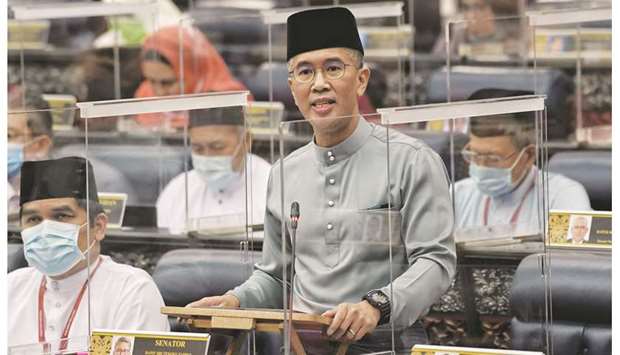
Malaysia’s finance minister Tengku Zafrul presents the 2021 budget at the parliament house in Kuala Lumpur yesterday. Malaysia plans to spend a record $77.94bn next year, up 2.5% from this year, Tengku Zafrul said as he presented the budget.