


Italian officials yesterday agreed to impose a night-time curfew, joining a slew of European nations in ramping up restrictions to reverse a dramatic surge in coronavirus cases.
Governments in Europe are struggling to get a hold of a pandemic that has now infected more than 11mn on the continent.
Yesterday saw Russia announce nearly 20,000 new infections and 389 additional deaths, both daily records that upped pressure on the government only days after President Vladimir Putin said there were no plans for a lockdown.
Russia has listed a total of nearly 1.7mn infections and more than 29,000 deaths.
The US remains the worst-affected country with more than 9mn cases and 230,000 deaths.
President Donald Trump, who has been widely criticised for his virus policies, faced off with Joe Biden on election day Tuesday, with tens of millions of mask-wearing Americans streaming to the polls.
The virus has transformed the election, with many millions avoiding the queues and the risk of infection by returning postal votes before election day.
With results from crucial battleground states not yet returned, the election was on a knife-edge yesterday with neither candidate taking a decisive lead.
The virus figures from the US are dire, but Europe too is reeling from an upsurge that leaders have admitted took them by surprise.
“There is only one way out of this dramatic period: to remain united. Always,” said Italian Prime Minister Giuseppe Conte.
He has struggled to build a coalition backing more stringent measures — with defiance from regional leaders and sporadic street protests marring attempts last week to enforce a national 6pm closing time for restaurants.
Italian officials agreed on a measure restricting citizens to their homes between 10pm and 5am
The national curfew was less stringent than rules imposed in France, Belgium and Germany.
And combined with a tiered system of risk where the most affected zones will see lockdowns, it appeared to have placated local politicians.
Measures imposed this week in countries from Britain to Turkey are not as draconian as those imposed earlier in the year, but they have been resisted by many business owners, politicians particularly from the right, and large sections of the population.
Belgium is facing one of the world’s most intense outbreaks and has imposed a strict curfew — enforced stringently by police.
“The curtain is closed, the light is dimmed. When you get closer, you hear noise inside: we found 30 or so people hiding in the back, almost all of them without masks,” Officer Bart Verbeeren told AFP, describing how he issued 37 fines in one go.
Belgium has, however, allowed bookshops to stay open — unlike neighbouring France, which has ordered them shut along with book sections in supermarkets and libraries.
“It’s incredible; it makes the book a totally forbidden product,” Helene Brochard, director of a library near the Belgian border, told AFP.”The message being sent is catastrophic.”
Senior political figures, meanwhile, continue to fall victim to the virus.
Hungary’s Foreign Minister Peter Szijjarto tested positive shortly after holding talks with Cambodian Prime Minister Hun Sen, who later said he had been given the all clear despite being pictured without a mask during the meeting.
Denmark’s Prime Minister Mette Frederiksen and two thirds of her government went into isolation yesterday after the justice minister tested positive.
With alarm over the virus sweeping the world’s ruling classes, one global figure taking renewed care over virus measures was Pope Francis, who had been criticised for continuing to mix with his flock.
“Unfortunately, we are back to doing this audience in the library in order to protect ourselves from the infections of Covid,” said the pope yesterday as he streamed his weekly general audience from the Vatican Library rather than in person.
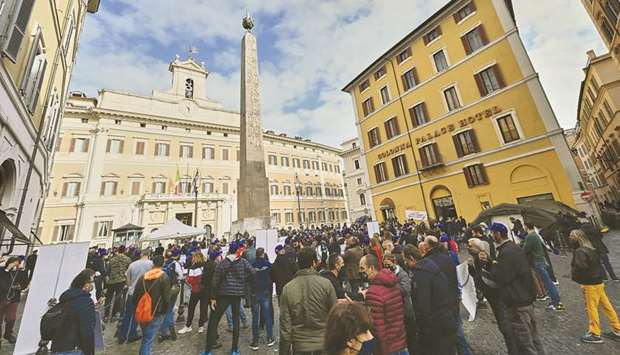
Demonstrators take part in a protest against the government’s decision to close the facilities of sports associations of gyms and swimming pools, in front of Montecitorio palace, the Italian parliament, in central Rome yesterday. Italy shut all stores except for pharmacies and food shops in a desperate bid to halt the spread of a coronavirus that has killed 827 in the country in just over two weeks.