


In early May, one year into his last consecutive term as president, Vladimir Putin summoned four dozen officials from across Russia to the Grand Kremlin Palace for a televised progress report on the central pledge of his re-election campaign.
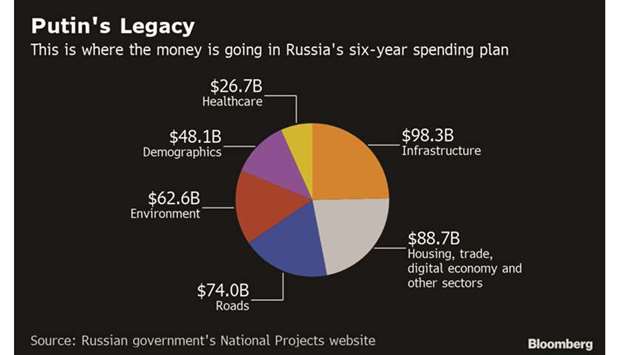
With a budget of almost $400bn over six years, Putin was eager to find out how the country’s most ambitious effort to raise living standards since the Soviet era was coming along.
Dubbed National Projects, the spending programme established very specific targets to hit by 2024 in categories ranging from social services and infrastructure to technology and ecology.
For an hour and a half, Putin listened patiently as subordinates rattled off their achievements with the kind of statistical minutiae he’s known to appreciate. Then, at the moment enthusiasm gave way to criticism, the broadcast of the discussion abruptly ended - on a dung-heap. The last briefer had just given an emotional recounting of how local officials in the Urals were allotted funds to build a badly needed playground in a particularly poor village, which they did.
But nobody goes there because they built it “right next to a manure shed,” he said. “This is the kind of decision, made without input from the people, that inspires nothing but annoyance.” And with that, Putin, shifting uncomfortably in his chair, wrapped up the first public overview of his signature economic issue with a hoarse “Thank you.”
Putin, 66, may have proven his mastery of global affairs during his previous term, annexing Crimea from Ukraine and turning the tide of Syria’s civil war, but his singular focus on restoring Russia’s superpower status left little time to push through the bureaucratic, legal and other reforms economists and his own advisers say are needed to spur meaningful growth at home.
With the average Russian worker now poorer than they were before the West first imposed sanctions five years ago, Putin is vowing to deliver a “decisive breakthrough” through National Projects, though even Kremlin officials say privately they aren’t expecting anything of the sort anytime soon.
“Putin had this illusion last year that the projects really would work, but now that illusion is gone,’’ said Evgeny Gontmakher, a former government official who’s a specialist on social policy. “He knows full well that even if they start being implemented properly, the effects won’t be felt for several years.’’
Details of the six-year plan, which is roughly equal to what China spends annually on infrastructure alone, were revealed in a 110-page blueprint posted online in February. Almost 30% of all spending is supposed to come from the private sector, with state and regional budgets making up the rest.
One of the main goals is to increase gross domestic product per capita by at least half by the middle of the next decade. In reality, continuing sanctions and the absence of reforms mean Russia’s economy, currently expanding at less than 1% a year, will be lucky to climb much higher than 2%, both Morgan Stanley and Alfa-Bank said in recent research notes.
Concern about future US financial penalties has led the Finance Ministry to move billions of dollars in oil revenue into its rainy-day funds, leaving less money for investment. Russia, one of a handful of major economies to run a budget surplus last year, expects another one this year.
Still, the central bank considers yearly outlays on National Projects, at about 1% of GDP, “significant.” Governor Elvira Nabiullina this week said “effective” allocation of those funds may lead to gains in productivity and economic “potential.” Ineffective spending, on the other hand, may do nothing but stoke inflation, she said.
One thing economists seem to agree on is that National Projects alone won’t deliver the 3%-plus growth rate Putin has said Russia needs to average in order to become a top five economy by the end of his six-year term. At most, the program may increase Russia’s economic potential by 0.5%, the International Monetary Fund said.
“There’s some risk that the ambitious targets will overshadow the agenda for reform. Policy makers could get everything right in the execution and still find that growth disappoints relative to Putin’s decrees,” says Scott Johnson, Russia economist.
One reason the impact is expected to be muted is that many of the line-items in the blueprint come from programmes that were already in the federal budget, according to the Finance Ministry.
The projects are broken down into 13 focus areas, each managed by a different set of officials and ministers with granular benchmarks to reach, such as building 180 war memorials by 2024 and improving the speed of cargo trains by 28% on average.
Putin Legacy