


In Qatar, lending growth is close to 3% in 1st Quarter of 2018, with real estate and government sector being the major contributors to growth. QCB liquidity injections and increased public-sector deposits have helped mitigate the funding pressures on Qatari banks in the wake of the economic blockade.
The QCB is further strengthening its financial sector surveillance to detect in a timely fashion emerging pressures, including those related to liquidity, real estate sector and the impact of US monetary policy normalisation. Greater co-ordination and information sharing between the central government, the QCB, and the QIA has supported liquidity in Qatar.
In March 2018, the QCB raised its deposit rate by 25 basis points to 1.75% from 1.50%, after the US Fed’s Action which had raised its benchmark federal-funds rate by a quarter-percentage point to a range between 1.5% and 1.75%, marking the sixth time since the financial crisis that it has raised rates. The QCB maintained its lending rate at 5%, while the QCB repurchase rate was kept unchanged at 2.50%.
In Oman’s banking sector, the lending growth was at 1.1% in the first two months of 2018. However, deposit growth was close to 1.4% during the same period. Oman’s central bank raised its interest rate on capital deposits by 50 basis points to 1.50% in March 2018. The revision in the rate takes effect from January 1, 2018. The Oman central bank cited recent rises in the Omani market interest rates, which have been climbing in response to the hikes in US rates.
In Kuwait, business credit activity improved in February, but overall credit slowed to 2.5% y/y in February 2018. In order to avoid a further widening of the spread between US dollar and dinar interest rates, the Central Bank of Kuwait (CBK) increased its policy rate in March, following a similar move by the US Federal Reserve.
Oil prices have been maintaining a high in recent times on account of uncertainty in Iran nuclear deal. WTI was at $68.1/barrel and Brent at $74.64/barrel by end of last week.
The Iranian deal was reached in 2015. Economic sanctions on Iran were lifted in exchange for denuclearisation. US President Donald Trump, however, wishes to impose more sanctions on Iran and threaten to pull out of the deal by May 12, if changes are not made.
The oil rally was curtailed a bit on account of a strong dollar which is at 91.5 levels. US dollar strengthened on account of surge in US bond yields, which touched 3% last week. Faster US wage gains probably nudge the Federal Reserve towards raising interest rates a total of four times this year, rather than the three moves officials had pencilled in for 2018 when they met in March, also gave boost to US dollar.
The strong dollar also have curtailed the prices of precious metals in recent times — gold and silver were at $1,324/ounce and $16.51/ounce by end of last week.
As the US Fed’s rate hikes continues, the Gulf central banks accordingly proceed with a monetary action, taking into consideration the Fed’s action, domestic economic cycles and local currency scenario.
The Fed is meeting this week and expectations are that it won’t lift the rates in this meeting. The recent sovereign bond issues in the Gulf and the surging oil prices can ease the fiscal deficit and improve the liquidity scenario, even though the lending growth is still modest. On the whole, the surge in oil prices can boost liquidity in the region, amidst the Fed meeting.
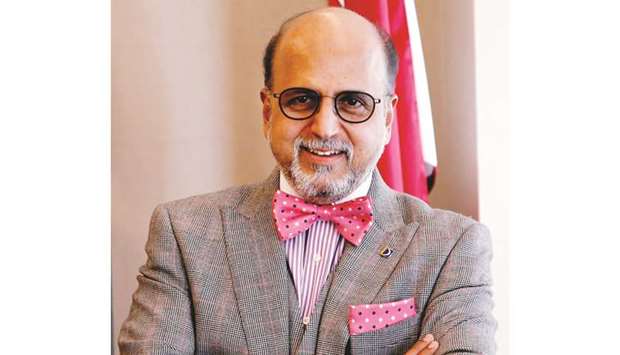
The author is Group CEO of Doha Bank.
REG