


An attorney for Donald Trump has asked a judge to let the president have a say on which records seized by the FBI from his personal lawyer Michael Cohen should be kept secret from federal prosecutors.
Joanna Hendon, who said she had been hired by Trump late on Wednesday, argued yesterday that Trump should be able to object to the disclosure of records relating to his long-time legal representation by Cohen.
“As a privilege holder he has an acute interest in these proceedings and in the manner that these materials are reviewed,” Hendon said at Manhattan federal court.
Documents relating to interactions between attorneys and their clients are typically privileged under law.
However, an exception can be made if the documents contain evidence of criminal activity.
Hendon persuaded Judge Kimba Wood to delay until Monday a hearing where Cohen’s lawyers were to argue for a restraining order temporarily banning authorities from inspecting the records.
“He is the president of the United States. These interests are so weighty I think we need more than an afternoon’s adjournment,” Hendon said, after Wood proposed that the court take a short break and reconvene later in the day.
“This is of most concern to him,” said Hendon. “I think the public is a close second. I think anyone who has hired a lawyer is a close third.”
Thomas McKay, an assistant US attorney, told the court that Trump had been “on notice about this search since Monday” and had waited until the last moment to intervene.
“With respect, his attorney-client privilege is no stronger than anyone who seeks legal advice,” said McKay.
Federal Bureau of Investigation (FBI) agents raided Cohen’s home, office and hotel room on Monday and are believed to have taken records relating to several different strands of investigation.
They are reported to have taken documents relating to the pay-off to Stephanie Clifford, the pornographic actor known as Stormy Daniels, who alleged that she had a sexual encounter with Trump.
Records relating to Cohen’s finances and business interests, including his ownership of several taxi firms, are also thought to have been seized.
The court hearing was called due to a dispute over who should be allowed to decide which of the documents are kept secret.
Prosecutors from the southern district of New York want a so-called “taint team” from the government to review the documents to determine which of them should be protected under attorney-client privilege.
Cohen’s attorneys objected and argued that they should be allowed to review the documents themselves.
As a “fall-back option”, they propose that the judge appoint a special master to review the documents.
“We think we deserve to know some of the findings from this ongoing investigation,” Todd Harrison, an attorney for Cohen, told the court.
Michael Avenatti, an attorney for Daniels, also stood to ask the judge to allow him to be involved in the discussions on who should have access to the documents seized from Cohen.
“We have every reason to believe that some of the documents relate to my client,” said Avenatti.
Much of yesterday’s hearing ended up focusing on arguments from the media that hearings on the dispute over document disclosure should not be heard in secret, which Wood said she had been intending to do in order to protect the identities and privacy of “innocent people” whose information was scooped up in the raids.
An attorney for ABC News argued that authorities could use pseudonyms to protect identities.
Lawyers for the New York Times submitted a letter to the judge asking that the press be allowed to object to any arguments in the case taking place privately.
The court was due to reconvene later to discuss how much of the case should be open to the press and public.
Attorneys for Cohen have requested to have the entire proceedings sealed and kept private.
Hendon said that Trump was entitled to have a say in order to ensure the “appearance of fairness”.
On the question of who should review the documents, she said that “prosecutors who are trained to root out crimes” would not be her first choice.
“I’m not trying to delay anything, nor do I see any particular rush here,” said Hendon. “The searches have been executed and the evidence has been locked down.”
Hendon said that “given the interest at stake and the exceptional nature of my client” it was important for everyone that the process be done “scrupulously, so that it is not subject to taint complaints later, and so that it withstands scrutiny for all time”.
“The privilege belongs to the privilege holder not the lawyer,” said Hendon. “The client can waive the privilege, the lawyer cannot.”
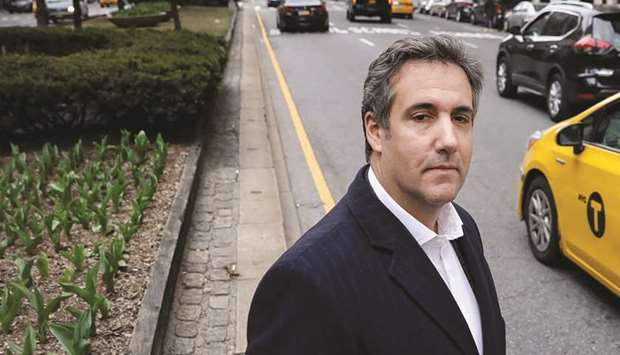
Cohen: seeking a temporary restraining order regarding the searches of his home and office.