


Urbanisation has many advantages. By bringing people together
physically, cities inspire innovation and fuel opportunity. They bring
workers closer to jobs and facilitate the diffusion of arts and culture.
But the benefits of urban life are often accompanied by costs.
Perhaps none feels more burdensome – and downright infuriating – than
traffic congestion. Packed roads and bumper-to-bumper traffic mean time
wasted and workdays shortened. And stationary vehicles still emit huge
quantities of exhaust fumes, damaging the environment and human health.
Many governments have tried to develop policies to reduce traffic
congestion by making it more expensive to get behind the wheel. Since
2003, London has successfully implemented a congestion charge, while
Singapore wants to use GPS technology to police its own
congestion-pricing strategy.
But such policies are harder to implement in poorer countries, where
technological capabilities and infrastructure are often lacking. That is
why developing countries typically seek more basic policies to improve
traffic flows.
For example, in India, Delhi’s suffocating air pollution has led the
government to experiment with “even-odd” policies: individuals can drive
only on certain days, based on the numbers on their license plates. But
this approach has had minimal impact. Gabriel Kreindler of the
Massachusetts Institute of Technology has shown that while the policy
reduced congestion slightly, drivers circumvented the rule by switching
to other vehicles. Vendors also started selling old plates so that
drivers could change their tags as needed.
Sadly, India did not learn from other countries’ experience. Research by
Lucas Davis of the University of California, Berkeley, had already
shown that a similar policy, implemented in Mexico City in 1989, did not
reduce air pollution – the intended goal – or significantly ease
traffic congestion. As in Delhi, households in Mexico City found
numerous ways to skirt the rules.
With these documented failures in mind, I worked with colleagues to
study policies that might be more effective. With MIT’s Benjamin Olken
and Kreindler, we examined the impact in Jakarta, Indonesia, of the
widespread policy of high-occupancy vehicle (HOV) restrictions, which
limit travel based on the number of passengers in a car.
Jakarta has some of the worst traffic gridlock in the world. Since the
early 1990s, Jakarta’s government has sought to improve traffic flows
with a rule that private cars driven during rush hours in the city’s
central business district must contain three or more passengers. Just
about everyone despised this “three-in-one” policy, and people often
complained that it created further inconvenience, without reducing time
spent on the road. Our research sought to quantify the policy’s true
impact.
In defending the view that the policy was onerous and ineffective,
drivers often pointed to an informal business of enlisting
“professional” passengers. These “jockeys” would wait near the entry
points of Jakarta’s three-in-one roads, and, for about 15,000 rupiah
($1.10), accompany drivers so their vehicle would be in compliance. Lone
drivers in need of two additional passengers could hire a mother and
baby. According to the policy’s opponents, what looked like carpooling
was an evasion of it.
Eventually, the Jakarta government sided with the policy’s naysayers,
announcing in March 2016 that the rules would be suspended indefinitely.
For researchers, this created a golden opportunity to measure the impact
of a policy before its adoption and immediately after its repeal. To do
that, we queried a Google Maps interface every ten minutes, 24 hours a
day. With this real-time, crowd-sourced traffic data for each route
previously under restriction, we were able to ascertain what happened to
traffic flows after the policy was suspended.
The results were striking. Despite what drivers – and eventually the
government – believed, the three-in-one policy was highly effective in
reducing congestion. Our data showed that traffic congestion worsened
significantly after the policy was rescinded. On Jakarta’s regulated
roads, average speeds fell from 28kph (17.4mph) to 19kph during the
morning rush, and from 21kph to 11kph during the evening rush.
Moreover, we found increases in traffic at times of day that were not
previously regulated, and more vehicles appearing on non-regulated roads
in general. Thus, suspending the three-in-one policy produced more
traffic and less carpooling.
These findings have implications for traffic-control measures in other
cities. For example, our data imply that Jakarta’s HOV restrictions were
more effective than London’s congestion pricing or Delhi’s even-odd
policy. The findings also suggest that while Jakarta’s “jockeys” were a
visible presence, they did not weaken the effect of the policy.
As megacities continue to emerge in many developing countries,
strategies like Jakarta’s three-in-one approach can help reduce
gridlock. But they can succeed in delivering benefits only if they are
crafted wisely, enforced effectively, and studied well. People will
always seek to circumvent regulations, but policymakers must consider
all the evidence before they decide to take the off-ramp. – Project
Syndicate
* Rema Hanna is Co-Director of the Evidence for Policy Design research programme at Harvard University.
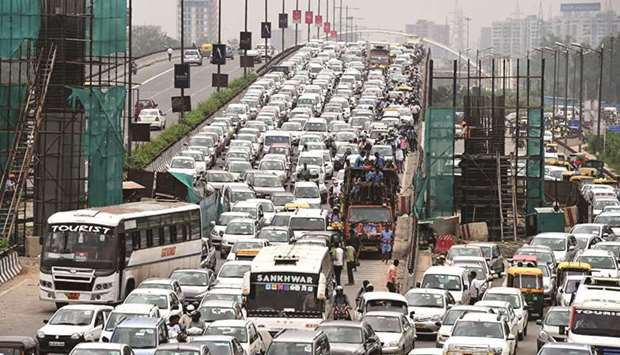
Delhi’s suffocating air pollution has led the government to experiment with u201ceven-oddu201d policies: individuals can drive only on certain days, based on the numbers on their license plates.