


Tropical Storm Harvey’s impact on the energy industry spread beyond flooding US refiners as fuel pipelines were also shut, threatening to squeeze national supply and roil global fuel markets as US retail fuel prices continue to climb.
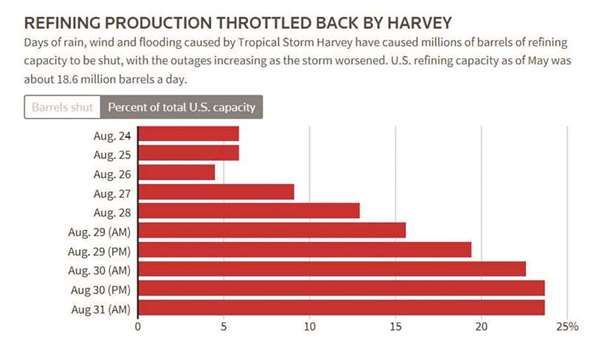
The storm, which lashed Louisiana with rain yesterday, has pummelled the US Gulf Coast, immersing Houston, Texas and the surrounding area in several feet of water and forcing the closure of about a quarter of US refining capacity.
Benchmark US gasoline prices and margins surged anew yesterday.
The jump came after the Colonial Pipeline, the biggest US fuel system, said it would shut its main lines to the Northeast by later yesterday amid outages at pumping points and lack of supply from refiners.
That artery can carry 3mn barrels of gasoline and other products daily.
At least two East Coast refineries have run out of gasoline for immediate delivery as they scrambled to fill barges for markets normally supplied by the Gulf Coast, two refinery sources said.
Others were seen running at higher rates to boost profitability by filling shortages. “This is going to be the worst thing the US has seen in decades from an energy standpoint,” said an East Coast market source, who declined to be named as he was not authorised to speak to the press.
Concerns over fuel shortages ahead of the US Labour Day extended weekend were mounting, said analysts at JBC Energy.
US gasoline futures topped $2 per gallon for the first time since 2015, with benchmark prices up more than 20% since the August 23 close, just before the storm began.
US crude oil prices were on track for their steepest monthly losses in more than a year.
Average US retail fuel prices have surged by more than a dime per gallon from a week ago, the AAA said early yesterday.
The Gulf makes up nearly half of total refining capacity in the United States, the world’s largest net exporter of refined petroleum products, and the storm is set to impact global flows.
About 4.4mn barrels of US refining capacity have been shut by Harvey, including the nation’s largest refiner, Motiva Port Arthur, which can process more than 600,000 barrels a day.
The total shut-in is about 24% of US refining capacity, almost equal to Japan’s daily consumption.
Traders in Europe scrambled to reroute cargoes to the United States and Latin America to fill the gap left by refining and shipping closures, but supplies may not arrive fast enough to avert a crunch.
“Sourcing additional barrels from Europe is a potential solution, but an increased level of uncertainty is introduced surrounding the timeliness of delivery given the logistics of travel time and securing tankers,” said Michael Tran, director of global energy strategy at RBC Capital Markets.
The crippling of the US Gulf Coast refining hub by Harvey rattled global fuel markets yesterday as traders rushed to buy gasoline and diesel from distant markets to avert supply shortages in the Americas.
Refiners in Asia have also been trying to fix fuel cargoes to the United States, despite the massive distance across the Pacific.
The Asian refining margin yesterday hit $10.41 a barrel, the highest since January 2016.
Gasoline prices in the region were $16.34 a barrel, also the highest since January 2016.
Traders have said a slew of gasoline tankers was booked over the past two days out of Europe to the United States and Latin America.
The US disruptions have hit wholesalers.
The premium for Chicago-area gasoline above benchmark futures is at its highest since June 2016, while the Gulf Coast price is at its widest above futures since August 2012. Suppliers in Chicago were trying to secure supplies after the Explorer Pipeline, which typically carries about 350,000 barrels a day (bpd) to the region, shut down.
“It’s not a significant problem at the present time, but it could turn into one,” said William Fleischli, executive vice president of the Illinois Petroleum Marketers Association, which represents 400 fuel distributors.
Fleischli said much depended on how long the shutdowns last.
Average retail gasoline prices have risen to $2.449 per gallon nationwide, up 4.5 cents a gallon from a day earlier and 10.1 cents from a week ago, AAA data showed.
In Georgia and North Carolina, fuel prices are up about 17 cents and average prices in South Carolina have risen nearly 20 cents per gallon from a week ago.
Though flood waters have yet to recede, energy analysts said they anticipated potential long-term effects from the historic storm.
Goldman Sachs analysts wrote Wednesday they expected about a tenth of what is now offline to stay shut for several months.
.