


After the death of former German chancellor Helmut Kohl, reactions from world leaders, ex-leaders and politicians poured in.
The great majority of them hailed the architect of German reunification as a giant of European politics.
“Helmut was a rock,” former US president George HW Bush said. “We know his remarkable life will inspire future generations of leaders to dare and achieve greatly.”
That sentiment was echoed by current German Chancellor Angel Merkel, who said Kohl had been “a stroke of luck for us Germans”, adding: “I am personally very grateful that he was there.”
The German press, reacting to Kohl’s death yesterday, acknowledged his position as a European statesman.
But they also delved into the broken relationships – both political and personal – that defined the life of the “eternal chancellor”.
Kohl was widely viewed by political scholars as Merkel’s mentor.
Yet their relationship soured, with Kohl once telling journalist Heribert Schwan that, politically, “Merkel doesn’t have a clue”.
Kohl’s inability to maintain his personal relationships is the focus of Sueddeutsche Zeitung’s Thorsten Denkler, who notes that Kohl was unable to inform his son Walter of his wife Hannelore’s suicide in 2001, leaving it instead to his office manager.
Walter and Kohl’s other son, Peter, became estranged from their father, with the former writing a book – To Live Or Be Lived – in what he said was an act of self-therapy that helped him avoid following his mother’s example by taking his own life, Denkler writes.
In the Frankfurter Allgemeine Zeitung, Maria Weisner looks at the influence upon Kohl’s life with his second wife, Maike Richter.
Peter Kohl claimed that his father’s relationship with Richter – and that with Merkel – had contributed to Hannelore’s suicide.
Richter – 34 years Kohl’s junior – was continually depicted by the media as isolating the former chancellor from the public eye, Weisner writes.
But she became Kohl’s carer as his health deteriorated and Kohl himself said: “Without her, I wouldn’t be here.”
Despite the bitterness that had seen him last speak with his father in 2011, Walter Kohl told journalists that he had been at his father’s side as he died and said he was “very sad” at his death.
Die Tageszeitung – known as taz – courted controversy with its front page, which featured a Kohl quote relating to post-reunification opportunities in East Germany – “blooming landscapes” – next to an image of a funeral wreath.
“Like no other chancellor of the German post-war era, he became the prototype of the power-hungry politician,” Bettina Gaus writes.
Berlin daily Tagesspiegel called the taz cover “tasteless” and taz editor-in-chief Georg Loewisch apologised later, calling the cover design a “failure”.
Meanwhile, Sebastian Dullien, writing in the weekly Der Spiegel, was critical of the financial legacy left by Kohl to Germany, saying that his “mismanagement” of German reunification had laid the foundations for current financial problems in the eurozone.
“The chancellor of unity didn’t just leave the Germans a united country, but also a series of economic time bombs that, at worst, could explode the European currency union.”
However in the same publication, Wolfram Bickerich did acknowledge Kohl’s impact on German and European politics: “When it comes to the unity of Germany and Europe, Helmut Kohl was a great statesman.”
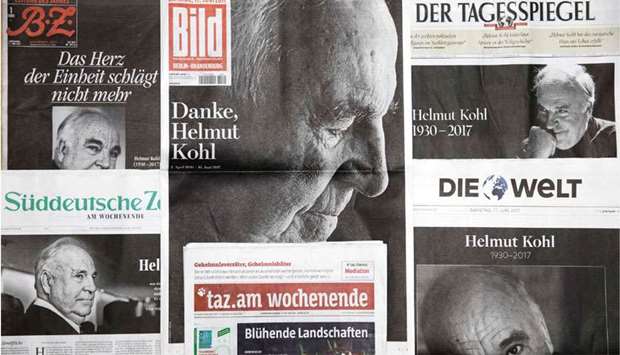
Portraits of former German Chancellor Helmut Kohl are seen on the front pages of German newspapers yesterday, one day after his death.