


It’s set to be a long week for Korea watchers. Donald Trump’s tweet on Tuesday claiming North Korea is “looking for trouble” is stoking a sense of unease that’s wiped $30bn from South Korean equity values this week and drove a spike in the nation’s debt risk.
Those mulling what comes next should familiarise themselves with the North Korean holiday calendar, as a series of events over the next 13 days – from Kim Il-sung’s 105th birthday to the army’s anniversary – raise the chance of provocative action from the nuclear-armed state.
“Some traders are concerned that North Korea might conduct a sixth nuclear test around these events, prompting a US-China-South Korea response,” Thierry Wizman, a global interest-rates and currency strategist at Macquarie Group Ltd in New York, said in an e-mail. “The market’s attention will remain fixated on tensions in the region.”
After an almost uninterrupted selloff since Trump’s Syria strike sparked concern over what it means for his stance toward North Korea, assets in the South took a breather on Wednesday, with the Kospi index bouncing off a one-month low following a surge in volatility bets. The won gained 0.2% as of 2:12pm on Wednesday in Seoul after a six-day slump that’s earned it the mantle of the worst-performing emerging-market currency this week.
While the US emphasised it wasn’t interested in regime change in North Korea, the diversion of a warship into the region ratcheted up tensions, fuelling losses in a market more accustomed to shrugging off North Korean attention seeking.
The ‘Day of the Sun’ holiday tomorrow commemorates the birth of Kim Il-sung, North Korea’s founder and current leader Kim Jong-un’s grandfather. April has proven to be an active month for North Korea in the past, with a failed rocket launch in 2012. In April 2009, the country fired a missile claiming it was a satellite, prompting the strengthening of UN sanctions.
“I don’t think the actual situation is too different from previous episodes at this time of year around the birthday celebrations and US-South Korea military exercises,” said Ashley Perrott, head of pan-Asia fixed income at UBS Asset Management in Singapore. “The variable this time that is an unknown for the market is the US president and what the reaction function will be, particularly post the Syria events. That is what is making markets cautious.”
Kim Il-sung’s birthday holiday spills over into Sunday as well, and is followed on April 25 by a holiday marking the foundation of the North Korean military 85 years ago.
With Japan’s foreign ministry issuing a travel alert for South Korea, the finance ministry in Seoul has said it will take action if volatility in the markets increases. Ministry officials met with regulators and the Bank of Korea on Wednesday to discuss the impact of geopolitical tension on the market.
President Trump spoke with his Chinese counterpart, Xi Jinping, about North Korea by phone on Wednesday.
“The market continues to be concerned over the risk of a US attack on North Korea,” said Masashi Murata, a currency strategist at Brown Brothers Harriman in Tokyo. “A risk is just a risk, but the possibility may be higher than before.”
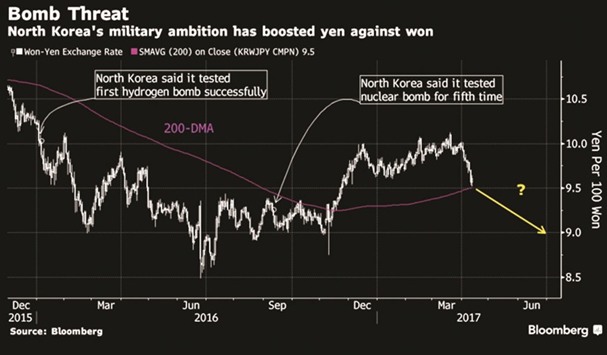
For how traders see North Korea risk, watch yen versus won
Bloomberg/Singapore
Perhaps the best barometer of rising geopolitical risk in East Asia is the outperformance of the yen against the won. And despite some technical resistance ahead, the yen’s strength can continue, according to Daiwa Securities Co.
Japan’s currency has gained about 3% against its South Korean counterpart since April 3, when President Donald Trump said the US could act alone to solve the North Korean problem. The currency pair rebounded to 9.65 yen per 100 won yesterday after approaching its 200-day moving average of 9.51 on Wednesday.
The yen may breach this resistance level and rise beyond 9 per 100 won by the end of June, said Yuji Kameoka, chief FX analyst in Tokyo at Daiwa Securities Co. Concerns are rising that North Korea will conduct a nuclear test to celebrate its founder Kim Il-sung’s 105th birthday and the anniversary of the establishment of its army this month. Trump and his Chinese counterpart, Xi Jinping discussed North Korea over the phone on Wednesday. Adding to tensions, Ahn Cheol-soo, a top contender in South Korea’s presidential election on May 9, supports the US’s anti-ballistic missile system in the south that China sees as a threat.
“Won weakness also reflects the risk that South Korea’s relationship with the North will worsen given the candidate who advocates a tougher stance against them is gaining popularity,” said Daiwa’s Kameoka. Although Japan wouldn’t remain unscathed should there be military conflict in the peninsula, the yen is still bought when risk aversion heightens globally, he added.
.