
Qatar is moving ahead with some revenue-raising measures, but these will be relatively limited in scope and therefore “unlikely to have a substantially negative impact” on private consumption and investment, BMI Research said in a report.
Rising hydrocarbon prices will translate into higher-than-anticipated state earnings, further reducing the incentive for Doha to implement austerity measures over the coming years.
Coupled with robust population growth over the coming years, which the Fitch Group company forecasts at 1.9% and 1.3% in 2017 and 2018, respectively — as Qatar’s construction projects continue to attract foreign workers — these factors will support private consumption in the quarters ahead.
BMI Research forecasts household spending growth to average 3.9% annually in real terms up to 2021 — spiking at 7.4% in 2022 — before decelerating in the years after the World Cup, when construction growth slows and the expatriate population declines.
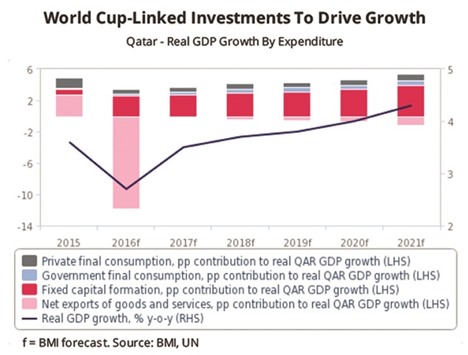
Qatar will see its real GDP growth pick up — and outperform the rest of the GCC — over the coming years, driven by large-scale government investment into World Cup-related infrastructure projects and higher hydrocarbon production, the report said.
Improving consumer and business confidence amid rising oil prices will further support the emirate’s economic recovery. Qatar’s economic growth will accelerate in the years ahead, as the government continues to invest heavily in infrastructure in preparation for the 2022 FIFA World Cup. Moreover, BMI analysts expect Qatar’s hydrocarbon production to tick up over 2017-2018, boosting output and facilitating higher export growth, while higher hydrocarbon prices will support an ongoing increase in consumer and business confidence.
Accordingly, it expects the country’s annual real GDP growth rate to outperform the rest of the GCC — at 3.5% in 2017 and 3.7% in 2018, compared with regional averages of 2.2% and 2.8% for those two years, respectively.
That said, these figures are still far lower than the historical annual average of 14.3% recorded in the decade prior to the H2, 2014 oil price plummet, reflecting the persistent impact of a prolonged period of weaker energy prices on the Qatari economy.
Large-scale government investments into infrastructure development programmes ahead of the FIFA 2022 World Cup will continue to drive economic growth in Qatar over the coming years.
Indeed, the government reported in early February that it is currently spending around $500mn a week on infrastructure projects linked to the event, and suggested this level may be maintained for another three-to-four years.
Given the wide scope of its development programme, BMI expects Qatar to see strong construction sector growth over the coming years — though a slight deceleration from the 11.6% y-o-y figure recorded for Q3, 2016 is likely, as the focus gradually shifts towards the completion of existing projects, rather than the commencement of new ones.
A BMI team has forecast Qatar’s construction sector is to expand at an annual average rate of 12.0% in real value terms out to 2022.
“We do expect non-hydrocarbon sector expansion to continue at a robust pace beyond this time-frame as the government remains committed to the long-term diversification targets outlined in its National Vision 2030. Nevertheless, given the sheer magnitude of current projects linked to the event, we believe overall growth is bound to decelerate beyond 2022,” BMI said.
The hydrocarbon sector, which, despite the diversification efforts, will remain central to the Qatari economy for decades to come — is set to see activity pick up over 2017-2018, further boosting the country’s real GDP growth.
According to the latest data from Qatar’s Ministry of Development Planning and Statistics (MDPS), the sector experienced a 2.1% y-o-y contraction in H2, 2016 — likely the result of routine maintenance work on some of Qatar’s liquefied natural gas (LNG) trains, but showed a 2.7% y-o-y increase in the third quarter of the year, as these trains recovered capacity.
Business / Business
Revenue-raising steps not to impact Qatar’s private consumption, investment: BMI


.